
Find Your Solution
In 3 minutes, you’ll know where to start ➤


Enrollment NOW OPEN: CALMS Certification Level I. - Be a Founding Member! Learn more.
ADHD Case Study: How One Teen Finally Found Focus After Years of Struggling
This ADHD case study documents the real journey of a 19-year-old who struggled with attention, impulsivity, and academic failure for most of his life. Like so many families we work with, his parents had tried medication, therapy, and school accommodations — yet nothing produced lasting results.
What changed everything wasn't a new medication or a stricter behavior plan. It was a fundamental shift in approach: Regulation First®. Before addressing behavior, we addressed the brain. Before correcting the child, we regulated the nervous system. That shift — and the tools built around it — is what made the difference.
This ADHD case study shows what's possible when the root cause of dysregulation is addressed, not just managed.
What changed everything wasn't a new medication or a stricter behavior plan. It was a fundamental shift in approach: Regulation First®. Before addressing behavior, we addressed the brain. Before correcting the child, we regulated the nervous system. That shift — and the tools built around it — is what made the difference.
This ADHD case study shows what's possible when the root cause of dysregulation is addressed, not just managed.
Client Details

Client: Brent
(name changed to protect privacy)
Age: 19 years old
Diagnosis: ADHD
(name changed to protect privacy)
Age: 19 years old
Diagnosis: ADHD
Treatments Used

Neurofeedback

CALM PEMF®

Nutrition and wellness coaching

Dietary supplements and gut support

Executive functioning parent coaching (using the CALMS Dysregulation Protocol®)

Individual executive coaching

Family therapy

Cognitive behavioral psychotherapy
Progress Metrics

QEEG Brain Map (3 assessments)

Cognitive and Emotional Symptom Checklist

Physiological Symptom Checklist

Symptom Progress Tracking Likert Scale

Client and Parent Interviews
Brent's Story: Years of Trying, Years of Falling Short
Brent is a 19-year-old with a long history of difficulties with attention, alertness, distractibility, task completion, following directions, impulsiveness, low self-esteem, cannabis use, and academic failure in college.
His birth was normal. At age three, he fell down the stairs, resulting in a visible bump on his forehead. No other lasting effects were identified at the time — though, as we would later discover, that detail mattered more than anyone realized.
Early Childhood: First Signs of Dysregulation
Difficulties with impulse control, distractibility, and work completion appeared as early as preschool. By first grade, Brent was referred to the school Child Study Team, and a support plan was put in place. By the end of second grade, psychoeducational testing revealed difficulties with attention switching, distractibility, working memory, and slow processing speed. Brent qualified for special education services under the classification of Other Health Impairment due to ADHD.
Even then, what looked like a behavior problem was actually a nervous system problem — a brain that couldn't easily regulate itself. The strategies put in place managed the symptoms. They never reached the root.
Medication and Early Interventions
At the school's recommendation, Brent's parents took him to his pediatrician. Concerta was prescribed for ADHD, along with play therapy. The medication produced noticeable improvements in focus; play therapy led to gains in impulse control. Third and fourth grade were relatively successful.
By fifth grade, however, Brent was again struggling to keep pace, and his IEP was expanded. Socially, he had a few close friendships through Boy Scouts, but those friends were placed in different classes when middle school began.
Middle School: A Clue Nobody Followed
During middle school, Brent's medication was changed twice and he switched therapists. His mother tried a gluten-free, dairy-free diet with most sugar eliminated — and saw marked improvement in both focus and behavior. The family discontinued the diet because maintaining a separate food plan for Brent felt unsustainable.
This was a significant, overlooked signal: Brent's brain and nervous system were directly responsive to what he was eating. That connection would become central to his eventual recovery.
High School: Accommodations Masking the Real Problem
High school followed a predictable pattern: strong performance in the first and third quarters, poor performance in the second and fourth quarters when Brent lost momentum. With academic modifications in place, his grades were mostly B's — enough to earn college admission.
The accommodations were working. But they were also hiding how much Brent's dysregulated nervous system still hadn't been addressed.
College: When the Scaffolding Disappears
College exposed everything the accommodations had been masking. Independent reading, writing papers, and taking exams without structure or support overwhelmed Brent. He was placed on academic probation, persuaded his parents to let him try one more semester — and performed even worse.
This is a pattern I see repeatedly in my clinical work: children who are managed through school with accommodations and medication reach early adulthood without the internal regulation skills they need to function independently. The system compensated for the dysregulation. It never resolved it.
His birth was normal. At age three, he fell down the stairs, resulting in a visible bump on his forehead. No other lasting effects were identified at the time — though, as we would later discover, that detail mattered more than anyone realized.
Early Childhood: First Signs of Dysregulation
Difficulties with impulse control, distractibility, and work completion appeared as early as preschool. By first grade, Brent was referred to the school Child Study Team, and a support plan was put in place. By the end of second grade, psychoeducational testing revealed difficulties with attention switching, distractibility, working memory, and slow processing speed. Brent qualified for special education services under the classification of Other Health Impairment due to ADHD.
Even then, what looked like a behavior problem was actually a nervous system problem — a brain that couldn't easily regulate itself. The strategies put in place managed the symptoms. They never reached the root.
Medication and Early Interventions
At the school's recommendation, Brent's parents took him to his pediatrician. Concerta was prescribed for ADHD, along with play therapy. The medication produced noticeable improvements in focus; play therapy led to gains in impulse control. Third and fourth grade were relatively successful.
By fifth grade, however, Brent was again struggling to keep pace, and his IEP was expanded. Socially, he had a few close friendships through Boy Scouts, but those friends were placed in different classes when middle school began.
Middle School: A Clue Nobody Followed
During middle school, Brent's medication was changed twice and he switched therapists. His mother tried a gluten-free, dairy-free diet with most sugar eliminated — and saw marked improvement in both focus and behavior. The family discontinued the diet because maintaining a separate food plan for Brent felt unsustainable.
This was a significant, overlooked signal: Brent's brain and nervous system were directly responsive to what he was eating. That connection would become central to his eventual recovery.
High School: Accommodations Masking the Real Problem
High school followed a predictable pattern: strong performance in the first and third quarters, poor performance in the second and fourth quarters when Brent lost momentum. With academic modifications in place, his grades were mostly B's — enough to earn college admission.
The accommodations were working. But they were also hiding how much Brent's dysregulated nervous system still hadn't been addressed.
College: When the Scaffolding Disappears
College exposed everything the accommodations had been masking. Independent reading, writing papers, and taking exams without structure or support overwhelmed Brent. He was placed on academic probation, persuaded his parents to let him try one more semester — and performed even worse.
This is a pattern I see repeatedly in my clinical work: children who are managed through school with accommodations and medication reach early adulthood without the internal regulation skills they need to function independently. The system compensated for the dysregulation. It never resolved it.
How Regulation First® Changed Everything
Having exhausted conventional options, Brent's parents enrolled him in our intensive one-to-one program — one built from the ground up on a Regulation First® philosophy. The core principle is simple but transformative: you cannot change behavior until you calm the brain first. Correction, coaching, and skill-building can only take hold once the nervous system is regulated.
His QEEG Brain Map confirmed ADHD brainwave patterning: excess slow, unfocused brain waves (Theta and Delta) paired with insufficient fast, focused brain waves (Beta). The scan also revealed brainwave patterns consistent with a frontal head injury — directly consistent with his fall at age three. For the first time, Brent's family had a complete picture of what was actually driving his struggles.
His QEEG Brain Map confirmed ADHD brainwave patterning: excess slow, unfocused brain waves (Theta and Delta) paired with insufficient fast, focused brain waves (Beta). The scan also revealed brainwave patterns consistent with a frontal head injury — directly consistent with his fall at age three. For the first time, Brent's family had a complete picture of what was actually driving his struggles.
Phase One: Calming the Brain Before Anything Else
Brent and his family traveled to our Connecticut center for five intensive days of one-on-one sessions covering CALM PEMF®, biofeedback, brain-based exercise, and individual and family psychotherapy.
In keeping with the Regulation First® approach, the entire first phase was devoted to calming and regulating Brent's nervous system — not addressing his behavior, not building skills, not setting goals. Regulate first. Everything else follows.
The family committed to dietary changes and daily walks. Brent shifted to a high-protein diet and started a targeted supplement regimen. Continuing at home with four neurofeedback sessions per week, Brent reported steady improvement — with a dramatic shift after session 18, when he slept for over fifteen hours and woke feeling that a "brain fog had lifted."
That moment was the turning point. His brain was beginning to regulate.
In keeping with the Regulation First® approach, the entire first phase was devoted to calming and regulating Brent's nervous system — not addressing his behavior, not building skills, not setting goals. Regulate first. Everything else follows.
The family committed to dietary changes and daily walks. Brent shifted to a high-protein diet and started a targeted supplement regimen. Continuing at home with four neurofeedback sessions per week, Brent reported steady improvement — with a dramatic shift after session 18, when he slept for over fifteen hours and woke feeling that a "brain fog had lifted."
That moment was the turning point. His brain was beginning to regulate.
Phase Two: The CALMS Dysregulation Protocol® — Teaching the Family to Regulate Together
Phase two focused on executive functioning coaching and helping Brent build self-efficacy — learning to "see the result" rather than shutting down in shame before he even started.
But equally important was what happened with his parents. A dysregulated parent cannot regulate a dysregulated child — and years of frustration, conflict, and failed strategies had left the whole family system stuck. To break that cycle, Brent's parents were trained in the CALMS Dysregulation Protocol®, a structured framework for responding to dysregulation in a way that supports the nervous system rather than escalating it.
But equally important was what happened with his parents. A dysregulated parent cannot regulate a dysregulated child — and years of frustration, conflict, and failed strategies had left the whole family system stuck. To break that cycle, Brent's parents were trained in the CALMS Dysregulation Protocol®, a structured framework for responding to dysregulation in a way that supports the nervous system rather than escalating it.
The CALMS Dysregulation Protocol® works in five steps:
By applying CALMS, Brent's parents shifted away from nagging, punishing, and power struggles — and toward providing the co-regulation and emotional safety Brent's nervous system actually needed to move forward. The family communication patterns that had been stuck for years began to loosen. Brent became more engaged, more proactive, and more willing to try.
Before and After: Neurofeedback QEEG Brain Map
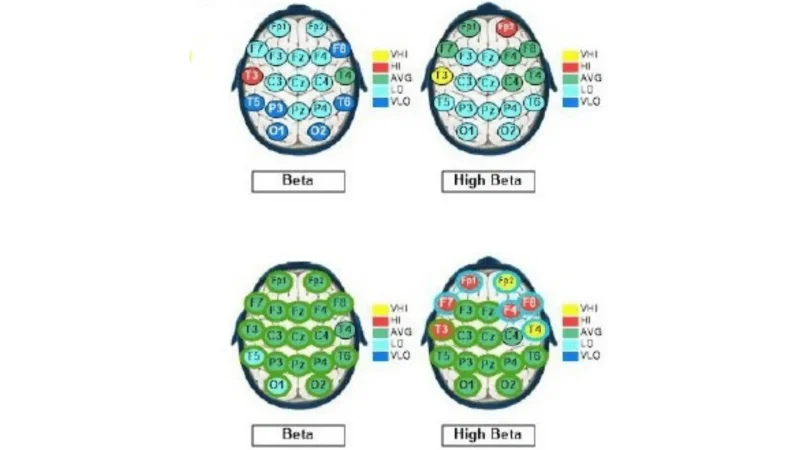
QEEG Brain Map Comparison from QEEG #1 to #3 after 50 sessions of Neurofeedback,
5 sessions of PEMF/BRT and individual and family therapy in our BrainBehaviorReset™ Program.
5 sessions of PEMF/BRT and individual and family therapy in our BrainBehaviorReset™ Program.
Treatment Outcomes
After 50 sessions of neurofeedback combined with individual and family therapy, dietary changes, supplementation, and daily exercise, Brent's brain activity normalized significantly.
These weren't behavioral adjustments achieved through pressure or reward. They were the natural result of a regulated nervous system — exactly what the Regulation First® approach predicts and produces.

What This ADHD Case Study Teaches Us
Brent's case illustrates several important truths about attention, dysregulation, and what it actually takes to help a struggling child:
ADHD rarely exists in isolation. Brent's childhood head injury contributed to his brainwave patterns and may have compounded his ADHD symptoms for years — completely undetected by every clinician and educator who worked with him.
Medication and accommodations manage symptoms; they don't resolve them. Brent functioned well enough within a structured support system but was entirely unprepared for the demands of independent adult life when that scaffolding disappeared.
The brain can change. With the right interventions, Brent's QEEG showed measurable neurological improvement — not just behavioral adjustment. That's the difference between managing dysregulation and actually resolving it.
Family systems matter as much as individual treatment. Brent's progress accelerated when his entire family engaged in the process. The CALMS Dysregulation Protocol® gave his parents a concrete, science-backed way to support his regulation — and that changed the dynamic at home as much as any clinical intervention.
Regulation First® is not a philosophy. It's a sequence. Regulate. Connect. Correct. In that order, every time. When families understand and apply that sequence, everything else — the coaching, the skill-building, the behavior change — finally has somewhere to land.
A Note on Privacy: The names and some identifying details in this ADHD case study have been changed to protect client privacy. Each client's experience and treatment protocol is unique and individually tailored based on their specific clinical profile.
ADHD rarely exists in isolation. Brent's childhood head injury contributed to his brainwave patterns and may have compounded his ADHD symptoms for years — completely undetected by every clinician and educator who worked with him.
Medication and accommodations manage symptoms; they don't resolve them. Brent functioned well enough within a structured support system but was entirely unprepared for the demands of independent adult life when that scaffolding disappeared.
The brain can change. With the right interventions, Brent's QEEG showed measurable neurological improvement — not just behavioral adjustment. That's the difference between managing dysregulation and actually resolving it.
Family systems matter as much as individual treatment. Brent's progress accelerated when his entire family engaged in the process. The CALMS Dysregulation Protocol® gave his parents a concrete, science-backed way to support his regulation — and that changed the dynamic at home as much as any clinical intervention.
Regulation First® is not a philosophy. It's a sequence. Regulate. Connect. Correct. In that order, every time. When families understand and apply that sequence, everything else — the coaching, the skill-building, the behavior change — finally has somewhere to land.
A Note on Privacy: The names and some identifying details in this ADHD case study have been changed to protect client privacy. Each client's experience and treatment protocol is unique and individually tailored based on their specific clinical profile.
Frequently Asked Questions About ADHD Treatment
Can I work with Dr. Roseann one on one?
What is the Regulation First® approach to ADHD?
What is the CALMS Dysregulation Protocol®?
Is a holistic approach right for my child with ADHD?
How long does it take to see results?
Ready to See What's Possible?
Disclaimer: The effectiveness of diagnosis and treatment varies by patient and condition. Dr. Roseann Capanna-Hodge, LLC does not guarantee specific results.