Find Your Solution
In 3 minutes, you’ll know where to start ➤


Enrollment NOW OPEN: CALMS Certification Level I. - Be a Founding Member! Learn more.
PANS and OCD Case Study: How a Typical 15-Year-Old Went from Thriving to the Edge of Hospitalization — and Found His Way Back
This PANS and OCD case study follows Ben, a 15-year-old boy who went from a healthy, active teenager to a child with debilitating OCD, depression, suicidal thoughts, and depersonalization — in a matter of months.
Ben didn't have a history of mental health struggles. He had no anxiety, no learning difficulties, no behavioral concerns. Then he got COVID. And within weeks, everything changed.
For eighteen months, Ben and his family cycled through psychiatrists, medications, and therapists — each one treating the symptoms they could see, none of them asking why a previously healthy teenager had suddenly developed them. By the time his family found us, they were trying to avoid inpatient hospitalization.
This is Ben's story — and a look at what becomes possible when a family finally gets the right diagnosis and the right approach.
Ben didn't have a history of mental health struggles. He had no anxiety, no learning difficulties, no behavioral concerns. Then he got COVID. And within weeks, everything changed.
For eighteen months, Ben and his family cycled through psychiatrists, medications, and therapists — each one treating the symptoms they could see, none of them asking why a previously healthy teenager had suddenly developed them. By the time his family found us, they were trying to avoid inpatient hospitalization.
This is Ben's story — and a look at what becomes possible when a family finally gets the right diagnosis and the right approach.
Client Details
15-year old boy diagnosed with Pediatric Acute-Onset Neuropsychiatric Syndrome (PANS)
Treatments

CALM PEMF®

Brain-based regulatory therapies

Nutrition and wellness coaching

Dietary Supplements

Detoxification and Gut Support

Parent coaching (using the CALMS Dysregulation Protocol®)

Exposure and Response Prevention (ERP) therapy

Educational support

Medical care coordination (functional PANS-literate physician)
Metrics

QEEG Brain Map (3)

Cognitive and Emotional Symptom Checklist

Physiological Symptom Checklist

Symptom Progress Tracking Likert Scale

Client and Parent Interviews

Lab work
Ben's Story: A Healthy Kid, a Virus, and a Nervous System in Freefall
Ben had a normal, uncomplicated birth and an entirely unremarkable childhood. He was an active, typical teenager — no known medical issues, no attention or learning difficulties, no behavioral or emotional concerns. At age eleven, he had a sports-related head injury, but recovered without complication.
None of that prepared his family for what COVID would do to him.
COVID Arrives: The Infection That Set Off a Chain Reaction
Within ten weeks of contracting COVID, Ben developed Type 1 Diabetes. It was a significant diagnosis — and initially, it explained everything. When signs of anxiety began to appear shortly after — repeated questions, difficulty sleeping, reluctance to try new things — his parents assumed it was a natural response to a major medical diagnosis. Who wouldn't be anxious?
But the anxiety didn't resolve. It escalated.
Obsessions, Rituals, and the Beginning of Eighteen Months of Wrong Answers
Obsessive thinking and compulsive rituals appeared and intensified rapidly. Ben began refusing to go to school. Intrusive thoughts drove compulsive questioning that he couldn't stop. Food restricting began to interfere with his daily functioning. His parents brought him to a psychiatrist, who diagnosed Generalized Anxiety Disorder and OCD and prescribed an SSRI.
The medication offered some relief from the intrusive thoughts and anxiety — but then Ben became deeply depressed and withdrawn. More medication trials followed. None worked. Three different therapists tried cognitive behavioral therapy and mindfulness approaches. His parents reported that while the therapy gave them tools to manage Ben's behaviors in the moment, Ben himself made no meaningful progress. Over the course of eighteen months, he got worse.
Then depersonalization symptoms developed — Ben began to feel disconnected from his own body, from his thoughts, from the people around him.This is one of the most devastating patterns I see in my clinical work. A child presents with sudden-onset OCD, anxiety, and depression, and the system responds by treating those conditions as if they appeared in a vacuum. Nobody asks why a healthy fifteen-year-old, with no prior history of mental health struggles, suddenly developed debilitating psychiatric symptoms after a viral illness. The infection isn't seen. Only its consequences are treated — again and again, without resolution.
One Step From Hospitalization: Finding a Different Path
Ben's family came to us through a referral from their pediatrician and a recommendation from a friend — and with a specific, urgent goal: to avoid inpatient hospitalization.His QEEG Brain Map told us something that no prior clinician had seen: rather than overactivity, Ben's brain showed diffuse low activity across all brainwave frequencies and in his brain communication networks. His brain was profoundly understimulated — shut down rather than revved up.
Having done more than 10,000 brain maps, including a substantial number from individuals with infectious disease histories, this pattern was immediately recognizable. Ben's brain wasn't producing an anxiety disorder. It was producing the neurological aftermath of a virus. His sudden-onset Type 1 Diabetes followed by OCD, depression, and anxiety were the footprint of infection-induced autoimmune PANS — triggered by COVID.
For the first time, Ben's family had a diagnosis that actually explained what had happened to their son.
None of that prepared his family for what COVID would do to him.
COVID Arrives: The Infection That Set Off a Chain Reaction
Within ten weeks of contracting COVID, Ben developed Type 1 Diabetes. It was a significant diagnosis — and initially, it explained everything. When signs of anxiety began to appear shortly after — repeated questions, difficulty sleeping, reluctance to try new things — his parents assumed it was a natural response to a major medical diagnosis. Who wouldn't be anxious?
But the anxiety didn't resolve. It escalated.
Obsessions, Rituals, and the Beginning of Eighteen Months of Wrong Answers
Obsessive thinking and compulsive rituals appeared and intensified rapidly. Ben began refusing to go to school. Intrusive thoughts drove compulsive questioning that he couldn't stop. Food restricting began to interfere with his daily functioning. His parents brought him to a psychiatrist, who diagnosed Generalized Anxiety Disorder and OCD and prescribed an SSRI.
The medication offered some relief from the intrusive thoughts and anxiety — but then Ben became deeply depressed and withdrawn. More medication trials followed. None worked. Three different therapists tried cognitive behavioral therapy and mindfulness approaches. His parents reported that while the therapy gave them tools to manage Ben's behaviors in the moment, Ben himself made no meaningful progress. Over the course of eighteen months, he got worse.
Then depersonalization symptoms developed — Ben began to feel disconnected from his own body, from his thoughts, from the people around him.This is one of the most devastating patterns I see in my clinical work. A child presents with sudden-onset OCD, anxiety, and depression, and the system responds by treating those conditions as if they appeared in a vacuum. Nobody asks why a healthy fifteen-year-old, with no prior history of mental health struggles, suddenly developed debilitating psychiatric symptoms after a viral illness. The infection isn't seen. Only its consequences are treated — again and again, without resolution.
One Step From Hospitalization: Finding a Different Path
Ben's family came to us through a referral from their pediatrician and a recommendation from a friend — and with a specific, urgent goal: to avoid inpatient hospitalization.His QEEG Brain Map told us something that no prior clinician had seen: rather than overactivity, Ben's brain showed diffuse low activity across all brainwave frequencies and in his brain communication networks. His brain was profoundly understimulated — shut down rather than revved up.
Having done more than 10,000 brain maps, including a substantial number from individuals with infectious disease histories, this pattern was immediately recognizable. Ben's brain wasn't producing an anxiety disorder. It was producing the neurological aftermath of a virus. His sudden-onset Type 1 Diabetes followed by OCD, depression, and anxiety were the footprint of infection-induced autoimmune PANS — triggered by COVID.
For the first time, Ben's family had a diagnosis that actually explained what had happened to their son.
Phase One: Understand the Damage, Then Calm the Brain
Before any behavioral or therapeutic work could take hold, we needed to understand the full picture of what COVID had done to Ben's brain and body. Phase one began by connecting Ben with a functional, PANS-literate physician to run comprehensive lab work — mapping the physical damage that was driving his psychiatric presentation.In parallel, and true to the Regulation First® principle that the brain must be calmed before it can be reached, we began intensive brain-based work: CALM PEMF®, targeted dietary changes, supplements, and detoxification and gut support.
Ben and his parents also needed deep education — about how infectious disease affects the brain, how OCD thoughts and rituals become entrenched neural habits over time, and what that meant for how everyone in the family needed to respond. Exposure and Response Prevention (ERP) therapy was introduced to address Ben's intrusive thoughts and compulsive rituals, and critically, his parents participated directly — learning the precise language and responses that support rather than inadvertently reinforce OCD behaviors.
For three weeks, Ben engaged in intensive brain-based therapies, CALM PEMF®, and psychotherapy — the concentrated work needed to bring his depression and OCD from a crisis level to one that was safer and more manageable. Sessions were then gradually tapered as stability was established.
Ben and his parents also needed deep education — about how infectious disease affects the brain, how OCD thoughts and rituals become entrenched neural habits over time, and what that meant for how everyone in the family needed to respond. Exposure and Response Prevention (ERP) therapy was introduced to address Ben's intrusive thoughts and compulsive rituals, and critically, his parents participated directly — learning the precise language and responses that support rather than inadvertently reinforce OCD behaviors.
For three weeks, Ben engaged in intensive brain-based therapies, CALM PEMF®, and psychotherapy — the concentrated work needed to bring his depression and OCD from a crisis level to one that was safer and more manageable. Sessions were then gradually tapered as stability was established.
Phase Two: Reconnect, Nourish, and Find Ben Again
Phase two addressed the layers that had accumulated on top of the neurological dysregulation: the food restricting, the sensory aversions, and perhaps most significantly, the depersonalization — Ben's disconnection from his own body and inner life.
As Ben learned to "talk back to his OCD" and became more emotionally regulated, the focus expanded to rebuilding his daily life from the inside out. Stress-lowering activities were gradually introduced: walks, time with family, exposure to ordinary stressors he had been avoiding. Nutritional coaching supported the shift away from food restricting toward a genuinely nourishing diet.
The CALMS Dysregulation Protocol® guided the family's approach throughout, giving Ben's parents a structured, science-backed framework for the moments when Ben's nervous system still flared.
As Ben learned to "talk back to his OCD" and became more emotionally regulated, the focus expanded to rebuilding his daily life from the inside out. Stress-lowering activities were gradually introduced: walks, time with family, exposure to ordinary stressors he had been avoiding. Nutritional coaching supported the shift away from food restricting toward a genuinely nourishing diet.
The CALMS Dysregulation Protocol® guided the family's approach throughout, giving Ben's parents a structured, science-backed framework for the moments when Ben's nervous system still flared.
Reconnecting Ben to his body — reducing the depersonalization that had made him feel like a stranger to himself — required that his OCD and anxiety be sufficiently under control first. That sequencing was intentional. Regulation First®, in every phase.
Before and After: Neurofeedback QEEG Brain Map
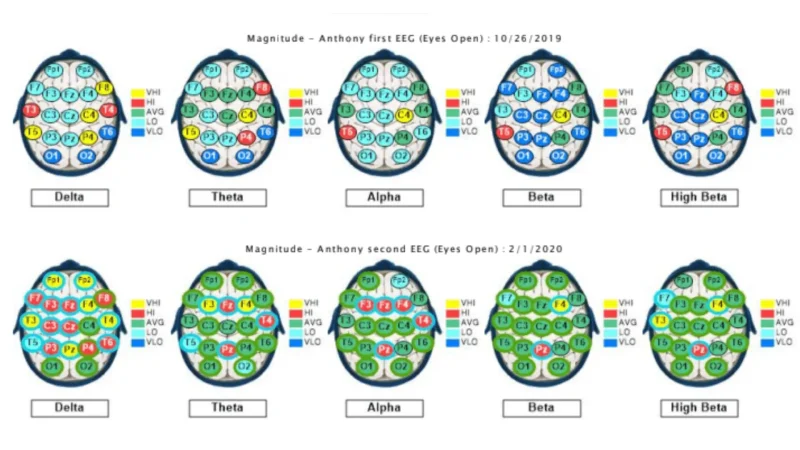
The QEEG comparison — from Brain Map #1 to Brain Map #3 — captures the neurological transformation that took place over the course of treatment.
[Brain Map comparison image — QEEG #1 vs. QEEG #3 after 56 sessions of brain-based therapy, 20 sessions of CALM PEMF®, and ERP psychotherapy]
[Brain Map comparison image — QEEG #1 vs. QEEG #3 after 56 sessions of brain-based therapy, 20 sessions of CALM PEMF®, and ERP psychotherapy]
PANS and OCD Case Study Outcomes
After 56 sessions of brain-based therapy combined with 20 sessions of CALM PEMF® and biofeedback, ERP psychotherapy, parent coaching, dietary changes, and supplementation, Ben's brain activity shifted from a state of profound underactivity to nearly complete normal brainwave functioning.
Ben and his family continue to work with a psychotherapist, use targeted supplements for mood, stress, detoxification, and immune support, and use CALM PEMF® to maintain his brain's regulation.
These weren't behavioral adjustments achieved through pressure or reward. They were the natural result of a regulated nervous system — exactly what the Regulation First® approach predicts and produces.
These weren't behavioral adjustments achieved through pressure or reward. They were the natural result of a regulated nervous system — exactly what the Regulation First® approach predicts and produces.

What This PANS and OCD Case Study Teaches Us
Ben's case carries lessons that are critical for any family whose child has developed sudden-onset psychiatric symptoms — especially following a viral illness:Sudden-onset OCD and anxiety are a red flag, not a starting point. When a healthy child develops psychiatric symptoms rapidly and without prior history, the question isn't how to treat the OCD — it's why it appeared. In Ben's case, the answer was infection-induced autoimmune PANS. Treating the OCD without addressing its cause was never going to work.
COVID can trigger PANS. This is still poorly understood and widely underrecognized. Ben's brain map showed us a pattern consistent with viral-induced neurological disruption. His Type 1 Diabetes onset, followed immediately by psychiatric symptoms, was the clinical fingerprint of infection-triggered autoimmunity.
A dysregulated brain cannot be reasoned with. Eighteen months of CBT, mindfulness, and medication trials produced no meaningful change in Ben — not because those approaches are without value, but because none of them addressed the underlying neurological state driving his symptoms. Regulate the brain first. Then the therapy has somewhere to land.
ERP works best when the nervous system is calm enough to use it. ERP is the gold-standard treatment for OCD — but it requires a regulated enough nervous system to tolerate the discomfort of the exposure process. Ben couldn't access it until his brain had been calmed sufficiently through CALM PEMF® and brain-based therapy.
Parent involvement is not optional. OCD rituals are maintained, in part, by the accommodations and responses of the people around the child. Ben's parents learning the right language and approach — through the CALMS Dysregulation Protocol® — was as clinically important as any intervention with Ben himself.
A Note on PrivacyThe names and some identifying details in this PANS and OCD case study have been changed to protect client privacy. Each client's experience and treatment protocol is unique and individually tailored based on their specific clinical profile.
COVID can trigger PANS. This is still poorly understood and widely underrecognized. Ben's brain map showed us a pattern consistent with viral-induced neurological disruption. His Type 1 Diabetes onset, followed immediately by psychiatric symptoms, was the clinical fingerprint of infection-triggered autoimmunity.
A dysregulated brain cannot be reasoned with. Eighteen months of CBT, mindfulness, and medication trials produced no meaningful change in Ben — not because those approaches are without value, but because none of them addressed the underlying neurological state driving his symptoms. Regulate the brain first. Then the therapy has somewhere to land.
ERP works best when the nervous system is calm enough to use it. ERP is the gold-standard treatment for OCD — but it requires a regulated enough nervous system to tolerate the discomfort of the exposure process. Ben couldn't access it until his brain had been calmed sufficiently through CALM PEMF® and brain-based therapy.
Parent involvement is not optional. OCD rituals are maintained, in part, by the accommodations and responses of the people around the child. Ben's parents learning the right language and approach — through the CALMS Dysregulation Protocol® — was as clinically important as any intervention with Ben himself.
A Note on PrivacyThe names and some identifying details in this PANS and OCD case study have been changed to protect client privacy. Each client's experience and treatment protocol is unique and individually tailored based on their specific clinical profile.
A Note on Privacy
The names and some identifying details in this PANS and OCD case study have been changed to protect client privacy. Each client's experience and treatment protocol is unique and individually tailored based on their specific clinical profile.
Frequently Asked Questions About PANS and OCD Treatment
Can I work with Dr. Roseann one on one?
I'm not taking individual clients right now, but that doesn't mean we can't work together! Through my Parent Certification Program, I teach you the exact tools and strategies I use in my practice — including the CALMS Dysregulation Protocol® — so you can apply them with your child at home. So many parents have told me it was the turning point for their family. [Learn more about the Parent Certification Program →]
What is the Regulation First® approach to PANS and OCD?
Regulation First® means we address the nervous system before we address behavior. With PANS-driven OCD, this is especially important — because OCD treatments like ERP require a nervous system that is calm enough to tolerate them. If the brain is inflamed and shut down, the therapy simply can't reach it. We calm the brain first, and then the therapeutic work has somewhere to land.
What is the CALMS Dysregulation Protocol®?
The CALMS Dysregulation Protocol® is a five-step framework I developed to help parents respond to their child's dysregulation in a way that supports the nervous system rather than escalating it. It stands for: Co-regulate first, Avoid personalizing, Look for root causes, Model coping strategies, and Support and reinforce. For families navigating OCD rituals and PANS-related behaviors, it's one of the most important tools I teach — because what parents say and do in those moments matters enormously.
Is a holistic approach right for my child with PANS and OCD?
In my experience, yes — especially when the OCD appeared suddenly and without prior history. A QEEG Brain Map gives us objective information about what's actually happening in the brain, which changes everything about how we approach treatment. With Ben, his brain map revealed a neurological pattern consistent with viral damage that no behavioral assessment would ever have caught. That information was the foundation of his entire recovery.
How long does it take to see results with PANS-related OCD?
It depends on how long the infection has been active, how entrenched the OCD patterns have become, and how the whole family is engaged in the process. What I can tell you is that intensive, brain-first work moves faster than most families expect — because it's addressing the actual cause rather than managing the symptoms of it. With Ben, three weeks of intensive work was enough to bring him back from the edge of hospitalization. The deeper recovery took longer. But the trajectory changed quickly.
I'm not taking individual clients right now, but that doesn't mean we can't work together! Through my Parent Certification Program, I teach you the exact tools and strategies I use in my practice — including the CALMS Dysregulation Protocol® — so you can apply them with your child at home. So many parents have told me it was the turning point for their family. [Learn more about the Parent Certification Program →]
What is the Regulation First® approach to PANS and OCD?
Regulation First® means we address the nervous system before we address behavior. With PANS-driven OCD, this is especially important — because OCD treatments like ERP require a nervous system that is calm enough to tolerate them. If the brain is inflamed and shut down, the therapy simply can't reach it. We calm the brain first, and then the therapeutic work has somewhere to land.
What is the CALMS Dysregulation Protocol®?
The CALMS Dysregulation Protocol® is a five-step framework I developed to help parents respond to their child's dysregulation in a way that supports the nervous system rather than escalating it. It stands for: Co-regulate first, Avoid personalizing, Look for root causes, Model coping strategies, and Support and reinforce. For families navigating OCD rituals and PANS-related behaviors, it's one of the most important tools I teach — because what parents say and do in those moments matters enormously.
Is a holistic approach right for my child with PANS and OCD?
In my experience, yes — especially when the OCD appeared suddenly and without prior history. A QEEG Brain Map gives us objective information about what's actually happening in the brain, which changes everything about how we approach treatment. With Ben, his brain map revealed a neurological pattern consistent with viral damage that no behavioral assessment would ever have caught. That information was the foundation of his entire recovery.
How long does it take to see results with PANS-related OCD?
It depends on how long the infection has been active, how entrenched the OCD patterns have become, and how the whole family is engaged in the process. What I can tell you is that intensive, brain-first work moves faster than most families expect — because it's addressing the actual cause rather than managing the symptoms of it. With Ben, three weeks of intensive work was enough to bring him back from the edge of hospitalization. The deeper recovery took longer. But the trajectory changed quickly.
Ready to Find a Path Forward?
If Ben's story resonates with what your family is going through right now, you don't have to keep trying approaches that aren't reaching the root cause.
[Learn More About How We Can Help →]
[Learn More About How We Can Help →]
The effectiveness of diagnosis and treatment varies by patient and condition. Dr. Roseann Capanna-Hodge, LLC does not guarantee specific results.