Join the Dysregulation Insider get free calm parenting tips straight to your inbox!
YES, I'M IN!Regulate. Connect. Correct.™: The Parenting Order That Works | Regulation First Parenting® | E428





Estimated reading time: 4 minutes
If every request seems to turn into an argument, you're not alone. The parenting order that works can transform how you respond to your child's biggest meltdowns by helping you stop power struggles before they spiral.
Why does my child get more upset when I correct them during a meltdown?
When your child is dysregulated, their nervous system is in survival mode. They're not refusing to listen because they're stubborn—they simply can't access the thinking part of their brain yet.
Behavior is communication. That's why correcting, lecturing, or adding consequences in the middle of an emotional storm usually makes things worse instead of better.
Key takeaways:
- A dysregulated brain can't learn new lessons.
- Correction during a meltdown increases resistance.
- Calming the brain must come first.
Real-life example: Imagine asking your child to start homework. They yell, slam the door, and you respond with a stricter tone. Suddenly you're both escalating instead of solving the problem.
Why do simple requests turn into huge power struggles?
Many parents believe the problem is defiance. In reality, it's often timing.
When both you and your child become emotionally activated, you're caught in a cycle of co-dysregulation. Neither nervous system is ready for learning, problem-solving, or cooperation.
Instead of reacting:
- Pause before responding.
- Lower your voice instead of raising it.
- Say less, not more.
- Give both nervous systems time to settle.
You're not failing as a parent. You've simply never been taught the right order.
“You've been doing this out of order—not because you're doing it wrong, but because you were never taught the right sequence.” — Dr. Roseann
What is the right order for correcting behavior?
The answer is simple:
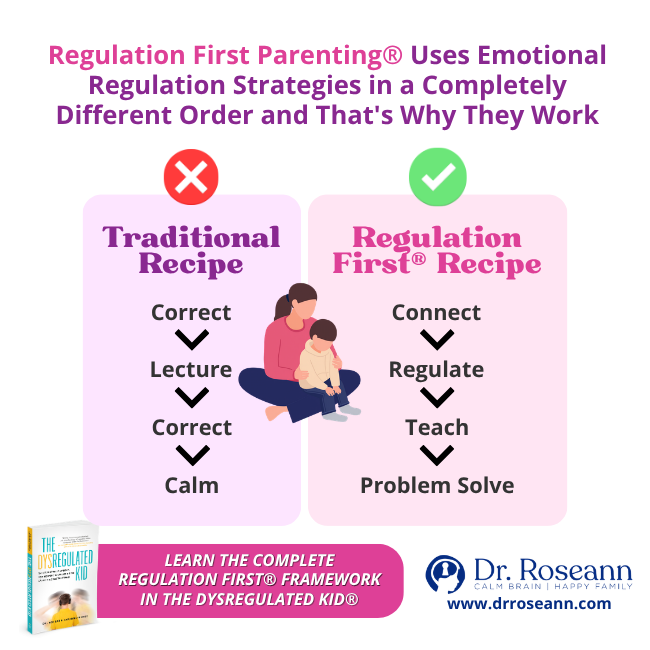
Regulate. Connect. Correct.™
The sequence matters because the nervous system determines whether your child can actually hear what you're saying.
Start by helping everyone become calmer. Then create emotional safety through connection. Only after that should you teach, set limits, or discuss consequences.
Remember this order:
- Regulate first.
- Connect second.
- Correct last.
The boundary doesn't change.
The timing does.
Want to stay calm when your child pushes every button?
Become a Dysregulation Insider VIP and get the FREE Regulation Rescue Kit—your step-by-step guide to stop oppositional behaviors without yelling or giving in.
Go to www.drroseann.com/newsletter and grab your kit today.
How do I connect with my child without giving in?
Many parents worry that empathy means lowering expectations.
It doesn't.
Connection simply reduces your child's sense of threat so their brain can return online. Once that happens, they're far more able to hear limits, solve problems, and cooperate.
Try this instead:
- Acknowledge their feelings first.
- Stay physically and emotionally present.
- Validate without rescuing.
- Return to the expectation once they're calmer.
Real-life example: Instead of saying, "Do your homework right now!" try:
"Wow, that's a lot of homework today. I can see why it feels overwhelming."
After they've settled, you can calmly say, "Now let's figure out how to get it done."
Looking for a simple way to calm both your nervous system and your child's? Quick CALM teaches easy, science-backed regulation strategies you can start using to reduce stress and improve connection.
How can I stop yelling without letting bad behavior continue?
Parents often think they must choose between being firm or being kind.
You don't.
Let's calm the brain first. Once regulation happens, boundaries actually become more effective because your child is finally able to receive them.
Remember:
- Lower your voice.
- Pause before reacting.
- Teach after calm returns.
- Consistency works better than intensity.
It's not bad parenting—it's a dysregulated brain.
Takeaway & What’s Next
When you shift from correcting first to regulating first, everything changes. Your child feels safer, conversations become more productive, and your guidance finally sticks.
It's gonna be OK. Small changes in the order of your response can create lasting changes in your family's emotional health.
Join the Regulated Child Summit and pre-order The Dysregulated Kid to learn practical tools that help families move beyond constant meltdowns and into lasting regulation.
The order matters: regulate first, connect next, and correct when the brain is ready. The Dysregulated Kid® gives you the practical playbook for putting this nervous-system-first approach into action during meltdowns, power struggles, transitions, and everyday parenting challenges. Get The Dysregulated Kid® at dysregulatedkid.com.
FAQs
Can you discipline a child during a meltdown?
No. Wait until your child has regulated. Learning happens after the nervous system feels safe.
Why doesn't punishment stop emotional outbursts?
Because punishment doesn't calm the brain. Dysregulated children need regulation before correction.
What does Regulate. Connect. Correct.™ mean?
It means calming the nervous system first, building connection second, and teaching or correcting behavior last.
How do I help my child calm down faster?
Stay calm yourself, lower your voice, pause, and offer connection before trying to solve the problem.
Will this work for ADHD and anxious kids?
Yes. Many neurodivergent children experience heightened nervous system activation, making regulation-first parenting especially effective.
Feel like you've tried everything and still don't have answers?
The Solution Matcher™ helps you find the best starting point based on your child's symptoms, behaviors, and history.
It's fast, free, and based on decades of clinical expertise.
Get your personalized plan now at www.drroseann.com/help

Find this helpful? Leave us a review!
Your feedback helps more overwhelmed parents find calm, clarity, and the proven tools that make everyday life easier.
Dr. Roseann Capanna-Hodge: Helping Families of Dysregulated Kids Thrive Through Regulation First Parenting®
As the creator of Regulation First Parenting®, she’s helping families of dysregulated kids discover a compassionate, brain-based path forward. Through The Dysregulated Kids™ Podcast (top 2% globally), she offers practical strategies that help parents understand their child’s brain and support lasting change.
Through The Global Institute of Children’s Mental Health and Dr. Roseann, LLC, she’s created resources like the Neurotastic® Brain Formulas and the Regulation First Parenting® framework—meeting families where they are and supporting them through challenges like ADHD, anxiety, OCD, PANS/PANDAS, and behavioral struggles.
Recognized by Forbes as “a thought leader in children’s mental health,” Dr. Roseann is changing how we understand emotional dysregulation in children—one family at a time.