Join the Dysregulation Insider get free calm parenting tips straight to your inbox!
YES, I'M IN!Why You Lose It Faster When You’re Already Overloaded | Nervous System Regulation | E427





Estimated reading time: 4 minutes
Ever wonder why a tiny comment from your child suddenly pushes you over the edge? Why you lose it faster when you're already overloaded isn't about becoming a better parent overnight—it's about understanding why your nervous system reaches its limit before your child even says a word.
In this episode, I explain why parenting feels impossible when your stress cup is already overflowing and how small moments of regulation can completely change what happens next.
Why do I lose my patience with my child so quickly?
If you find yourself snapping over something small and instantly feeling guilty, you're not alone. It's not bad parenting—it's a dysregulated brain.
When your nervous system has been carrying stress all day (or even for years), your reaction isn't caused by that one moment. It's the result of everything you've been holding.
Signs your stress cup is already full:
- Decision fatigue
- Financial or relationship stress
- Poor sleep or hormonal changes
- Constant caregiving without recovery
Imagine walking through the door after a long day of work, emails, and appointments. Your child complains about homework, and suddenly you're yelling before you even realize it. That's nervous system overload—not failure.
Why does everything feel harder when I'm already stressed?
When your body stays in survival mode, even ordinary parenting challenges feel enormous.
Instead of asking, "What's wrong with my child?" Dr. Roseann encourages parents to ask:
- What am I carrying right now?
- How full is my own stress cup?
- What does my nervous system need before I respond?
Behavior is communication—but so is your own reaction.
“You didn't snap because of what your kid just said. You snapped because your nervous system hit capacity hours ago.” — Dr. Roseann
How can I stop reacting before I think?
The answer isn't perfection. It's creating more space between the trigger and your response.
I recommend beginning with what I call the three-second pause.
Try this before responding:
- Take one slow breath.
- Drop your shoulders.
- Repeat a calming mantra like, "I'm resetting before I respond."
These tiny resets help your nervous system regain capacity before conflict escalates.
When your child is dysregulated, it’s easy to feel helpless. The Regulation Rescue Kit gives you the scripts and strategies you need to stay grounded and in control. Become a Dysregulation Insider VIP at www.drroseann.com/newsletter and get your free kit today.
Why is regulating myself the best way to help my child?
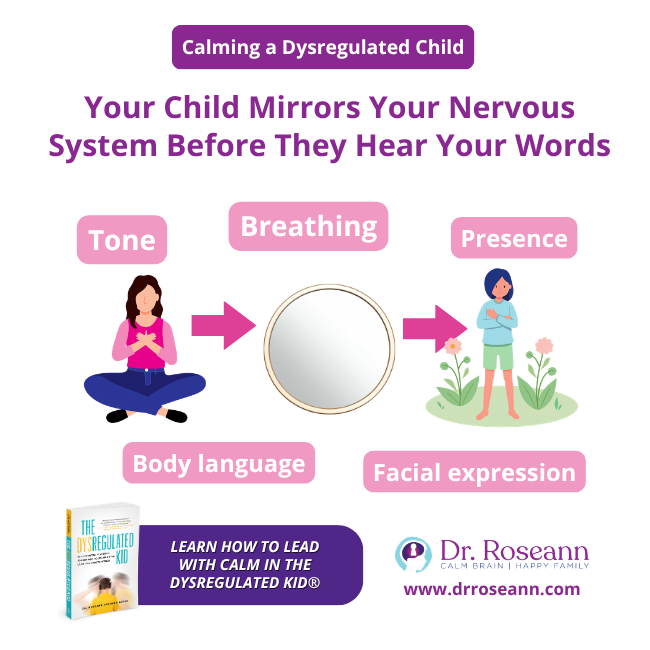
Children learn regulation by experiencing it—not by being told to calm down.
Written companion: understanding emotional dysregulation in children.
Remember, "Monkey see, monkey do."
When you consistently regulate yourself:
- Your child feels safer.
- Repair happens faster after conflict.
- Your family spends less time stuck in reactive cycles.
Let's calm the brain first. Everything follows.
Takeaway & What’s Next
You don't lose your patience because you're a bad parent. You lose it because your nervous system has reached capacity.
The good news? Every small reset builds resilience over time. It's gonna be OK, and you're not alone.
Need help calming your own nervous system? Quick CALM gives parents simple, science-backed tools to regulate before emotions take over.
If you’re looking for even more practical support, the Regulated Child Summit and The Dysregulated Kid teach parents how nervous system regulation transforms behavior, learning, and emotional resilience for the whole family.
You can know exactly how you want to parent and still lose access to those skills when your own nervous system gets triggered. The Dysregulated Kid® helps you regulate yourself first, interrupt the escalation cycle, and respond with more calm and intention when parenting gets hard. Get The Dysregulated Kid® at dysregulatedkid.com.
FAQs
Why do I yell even when I don't want to?
Your nervous system may already be overloaded before the conflict begins. Regulation creates the space to choose a different response.
How do I calm myself before reacting?
Pause for three seconds, breathe, relax your body, and give your nervous system a moment to reset before speaking.
Can small regulation practices really help?
Yes. Small moments throughout the day gradually increase your nervous system's capacity, making stressful situations easier to handle.
Does my child's behavior improve when I regulate first?
Absolutely. Children co-regulate with the adults around them. Your calm helps their nervous system settle too.
Is it ever too late to learn regulation?
Never. Whether you're a parent, grandparent, or caregiver, it's never too late to strengthen your nervous system and create healthier patterns.
Not sure where to start?
Take the guesswork out of helping your child. Use our free Solution Matcher™ to get a personalized plan based on your child's unique needs—whether it's ADHD, anxiety, mood issues, or emotional dysregulation. In just a few minutes, you'll know exactly what support is right for your family. Start here: www.drroseann.com/help

Find this helpful? Leave us a review!
Your feedback helps more overwhelmed parents find calm, clarity, and the proven tools that make everyday life easier.
Dr. Roseann Capanna-Hodge: Helping Families of Dysregulated Kids Thrive Through Regulation First Parenting®
As the creator of Regulation First Parenting®, she’s helping families of dysregulated kids discover a compassionate, brain-based path forward. Through The Dysregulated Kids™ Podcast (top 2% globally), she offers practical strategies that help parents understand their child’s brain and support lasting change.
Through The Global Institute of Children’s Mental Health and Dr. Roseann, LLC, she’s created resources like the Neurotastic® Brain Formulas and the Regulation First Parenting® framework—meeting families where they are and supporting them through challenges like ADHD, anxiety, OCD, PANS/PANDAS, and behavioral struggles.
Recognized by Forbes as “a thought leader in children’s mental health,” Dr. Roseann is changing how we understand emotional dysregulation in children—one family at a time.