



Estimated reading time: 8 minutes
ADHD emotional dysregulation medication is one of the most searched topics by parents who watch their child go from calm to explosive in seconds — and feel completely helpless. You're not alone.
Here's a quick overview of the main medication options and what the research says:
| Medication Type | Examples | Effect on Emotional Dysregulation |
|---|---|---|
| Stimulants (methylphenidate) | Ritalin, Concerta | Reduces irritability and emotional reactivity in many kids |
| Stimulants (amphetamines) | Adderall, Lisdexamfetamine | May worsen emotional lability in some children |
| Non-stimulants | Atomoxetine (Strattera), Guanfacine (Intuniv) | Can reduce mood swings and irritability, especially in girls and inattentive presentations |
| Mood stabilizers (combined) | Lithium, Valproate + MPH | Show strong results for emotional dysregulation in complex cases |
The bottom line: No single medication fully resolves emotional dysregulation. The research is clear that medication works best when paired with skill-building and behavioral support.
Between 34% and 70% of people with ADHD struggle to regulate their emotions (Astenvald et al., 2022). For kids, that can look like meltdowns over small changes, explosive outbursts after school, or tears that seem completely out of proportion to what just happened.
This isn't bad parenting. This isn't a bad kid.
Behavior is communication. And when a child with ADHD reacts with outsized emotion, their brain is telling you it's overwhelmed — not that they're choosing to be difficult.
The challenge is that ADHD emotional dysregulation is still underrecognized. Many clinicians focus on attention and impulsivity, and emotional symptoms get attributed to anxiety or mood disorders instead of being seen as part of ADHD itself. That means families spend years chasing the wrong solutions.
That's exactly why understanding what medication can and cannot do for emotional dysregulation matters so much.
I'm Dr. Roseann Capanna-Hodge, a licensed professional counselor and children's mental health expert with over 30 years of clinical experience helping kids with ADHD, anxiety, and emotional dysregulation. Guiding families through the complex landscape of ADHD emotional dysregulation medication — and the science-backed alternatives that work alongside it — is at the core of what I do every day.
Adhd emotional dysregulation medication glossary:
Understanding ADHD Emotional Dysregulation Medication Options
When we talk about adhd emotional dysregulation medication, we have to start with what’s actually happening in the brain. For a long time, the medical community viewed ADHD primarily as a "disorder of attention." But those of us living and working with these kids know that the "big feelings" are often the most disruptive part of the day.
Emotional dysregulation, or Deficient Emotional Self-Regulation (DESR), affects up to two-thirds of adults with ADHD and a massive percentage of children. It’s not just "being moody." It’s a core part of the ADHD brain's wiring. Research, such as the landmark work by Shaw et al. (2014), highlights that these emotional challenges are tied directly to the same neural pathways that cause inattention.
In the ADHD brain, two main areas are often out of sync:
- The Amygdala: This is the brain's emotional smoke detector. In kids with ADHD, it can be hyper-reactive, sounding a "five-alarm fire" alarm over a broken pencil or a change in plans.
- The Prefrontal Cortex (PFC): This is the "braking system" or the CEO of the brain. It’s responsible for executive functions like pausing before reacting. In ADHD, the PFC often struggles to send a strong enough signal to calm the amygdala down.
When the brakes are weak and the alarm is loud, you get emotional dysregulation. This manifests as low frustration tolerance, irritability, and "hot" impulsivity. Because this causes significant functional impairment in school and relationships, many parents turn to medication to help bridge that gap.

How ADHD Medication for Emotional Dysregulation Works in the Brain
Most adhd emotional dysregulation medication options target neurotransmitters—specifically dopamine and norepinephrine. These chemicals act like messengers that help the prefrontal cortex communicate more effectively.
When dopamine levels are optimized, the brain's "reward center" stabilizes, and the "executive center" gains better control over emotional impulses. Research has shown that some medications can actually help "normalize" how the brain processes emotional information. For instance, a study on methylphenidate and emotional processing found that it can help the brain respond to emotional cues more like a neurotypical brain would.
However, it’s important to note that medication doesn't "fix" the emotions themselves. Instead, it aims to strengthen the brain's ability to manage those emotions. It’s like giving your child a better pair of glasses so they can see the emotional "stop signs" before they run right through them.
Comparing Stimulants and Non-Stimulants for Mood Stability
Choosing the right adhd emotional dysregulation medication is rarely a straight line. What works for one child might make another feel like they’re on a roller coaster.
Stimulants (Methylphenidate vs. Amphetamines)Stimulants are the most common first-line treatment.
- Methylphenidate (Ritalin, Concerta): Studies generally show that methylphenidate is effective at reducing irritability and emotional outbursts in both children and adults. It helps "calm the noise" in the brain.
- Amphetamines (Adderall, Vyvanse): While great for focus for many, some research suggests that amphetamines carry a higher risk of worsening emotional lability (mood swings) in children. If your child becomes a "zombie" or more prone to rage on an amphetamine, it’s a sign their nervous system is overstimulated.
Non-Stimulants Non-stimulants like
Atomoxetine (Strattera) or
Guanfacine (Intuniv) work differently. They don't provide that immediate "kick" that stimulants do, but they build up in the system over time.
- Atomoxetine: This is often a go-to for kids who have comorbid anxiety or who experience significant mood swings. It targets norepinephrine and can help steady the emotional ship.
- Guanfacine: This medication actually works on the receptors in the prefrontal cortex to help strengthen those "brakes" we talked about. It’s often used to help with rejection sensitivity and high levels of irritability.
| Feature | Stimulants | Non-Stimulants |
|---|---|---|
| Onset | Fast (30-60 mins) | Slow (2-6 weeks) |
| Primary Target | Focus & Impulsivity | Irritability & Anxiety |
| Mood Effect | Can cause "crashes" | More "level" throughout the day |
| Best For | Combined Type ADHD | Inattentive Type / High Irritability |

The Limits of ADHD Emotional Dysregulation Medication
I always tell my families: Medication can help a child sit still, but it can't teach them what to do with their feelings.
There are significant limitations to relying solely on adhd emotional dysregulation medication:
- The "Crash" or Rebound: As medication wears off in the afternoon, many kids experience a "rebound effect" where their emotional dysregulation actually gets worse for a few hours. This is often the hardest time of day for families.
- Medication Attrition: A recent study Brikell et al. (2024) found that more than half of teenagers and adults stop taking their ADHD medication within the first year. If medication is the only tool in the toolbox, the child is left with no strategies when they stop taking it.
- Side Effects: From sleep disturbances to appetite loss, the side effects can sometimes outweigh the benefits. You can read more about 15 side effects of ADHD medication to know what to watch for.
- Skills Gap: Medication doesn't teach coping skills. It doesn't teach a child how to recognize they are getting angry or how to use a breathing technique.

Beyond the Prescription: A Holistic Approach to Regulation
At our center, we believe in a "brain-first" approach. While adhd emotional dysregulation medication is an option for some, it is never the whole story. We want to build a resilient nervous system that can handle life’s ups and downs without needing a pill to do the heavy lifting.
To truly help a dysregulated child, we have to look at the "Big Three":
- Calming the Nervous System: Tools like neurofeedback for ADHD and magnesium for ADHD help regulate the brain's baseline arousal level. When the brain is calm, it’s much easier to use coping skills.
- Skill Building: This is where therapies like CBT (Cognitive Behavioral Therapy) and DBT (Dialectical Behavior Therapy) come in. These teach kids how to "catch" their thoughts and manage their distress.
- Lifestyle Support: Never underestimate the power of a clean ADHD diet and solid sleep hygiene. A tired, sugar-crashing brain is a dysregulated brain.
One of our favorite "game-changing" tools is the 5-4-3-2-1 method. It’s a grounding technique that pulls a child out of an emotional spiral and back into their body:
- Identify 5 things you see.
- 4 things you can touch.
- 3 things you hear.
- 2 things you can smell.
- 1 thing you can taste.
By shifting the focus to sensory input, we bypass the reactive amygdala and re-engage the thinking brain.
Helping Skills Live Beyond the Treatment Plan
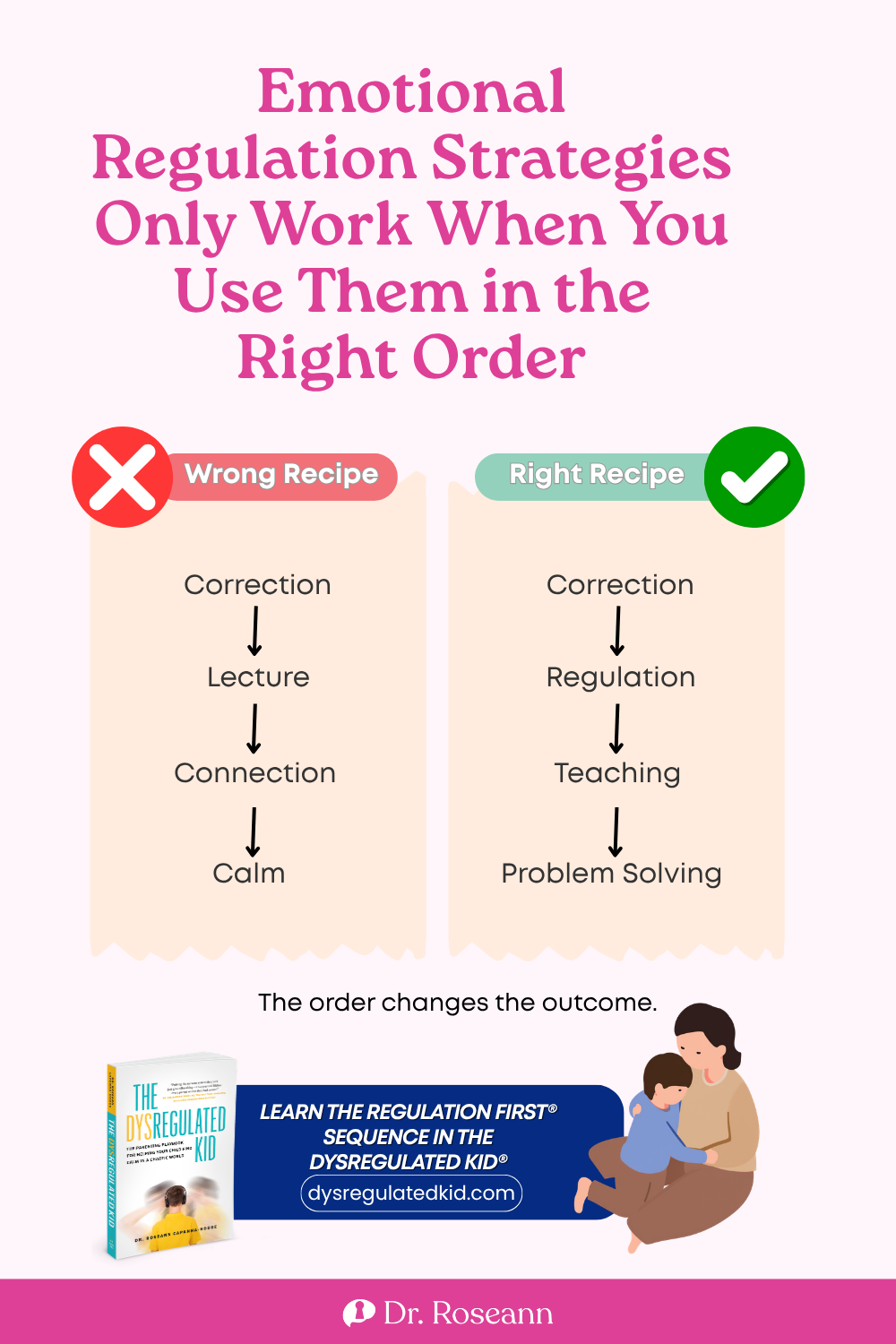
Decisions about medication belong with a qualified prescriber, while daily regulation skills are practiced in the ordinary moments around home, school, transitions, and disappointment. A steady routine can give children more chances to recognize what helps them pause, reset, and reconnect.
The Dysregulated Kid® gives parents a practical Regulation First Parenting® framework for supporting those everyday skills alongside the care plan their family chooses.
Frequently Asked Questions
Can ADHD meds make my child more irritable?
Yes, absolutely. This is one of the most common complaints I hear. Irritability on medication usually happens for one of three reasons:
- The Dose is Too High: Overstimulation can feel like "internal jitters," which leads to snapping and anger.
- The Rebound Effect: As the medication leaves the system, the brain struggles to adjust. This "crash" often happens right around dinner time.
- The Wrong Medication: For some kids, certain stimulants (especially amphetamines) simply don't agree with their unique neurochemistry.
If your child is more irritable on the meds than off them, that is a major red flag that the current plan needs a review.
How long does it take to see emotional changes?
It depends on the approach. With stimulants, you might see an immediate improvement in "cooling" the emotional temper, but you might also see that afternoon irritability right away.
With non-stimulants like Strattera, it can take 4 to 6 weeks to see the full emotional benefit. However, true, lasting emotional regulation—the kind where a child can handle a disappointment without a meltdown—is a marathon, not a sprint. It requires consistent brain-calming work and skill-building over several months.
Are there natural alternatives to medication?
Yes, and for many families, these are the "game-changers" they’ve been looking for. We focus on holistic therapy for ADHD because we want to treat the root cause, not just mask the symptoms.
- Neurofeedback: This is like "exercise for the brain." It teaches the brain how to stay in a calm, focused state on its own.
- Supplements: Magnesium is my "miracle mineral" for dysregulation because it helps relax the nervous system.
- Parent Training: Learning how to co-regulate with your child is one of the most powerful "medications" there is. When you stay calm, it helps their brain find its way back to calm, too.
Citations:
Astenvald, R., Frick, M. A., Neufeld, J., Bölte, S., & Isaksson, J. (2022). Emotion dysregulation in ADHD and other neurodevelopmental conditions: A co-twin control study. Child and Adolescent Psychiatry and Mental Health, 16(1), 92. https://doi.org/10.1186/s13034-022-00528-0
Shaw, P., Stringaris, A., Nigg, J., & Leibenluft, E. (2014). Emotion Dysregulation in Attention Deficit Hyperactivity Disorder. American Journal of Psychiatry, 171(3), 276–293. https://doi.org/10.1176/appi.ajp.2013.13070966
Brikell, I., et al. (2024). ADHD medication adherence: a systematic review and meta-analysis. The Lancet Psychiatry. https://doi.org/10.1016/S2215-0366(23)00332-2
When a child's nervous system is overwhelmed, the best interventions start with co-regulation. This principle is central to The Dysregulated Kid.
Related reading: Does Adderall help with emotional dysregulation?.
Always remember… “Calm Brain, Happy Family™”
Disclaimer: This article is not intended to give health advice and it is recommended to consult with a physician before beginning any new wellness regime. The effectiveness of diagnosis and treatment vary by patient and condition. Dr. Roseann Capanna-Hodge, LLC does not guarantee certain results.
Are you looking for SOLUTIONS for your struggling child or teen?
Dr. Roseann and her team are all about science-backed solutions, so you are in the right place!
Meet the Expert
Licensed Therapist | Certified School Psychologist
Board Certified in Neurofeedback (BCN) | 30+ Years Clinical Experience
Expert in Emotional Dysregulation in Children and Nervous System Regulation
Host, Dysregulated Kids Podcast | Author, The Dysregulated Kid
Dr. Roseann Capanna-Hodge is a licensed therapist, certified school psychologist, and leading expert in emotional dysregulation in children and nervous system regulation. With over 30 years of clinical experience and having analyzed more than 10,000 brain maps, she helps families understand what behavior is really signaling—and how to calm the nervous system first so real change can happen.
She is the creator of Regulation First Parenting® and the CALMS Protocol™, host of the top 1% podcast Dysregulated Kids, and author of The Dysregulated Kid.