


Estimated reading time: 9 minutes
AuDHD is the co-occurrence of Autism and ADHD, meaning a child experiences traits of both neurotypes at the same time. This
can affect attention, emotional regulation, sensory processing, social skills, and executive functioning in ways that often leave parents confused, overwhelmed, and searching for answers.
I’m Dr. Roseann Capanna-Hodge, and with 30+ years of experience helping neurodivergent children, I’ve guided families in understanding how autism and ADHD overlap and what support truly helps kids thrive.
In this article, you’ll learn:
- What AuDHD is
- How it’s assessed
- Everyday signs
- School supports
- And a step-by-step, regulation-first plan you can start today
What Is AuDHD?
AuDHD describes
co-occurring autism and ADHD in the same person.
Since DSM-5 allowed both diagnoses in 2013, more kids are accurately identified instead of being forced into an either/or box.
Research shows real overlap in traits. And even shared genetic influences—between autism and ADHD (Rommelse et al., 2021).
“Family and twin studies show ADHD and autism share genetic influences. Treat what’s shared and what’s distinct.” — Marieke Rommelse, Ph D (Rommelse et al., 2021)
This isn’t a fad. It’s better recognition—and better support—of kids who need both approaches.
How to Tell “Won’t” From “Can’t” With AuDHD Behavior
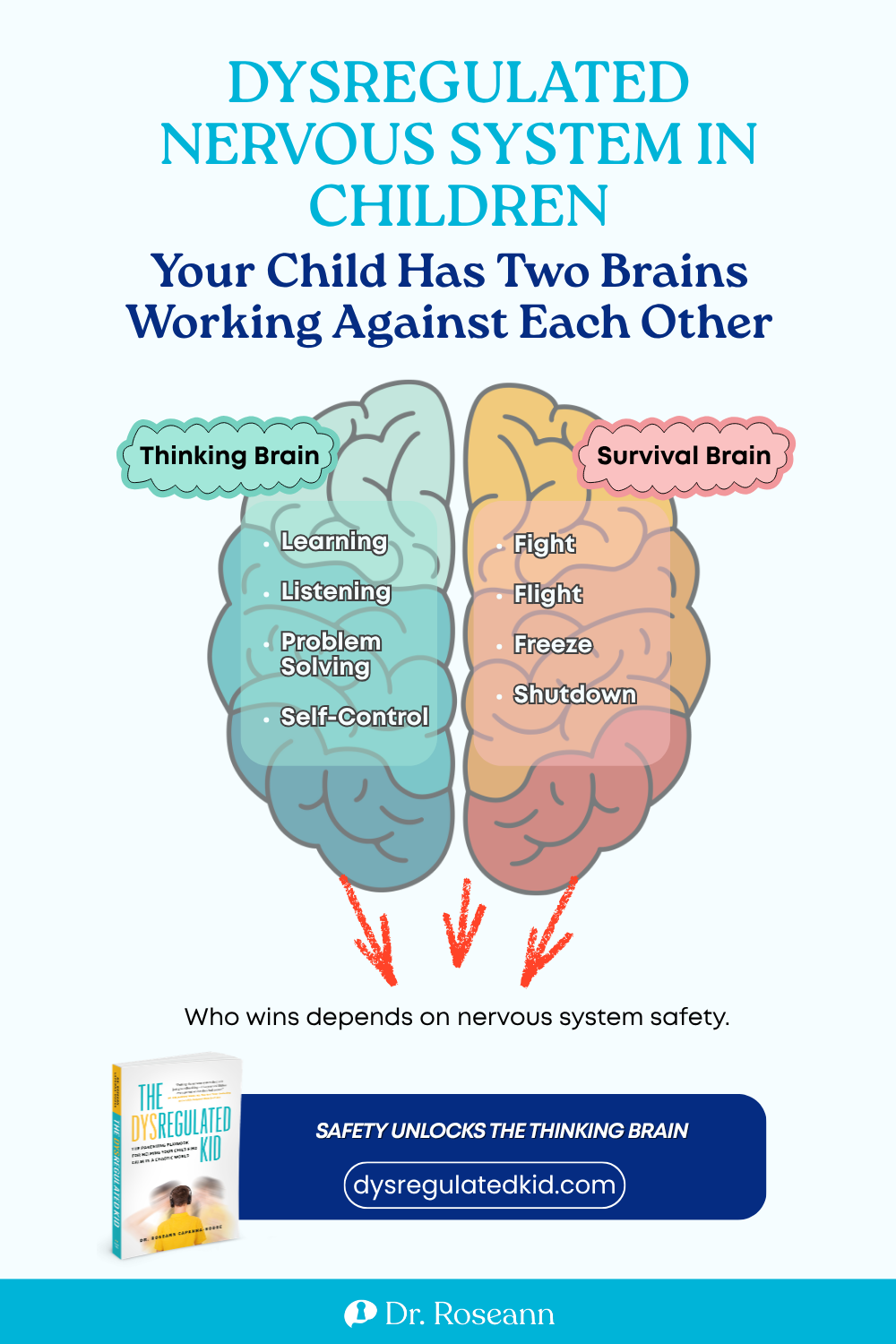
Capacity changes with regulation. A child can look “refusal-based” when their nervous system is actually overloaded.
Watch for “can’t” clues:
- Sudden shutdowns with noise, lights, or clothing textures.
- “Task start” paralysis, even for simple steps.
- Meltdowns after multiple instructions or fast transitions.
Parent snapshot:
Maddie, mom of a 10-year-old, thought her son “wouldn’t” do homework. We added a 3-step visual card and a two-minute wiggle break. He started on time and finished in 20 minutes.
Takeaway:
Behavior is communication; reduce load, and skills show up.
Quick script: “Let’s pause, breathe together, and start with just step one.”
Underline this mindset: Regulate. Connect. Correct.™
Day-To-Day Signs to Look for at Home and School
AuDHD blends autistic social/communication differences and sensory needs with ADHD patterns of
inattention, impulsivity, and hyperactivity . Population data confirm frequent co-occurrence (Danielson et al., 2018).
Home Patterns
- Sensory: strong reactions to sound, light, textures, or foods.
- Routines: trouble shifting; “one more minute” loops; bedtime battles.
- Emotions: fast “0→100” reactions; shame after outbursts.
School Patterns
- Executive function: loses papers, slow to start, stops mid-task.
- Social: literal communication, misses “hidden rules,” masks then crashes.
- Attention profile: hyperfocus on interests, distractible on non-preferred work.
Let’s look at how these traits often show up in daily life.

How Is AuDHD Diagnosed
A thorough evaluation should look beyond labels to function, context, and regulation. Use multiple sources—home, school, and direct observation.
Many children qualify for both diagnoses when the criteria are carefully reviewed (Danielson et al., 2018).
Ask Your Evaluator
- Detailed developmental history + parent/teacher input.
- Observation of social reciprocity, flexibility, and coping.
- Executive function and learning measures.
- A sensory profile to identify triggers and supports.
- Screening of sleep, medical, vision/hearing, and anxiety.
| Assessment Component | What It Looks For | Why It Matters |
|---|---|---|
| History & interviews | Early social/communication, restricted interests, attention patternsEstablishes onset and context | Establishes onset and context |
| Standardized scales (home/school) | Autism, ADHD, and EF indicators | Confirms cross-setting patterns |
| Direct observation | Social reciprocity, flexibility, masking | Captures real-world functioning |
| Cognitive/academic testing | Working memory, processing speed, decoding/writing | Guides learning supports |
| Sensory profile | Triggers, thresholds, seeking/avoidance | Targets accommodations |
| Health/sleep review | Factors that amplify dysregulation | Treats root contributors |
“Population data tell us many kids meet criteria for both—so we should design supports that reflect that reality.” — Melissa Danielson, MSPH (Danielson et al., 2018)
What Helps First at Home—Before Behavior Plans?
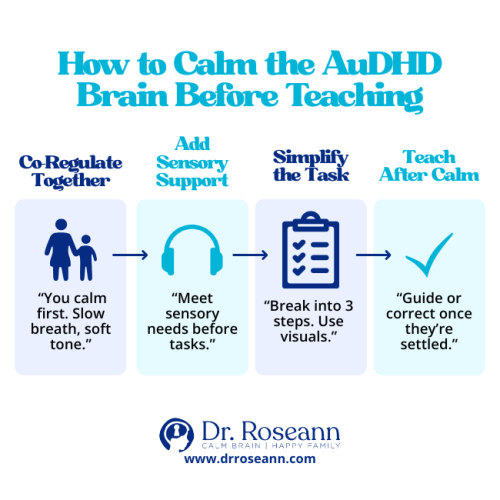
Start with Regulation First Parenting®: Regulate → Connect → Correct. Calm brains learn. Dysregulated brains don’t.
Try this today:
- Co-regulate: slow exhale; shoulder-to-shoulder; soft voice.
- Sensory menu: weighted lap pad, movement bursts, chewy snacks, dim lights.
- Visuals > words: 3-step checklist; timer for “start” and “wrap.”
- One change at a time: fix bedtime routine first; then homework setup.
Calm the brain first; everything follows.
Parent snapshot:
Marco needed motion. A five-minute trampoline break before homework cut meltdowns in a week.
Takeaway:
Sensory input before demand prevents overload.
What Actually Works at School Without a Fight
You don’t need 20 accommodations. You need the right ones.
Ask for:
- Prime the brain: movement or sensory break before
- Chunk tasks: 3 problems → check-in → next chunk.
- Alternate output: oral responses, graphic organizers, typing.
- Predictable routine: visual schedule, transition warnings.
- Low-stim space: headphones, fewer visual distractions.
Parent snapshot:
Ava, age 8, went from daily nurse visits to none after adding morning movement, a quiet table, and visual directions. T
Takeaway:
Lower the load, unlock learning.

Evidence-Based Treatments and How to Build a Plan
There’s no one-size protocol. There is good science to guide your choices.
Evidence Highlights
- Skill + parent-supported programs can improve attention and real-life function in ADHD (Chacko, Kofler, & Jarrett, 2014).
- Genetic overlap reminds us to treat shared and distinct needs in AuDHD (Rommelse et al., 2021).
- Population studies show many kids meet criteria for both (Danielson et al., 2018).
Build Your Stack (Layer, Don’t Swap)
- Brain-based: QEEG-informed neurofeedback; CALM PEMF®; protect sleep.
- Therapy: CBT/ACT adapted for autism; social-communication coaching.
- OT & sensory integration: a practical sensory diet for home/school.
- Lifestyle pillars: protein + fiber breakfast, daylight, daily movement.
- Parent training: co-reg scripts; visual supports; stepwise demands.
“Executive function is teachable—and when parents are coached too, gains are bigger and last longer.” — Anil Chacko, Ph D (Chacko et al., 2014)
How to Protect Self-Esteem and Keep Family Stress Down?
Kids with AuDHD hear a lot of corrections. Let’s change the story.
Protective habits:
- Catch micro-wins: “You started without me—nice job.”
- Belonging first: one friend, one club, one deep interest.
- Repair after rupture: brief apology; plan the do-over.
- Parent nervous system care: your calm body is therapy.
Parent snapshot:
Nate, 12, labeled “lazy.” We reframed skills as learnable and used a visual board. His smile returned first.
Takeaway:
Self-esteem grows when adults notice effort and scaffold the next step.
Bringing It Together (You’ve Got This)
If you came here asking “what is AuDHD” , here’s the heart: your child needs both
autism-informed and
ADHD-smart supports. Built on a
calm brain .
Start with one tool. Celebrate one win. You’re not alone. It’s gonna be OK.
Next step: Watch the video on creating a home sensory menu.
Regulate → Connect → Correct
FAQs
What does AuDHD mean in children?
AuDHD means a child has both autism and ADHD traits together, which can affect attention, emotions, sensory processing, and behavior in unique ways.
Why are more kids being identified with AuDHD now?
More children are being recognized with AuDHD because clinicians can now diagnose autism and ADHD together, leading to better understanding and support.
How does AuDHD affect behavior at home?
Kids with AuDHD may shift between hyperfocus, emotional overwhelm, shutdowns, impulsivity, or sensory sensitivity depending on how regulated their nervous system feels.
What are common school struggles for kids with AuDHD?
Children with AuDHD often struggle with focus, transitions, organization, sensory overload, emotional regulation, and completing everyday classroom tasks.
Can AuDHD cause emotional meltdowns?
Yes, AuDHD can lead to emotional meltdowns when sensory overload, stress, frustration, or executive functioning demands overwhelm the brain.
How do parents support a child with AuDHD at home?
Parents can support a child with AuDHD by creating predictable routines, reducing sensory stress, using visual supports, and focusing on calming the nervous system first.
Is AuDHD considered a real diagnosis?
AuDHD is not a separate medical diagnosis, but it is a widely used term that describes co-occurring autism and ADHD in the same person.
What treatments help children with AuDHD?
Children with AuDHD often benefit from a combination of behavioral support, sensory regulation strategies, parent coaching, school accommodations, and brain-based therapies.
Terminology
- AuDHD: Autism + ADHD co-occurrence.
- Executive function: planning, starting, shifting, finishing.
- Co-regulation: your calm body helps your child’s brain settle.
- Masking: hiding effort/distress to fit in; crash later.
- Sensory diet: planned input to keep the brain steady.
Related reading: compare overlapping traits across OCD and ADHD.
Citations
Chacko, A., Kofler, M., & Jarrett, M. A. (2014). Improving outcomes for youth with ADHD: A conceptual framework for combined neurocognitive and skill-based treatment approaches. Clinical Child and Family Psychology Review, 17(4), 368–384.https://pubmed.ncbi.nlm.nih.gov/25212820/
Danielson, M. L., Bitsko, R. H., Ghandour, R. M., Holbrook, J. R., Kogan, M. D., & Blumberg, S. J. (2018). The co-occurrence of autism spectrum disorder in children with ADHD: United States, 2007–2012. Journal of Developmental & Behavioral Pediatrics, 39(9), 701–708.https://pubmed.ncbi.nlm.nih.gov/30312202/
Rommelse, N. N. J., Franke, B., Geurts, H. M., Hartman, C. A., & Buitelaar, J. K. (2021). Shared heritability and mechanisms between ADHD and ASD: A review. Frontiers in Neuroscience, 15, 649588.https://www.frontiersin.org/articles/10.3389/fnins.2021.649588/full
©Roseann Capanna-Hodge
Understanding your child's emotional triggers is the first step toward helping them self-regulate. For a comprehensive guide, see The Dysregulated Kid by Dr. Roseann Capanna-Hodge.
Always remember… “Calm Brain, Happy Family™”
Disclaimer: This article is not intended to give health advice and it is recommended to consult with a physician before beginning any new wellness regime. The effectiveness of diagnosis and treatment vary by patient and condition. Dr. Roseann Capanna-Hodge, LLC does not guarantee certain results.
Are you looking for SOLUTIONS for your struggling child or teen?
Dr. Roseann and her team are all about science-backed solutions, so you are in the right place!

Meet the Expert
Licensed Therapist | Certified School Psychologist
Board Certified in Neurofeedback (BCN) | 30+ Years Clinical Experience
Expert in Emotional Dysregulation in Children and Nervous System Regulation
Host, Dysregulated Kids Podcast | Author, The Dysregulated Kid
Dr. Roseann Capanna-Hodge is a licensed therapist, certified school psychologist, and leading expert in emotional dysregulation in children and nervous system regulation. With over 30 years of clinical experience and having analyzed more than 10,000 brain maps, she helps families understand what behavior is really signaling—and how to calm the nervous system first so real change can happen.
She is the creator of Regulation First Parenting® and the CALMS Protocol™, host of the top 1% podcast Dysregulated Kids, and author of The Dysregulated Kid.