
Join the Dysregulation Insider get free calm parenting tips straight to your inbox!
YES, I'M IN!Inside The Dysregulated Kid: The Pages I Wrote for the Parent Who Feels Like They're Failing | Co-Regulation Parenting | E461





Estimated reading time: 5 minutes
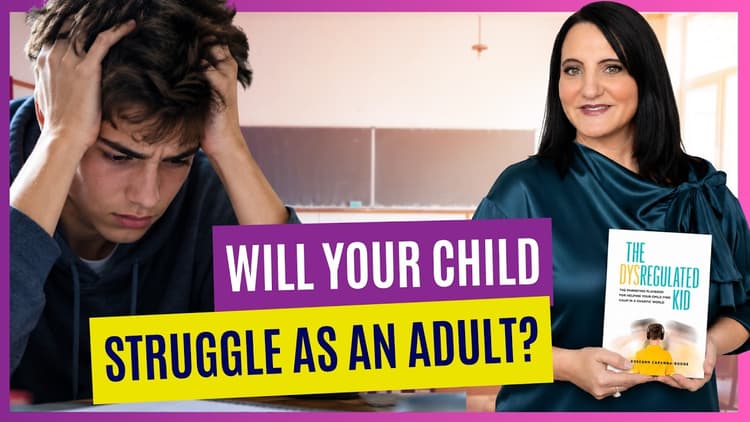
In this episode, Roseann Capanna-Hodge shares personal reflections from The Dysregulated Kid for parents who feel like they are failing. She introduces her Regulation First Parenting® approach and discusses noticing overwhelm, connection, and boundaries.
Why does it feel like nothing works when you're doing everything right?
You're following the recommendations. You're going to the school meetings. You're trying to be patient. You've tried the scripts, the rewards, the consequences, gentle parenting, and therapy. And your child or teen is still melting down, anxious, afraid to try anything, defiant, or shutting down.
And somewhere along the way, a quiet question starts following you around: am I failing my kid?
That question is the reason I wrote this book. I've also asked it about my own child — standing at the bus stop, terrified of what the other parents thought, just wanting my kid to knock it off.
Struggling with a parenting strategy does not make you a failure. My starting point is to notice what your child may need in the moment.
Needing support is not a character flaw. You do not have to work through every hard moment alone.
I want parenting guidance to offer hope and clarity, alongside a realistic account of its limits.
What do I suggest when a child feels overwhelmed?
Scripts, rewards, and consequences are familiar parenting tools. In this episode, I focus on what I suggest before returning to an expectation.
Instead of asking for a full explanation in a difficult moment, I suggest first noticing what is happening and what support your child needs.
My first step is not to add more reminders or a stronger consequence. It is to pause, when it is safe to do so, and consider how to approach the conversation.
For related background, read about what dysregulation actually is. My approach starts with regulation, then connection and correction.
Regulate. Connect. Correct. That's the order I teach.
How do I know whose parenting advice to trust?
There are genuinely good professionals sharing good advice. There are also accounts that lean on fear to sell quick fixes, with no clear person or accountability behind them.
Two questions I ask are: Does this offer hope? Does it make the next step clearer? Those questions do not replace checking the person's qualifications and the evidence for their claims.
Helping families in hard moments is serious. You deserve to know who is offering advice, what their qualifications are, and what they are accountable for.
Look for a real person. A face, a license, a body of work, accountability.
Ask for clarity. Look for an explanation of what the advice can and cannot support.
Spinning your wheels is information. It may mean you're running on empty, not that you're failing.
You can also learn more about The Dysregulation Insider newsletter at www.drroseann.com/newsletter.
What does co-regulation actually look like in the moment?
One question I suggest asking in a difficult moment is: does my child seem overwhelmed, anxious, or withdrawn? This is an invitation to observe, not a diagnosis.
When everyone is safe, you can consider pausing a non-urgent discussion and returning to it later. That does not mean dropping a boundary or ignoring an immediate safety need.
You might try a quieter setting, fewer words, and a moment to steady yourself. Adapt the approach to your child's needs and any existing care plan, then return to the expectation when it is appropriate.
Say you're 20 minutes into an argument about emptying the dishwasher. You could pause, then break the task into manageable steps, or reframe it: “Let's get the dishwasher emptied real fast, then we can make that chicken you want.” The expectation did not disappear; you tried a different way to discuss it.
In this episode, I discuss co-regulation through small, intentional moments of support. You do not have to approach every moment perfectly.
Does regulation first parenting mean letting your child off the hook?
Absolutely not. Regulation first is not regulation only.
We still want frustration tolerance, accountability, flexibility, communication, and repair. In my approach, boundaries remain part of the conversation; pausing a discussion is not the same as abandoning an expectation.
My aim is to support skills and understanding, rather than focus only on immediate compliance.
Keep appropriate boundaries and make room to practice skills.
Change the conditions, not the expectation. That's regulation first parenting in action.
Takeaway & What's Next
If you're wondering whether things will ever get better, please don't give up. Your child's story isn't finished. Neither is yours.
For me, this approach is about small moments rather than perfect calm. You do not need to turn every difficult day into a verdict on your parenting.
There is no single approach that fits every family. Asking for individualized professional support is an option when concerns persist.
For more of my perspective, learn about The Dysregulated Kid.
FAQs
Why do parenting strategies work for other kids but not mine?
There can be different reasons a strategy does not fit a family. In this episode, I suggest noticing overwhelm and considering what support is needed before returning to a non-urgent discussion. Persistent concerns deserve individualized professional attention.
Is regulation first parenting permissive?
No. In the approach I teach, boundaries and expectations remain. A pause in a non-urgent discussion is not permission for unsafe behavior.
How long does it take to see progress?
There is no universal timeline or promised result. If you are tracking concerns, you might note the frequency, intensity, and recovery time of difficult moments and discuss them with a qualified professional. These observations do not establish what caused a change.
How do I know if parenting advice online is trustworthy?
Look for an identifiable person, relevant qualifications that you can verify, and evidence that matches the claims. Hope and a clear next step matter, but they do not establish that advice is accurate or right for your family.
Can regulation first parenting work for teenagers or adult children?
My emphasis is on connection and appropriate boundaries. Support should fit the person's age, needs, and preferences. With adult children, respect their autonomy; this episode does not establish that one parenting sequence works at every age.
You can also explore the Solution Matcher™ at www.drroseann.com/help.
The information provided by Dr. Roseann Capanna-Hodge, LLC is for educational purposes only and is not intended as medical or mental health advice. It is not a substitute for professional care. Results may vary. Always consult a qualified healthcare provider regarding any medical or psychological concerns.

Find this helpful? Leave us a review!
Dr. Roseann Capanna-Hodge: Helping Families of Dysregulated Kids Thrive Through Regulation First Parenting®
As the creator of Regulation First Parenting®, she’s helping families of dysregulated kids discover a compassionate path forward. Through The Dysregulated Kids™ Podcast (top 2% globally on Listen Notes; checked November 16, 2026), she offers practical strategies.
Through The Global Institute of Children’s Mental Health and Dr. Roseann, LLC, she’s created resources like the Neurotastic® Brain Formulas and the Regulation First Parenting® framework.