

Join the Dysregulation Insider get free calm parenting tips straight to your inbox!
YES, I'M IN!The Real Reason Power Struggles Keep Happening | Nervous System Regulation | E422





If you're stuck with the real reason power struggles keep happening with your child, you're not imagining it—and you're definitely not alone. These repeated arguments aren't random; they're a predictable nervous system loop that escalates every single time.
When we understand this through a nervous system lens, everything shifts. Because this isn't about defiance—it's about dysregulation. And once you see that, you can finally change the pattern.
Let's walk through what's really happening in those heated moments, why nothing seems to work, and how to start calming the brain first so real change can finally begin.
Why This Matters More Than You Think
This isn't just about behavior—it's about a nervous system loop that strengthens every time it repeats.
When power struggles keep escalating, your child's brain is learning a pattern of stress, not connection or regulation. And the longer it goes on, the harder it becomes to break without intervention.
But here's the hopeful truth: once you understand this through a nervous system lens, everything changes. You're not stuck in defiance—you're in a pattern you can absolutely interrupt.
Why does the real reason power struggles keep happening over and over again?
Power struggles repeat because the nervous system loop between you and your child never gets interrupted. What starts as a small request quickly becomes escalation, resistance, frustration, and emotional overload—for both of you.
Your child isn't "choosing" to escalate. Their nervous system is shifting into stress response, and yours is responding right back. That's why it feels like a runaway train. This is what I see every day with dysregulated kids: the pattern becomes automatic.
What's actually happening:
- Request triggers stress response in the child's brain
- Resistance increases nervous system activation
- Parent escalates tone and urgency
- Both nervous systems lock into survival mode
Example: You ask your child to turn off a device. They say "one more minute." You repeat. They push back harder. Your tone sharpens. Suddenly you're arguing over something that started small—but now feels huge.
This is not misbehavior. This is a stress cycle.
What is happening in my child's nervous system during power struggles?
When your child escalates, their brain is no longer in "thinking mode." It's in survival mode—fight, flight, or freeze. And once that switch flips, logic goes offline.
This is where many parents get stuck. We keep trying to reason, explain, or correct—but the brain literally cannot access those skills in that moment.
That's why I always say: calm the brain first. Everything else follows.
What dysregulation looks like in real life:
- Fight: arguing, yelling, pushing back, defiance
- Flight: avoidance, running away, ignoring, shutting down
- Freeze: blank stare, refusal, emotional shutdown
Example: Your child melts down after school over a simple request like homework. It's not the homework—it's the accumulated stress from the day finally spilling out.
When the stress cup is full, even small demands feel overwhelming.
How do I calm a dysregulated child without making it worse?
This is one of the most common questions parents ask: How do I calm a dysregulated child without escalating things further?
The answer starts with you—not because you caused it, but because your calm is the catalyst for co-regulation. Your child borrows your nervous system before they can build their own.
Here's what helps in the moment:
- Lower your voice instead of raising it
- Pause before responding (even 3 seconds matters)
- Focus on connection before correction
- Say less—your presence does more than your words
Example: Instead of repeating instructions during a meltdown, you pause, soften your tone, and simply say, "I see you're having a hard time. I'm here."
That moment of regulation can shift everything.
When your child is dysregulated, it's easy to feel helpless. The Regulation Rescue Kit gives you the scripts and strategies you need to stay grounded and in control. Become a Dysregulation Insider VIP and get your free kit today.
Why don't consequences and yelling stop power struggles?
When parents feel unheard, it's natural to increase consequences or volume. But here's the truth: when a child is dysregulated, more pressure doesn't create compliance—it creates more stress. And stress always escalates behavior.
This is why traditional approaches often fail in the heat of the moment.
What actually happens:
- Consequences increase nervous system activation
- Yelling signals danger, not learning
- The child shifts further into survival mode
- The loop strengthens instead of breaking
This is not about being permissive. It's about timing. We correct after regulation, not during dysregulation.
Example: A child refusing to clean up during a meltdown isn't "being difficult." They literally cannot access executive functioning skills at that moment.
How do I break the nervous system loop for good?
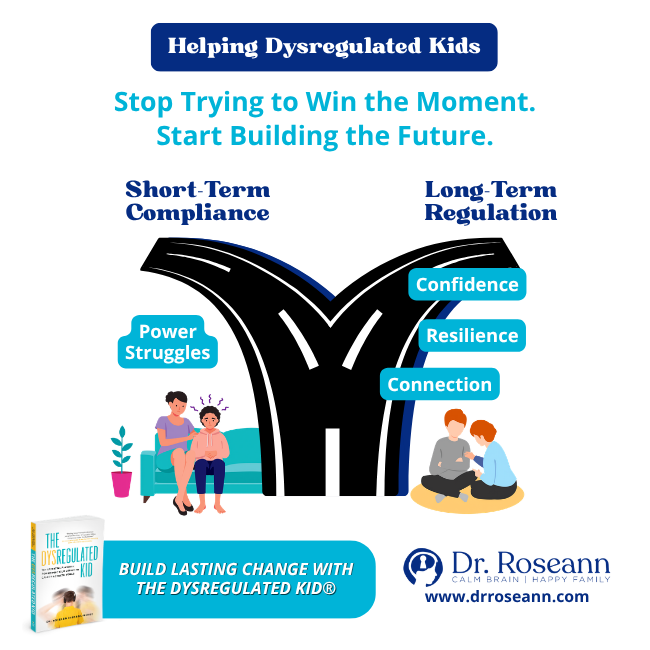
Breaking the real reason power struggles keep happening starts with interrupting the pattern—not winning the argument.
I teach parents a simple but powerful shift called the Love Pause. It's a 3-second interruption that changes everything.
Here's how it works:
- Pause before reacting (3 seconds)
- Breathe or ground your body
- Lower your voice and slow your movements
- Respond from regulation, not reactivity
VISUAL: "Love Pause reset"
- Stop
- Breathe
- Soften
- Connect
Once you interrupt the loop, you stop feeding it. And over time, the intensity, frequency, and duration of power struggles begin to decrease.
This is exactly what I teach inside The Dysregulated Kid—how to break these patterns step by step so your home feels calmer and more connected.
"Power struggles don't just repeat because your child is difficult—they repeat because the nervous system loop never changes."
— Dr. Roseann
You're not stuck—you're in a pattern that can be changed
If it feels like you're having the same argument over and over again, it's because you are caught in a predictable nervous system cycle—not a parenting failure.
And here's the hopeful truth: once you learn how to regulate first, everything starts to shift. The escalation shortens. The intensity softens. Connection returns.
You don't have to be perfect. You just have to be regulated enough in key moments to interrupt the loop.
Start there. That's where change begins. For more support, explore helpful resources like the Regulated Child Summit and Quick CALM.
And remember—it's gonna be OK. You're not alone in this, and your child's brain can learn a new way.
What looks like refusal or defiance can be a nervous system struggling with overwhelm, flexibility, or control. The Dysregulated Kid® helps you look beneath the behavior and use Regulation First Parenting® to reduce power struggles, build cooperation, and teach skills when the brain is ready. Get The Dysregulated Kid® at dysregulatedkid.com.
FAQs
Why does my child escalate so quickly during conflicts?
Their nervous system shifts into survival mode faster than it can return to calm. Once dysregulated, logic and reasoning go offline, making escalation more likely.
How can I calm a dysregulated child in the moment?
Focus on your own regulation first. Lower your voice, slow your body, and connect emotionally before trying to correct behavior.
Is my child being defiant or dysregulated?
Often what looks like defiance is actually a stress response. The key difference is whether your child can access thinking skills in that moment.
What is the fastest way to stop power struggles?
Interrupt the pattern early. Pause, regulate yourself, and respond calmly instead of reacting emotionally.
Tired of not knowing what's really going on with your child? The Solution Matcher gives you a personalized recommendation based on your child's behavior, not just a label. It's free, takes just a few minutes, and shows you the best next step. Go to drroseann.com/help
Dr. Roseann Capanna-Hodge is a licensed therapist, certified school psychologist, and leading expert in emotional dysregulation in children. With over 30 years of experience, she helps parents understand the root causes of meltdowns, anxiety, ADHD, and challenging behavior through the lens of nervous system regulation. Dr. Roseann teaches practical, science-backed strategies for co-regulation and how to calm a dysregulated child using her Regulation First Parenting® approach. She is the host of the Dysregulated Kids Podcast and author of The Dysregulated Kid.

Find this helpful? Leave us a review!
Your feedback helps more overwhelmed parents find calm, clarity, and the proven tools that make everyday life easier.
Dr. Roseann Capanna-Hodge: Helping Families of Dysregulated Kids Thrive Through Regulation First Parenting®
As the creator of Regulation First Parenting®, she’s helping families of dysregulated kids discover a compassionate, brain-based path forward. Through The Dysregulated Kids™ Podcast (top 2% globally), she offers practical strategies that help parents understand their child’s brain and support lasting change.
Through The Global Institute of Children’s Mental Health and Dr. Roseann, LLC, she’s created resources like the Neurotastic® Brain Formulas and the Regulation First Parenting® framework—meeting families where they are and supporting them through challenges like ADHD, anxiety, OCD, PANS/PANDAS, and behavioral struggles.
Recognized by Forbes as “a thought leader in children’s mental health,” Dr. Roseann is changing how we understand emotional dysregulation in children—one family at a time.