
Join the Dysregulation Insider get free calm parenting tips straight to your inbox!
YES, I'M IN!What is OCD in Kids? | Emotional Dysregulation in Children | E36





Estimated reading time: 7 minutes
When your child is spiraling with endless questions, rituals, or terrifying intrusive thoughts, you may be asking, what is OCD and how is it different from anxiety in children? Your childs' brain is stuck in fear. This is part of the stress response in children, especially in kids with big emotions.
In this episode, I break down what OCD really is, why so many kids hide it, and how parents can finally recognize the signs so they can start calming the brain and helping their child feel safe again.
This is where Regulation First Parenting® becomes essential.
Why does my child keep asking the same questions even after I answer?
Excessive reassurance seeking is one of the most common—but misunderstood—signs of OCD. Your child isn’t trying to annoy you; their brain is stuck in an irrational fear loop. The more you answer, the more their brain demands.
This is how the OCD loop keeps growing.
OCD tells them: “If I don’t get reassurance, something bad will happen.”
What’s really going on:
- Their intrusive thoughts feel real and dangerous
- Their brain can’t rationalize
- The compulsion (asking again) provides temporary relief
- Parent reassurance unintentionally strengthens the cycle
Try instead:
- Reduce the reassurance gently
- Validate the feeling, not the fear (“I know this feels scary”)
- Model calm breathing or grounding
- Use consistent language like: “That sounds like OCD talking.”
Parent Story: A mom shared that her daughter asked, “Are you sure the door is locked?” 18 times every night. When Mom learned to stop accommodating and instead responded, “I know this worry feels strong—and I believe you can handle it,” the cycle slowly weakened.
Why does my child hide their OCD symptoms?
Kids—especially bright or anxious ones—often hide their compulsions and thoughts because they feel ashamed or confused. Their thoughts can feel bizarre, dark, or frightening.
Kids often hide OCD because:
- They know the thoughts “don’t make sense”
- They fear adults will think they’re “crazy”
- The sensations are uncomfortable and hard to explain
- They’re trying to stay in control
Important note: Dark or disturbing thoughts are a symptom—not a reflection of who your child is.
Parent Story: A 10-year-old boy was convinced saying certain words would “make something bad happen” to his family. He hid this for months until the compulsions took over bedtime. Once his parents understood this was OCD—not behavior—everything shifted. Yelling less and staying calm isn’t about being perfect—it’s about having the right tools.
Join the Dysregulation Insider VIP list and learn how to calm your child without yelling, even during the hardest moments and get your FREE Regulation Rescue Kit, designed to help you handle oppositional behaviors without losing it.
Download it now at www.drroseann.com/newsletter
How is OCD different from anxiety in kids?
Anxiety comes from a real or anticipated stressor. OCD doesn’t need an actual trigger. The brain just hijacks itself.
This is a stress-driven brain pattern, not a behavior choice.
OCD tends to:
- Show up suddenly
- Latch onto irrational or nonsensical fears
- Create compulsions that temporarily soothe the fear
- Become consuming (1+ hour/day)
Anxiety tends to:
- Be tied to real-life stressors
- Show up in predictable patterns
- Respond to emotional support or problem-solving
It’s not bad parenting—it’s a dysregulated brain.
How do I know if my child has OCD—not just anxiety or quirky habits?
Look at the frequency, intensity, and impact. OCD disrupts daily life and often includes intrusive thoughts that feel uncontrollable. These thoughts are part of the brain’s fear response, not reality.
Possible signs of pediatric OCD:
- Repetitive questioning
- Bedtime rituals with panic if interrupted
- Fear something bad will happen if they don’t perform an action
- Checking, washing, counting, or repeating
- Patterns of all-day anxiety plus hidden compulsions
Real-Life Scenario: A child who must have a parent sleep next to them “or something bad will happen” may be experiencing OCD-driven fear—not separation anxiety.
🗣️ “OCD is rooted in irrational fear. These thoughts don’t make sense, and they don’t have to be real for your child to feel terrified. Behavior is communication from a dysregulated brain.” — Dr. Roseann
Takeaway
OCD is not a behavior problem. It is a fear-based brain pattern connected to the stress response in children.
When you understand what’s really going on, you can stop accommodating the fear and start calming the brain instead.
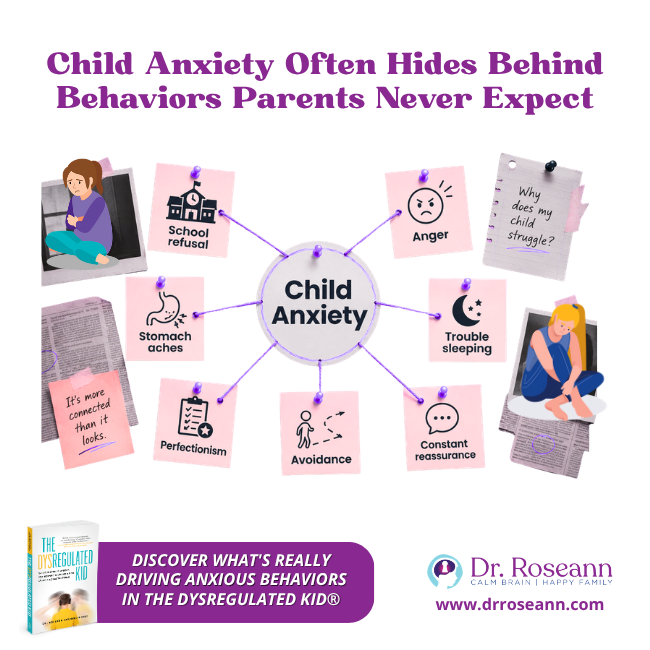
OCD in kids can look like obvious rituals, but it can also hide behind perfectionism, repeated questions, avoidance, bedtime struggles, irritability, getting stuck, or needing things to feel “just right.” In The Dysregulated Kid®, I help parents look beneath behavior and understand what the nervous system may be communicating. When you can recognize dysregulation and separate the child from the behavior, you’re better able to respond with connection, appropriate boundaries, and the right professional support instead of assuming your child is simply being difficult. Get The Dysregulated Kid® at dysregulatedkid.com.
FAQs
Does OCD always include compulsive behaviors?
Not always. Some kids have “pure O” OCD with mostly intrusive thoughts, but the fear pattern is the same.
Can anxiety turn into OCD?
Yes. Anxiety can become hijacked when the brain starts using compulsions to manage fear.
Are dark intrusive thoughts normal in OCD?
Yes. They’re a symptom—not truth or intent.
Can kids outgrow OCD?
With the right supports—ERP, brain-based calming, and parent strategies—kids can significantly improve.
Is reassurance bad for OCD?
Not “bad,” but it strengthens the OCD cycle. Reducing reassurance helps kids build tolerance.
When your child is struggling, time matters.Don’t wait and wonder—use the Solution Matcher to get clear next steps, based on what’s actually going on with your child’s brain and behavior.
Take the quiz at www.drroseann.com/help
Dr. Roseann Capanna-Hodge is a licensed therapist, certified school psychologist, and leading expert in emotional dysregulation in children. With over 30 years of experience, she helps parents understand the root causes of meltdowns, anxiety, ADHD, and challenging behavior through the lens of nervous system regulation. Dr. Roseann teaches practical, science-backed strategies for co-regulation and how to calm a dysregulated child using her Regulation First Parenting® approach. She is the host of the Dysregulated Kids Podcast and author of The Dysregulated Kid.
Dr. Roseann Capanna-Hodge
Emotional Dysregulation in Children & Nervous System Expert
Regulation First Parenting® | CALMS Protocol™
Host of the Dysregulated Kids Podcast (Top 1% Globally)
Author of The Dysregulated Kid

Find this helpful? Leave us a review!
Your feedback helps more overwhelmed parents find calm, clarity, and the proven tools that make everyday life easier.
Dr. Roseann Capanna-Hodge: Helping Families of Dysregulated Kids Thrive Through Regulation First Parenting®
As the creator of Regulation First Parenting®, she’s helping families of dysregulated kids discover a compassionate, brain-based path forward. Through The Dysregulated Kids™ Podcast (top 2% globally), she offers practical strategies that help parents understand their child’s brain and support lasting change.
Through The Global Institute of Children’s Mental Health and Dr. Roseann, LLC, she’s created resources like the Neurotastic® Brain Formulas and the Regulation First Parenting® framework—meeting families where they are and supporting them through challenges like ADHD, anxiety, OCD, PANS/PANDAS, and behavioral struggles.
Recognized by Forbes as “a thought leader in children’s mental health,” Dr. Roseann is changing how we understand emotional dysregulation in children—one family at a time.