





Estimated reading time: 11 minutes
A dysregulated child calms down when you first reduce sensory and emotional overwhelm through co-regulation, a calm presence, and simple grounding strategies before expecting any change in behavior.
It usually starts small—maybe a shift in your tone or a simple request—and then suddenly, emotions explode. Your child can go from calm to yelling, crying, shutting down, or melting down in seconds, leaving you wondering what happened and what you should do next.
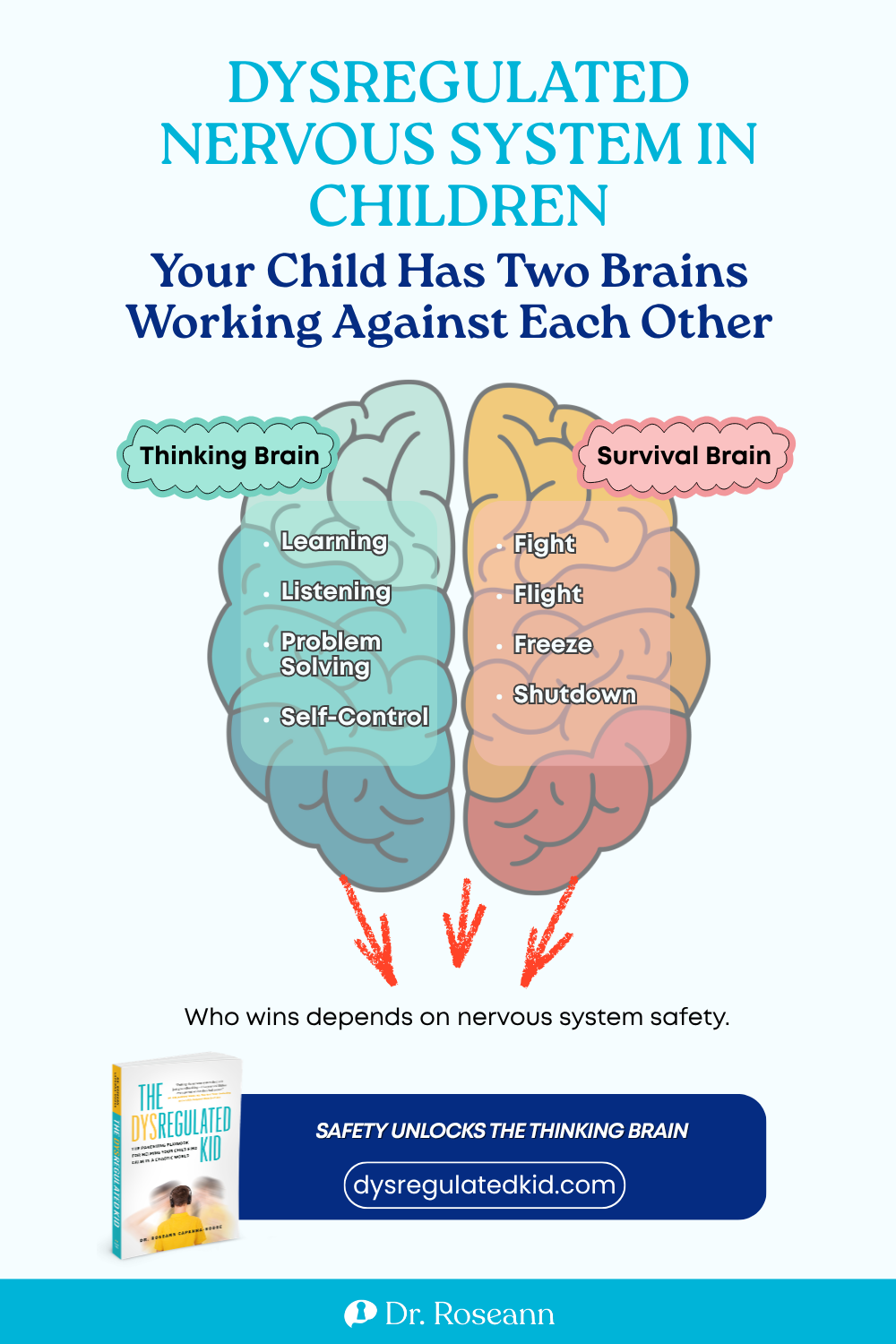
Supporting nervous system regulation in children helps you respond in ways that lower stress rather than add to it. And I know how exhausting it is when it feels like nothing works—whether you’ve tried consequences, reasoning, anticipating every trigger, or changing the entire family routine to prevent the next blowup.
I’m Dr. Roseann, author of The Dysregulated Kid, who has spent more than 30 years helping families understand and support emotional and behavioral regulation. I work with parents every day who feel overwhelmed by meltdowns, shutdowns, defiance, anxiety, and behaviors that seem to come out of nowhere.
What I want you to know is this: behavior is communication. When a child is dysregulated, their behavior is often telling us that their nervous system is overwhelmed and they need support getting back to a regulated state.
That’s why I always start with regulation first.
Watch Dr. Roseann explain how to calm a dysregulated child by helping the nervous system feel safe enough to regulate.
What You’ll Learn:
- What a dysregulated child truly needs in the moment to calm down
- Why traditional discipline strategies can increase dysregulation
- Effective tools to support calm at home, school, and in public settings
What is Emotional Dysregulation?
Emotional dysregulation means a child has difficulty managing strong emotions and returning to a calmer baseline after stress, disappointment, frustration, or sensory overload.
Their reaction may seem much bigger than what just happened because they don't yet have enough access to the skills and support they need to pause, recover, and respond differently.
This is why your own regulated presence matters so much. Before children can consistently create their own calm, they often need to experience it alongside a regulated adult.
Why Does Emotional Dysregulation Happen?
The nervous system plays an important role in emotional regulation.
Too much stimulation, too little stimulation, stress, sensory overload, transitions, sleep disruption, anxiety, frustration, and other factors can all affect how easily a child regulates.
Some children simply reach their threshold faster than others.
Understanding what is underneath the behavior changes the question from:
“How do I make this stop?”
to:
“What does my child need in order to regulate?”
7 Ways to Calm a Dysregulated Child in the Moment
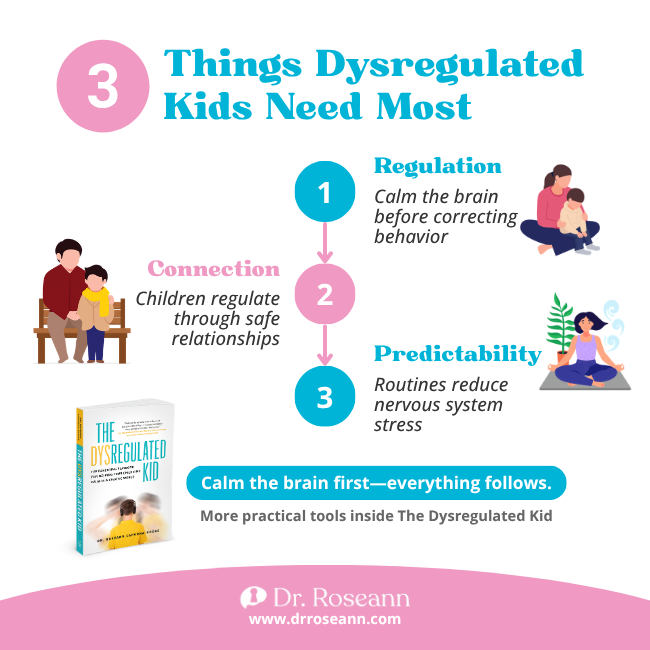
When your child is already overwhelmed, calm the nervous system before trying to correct the behavior. Keep your words short, reduce demands, and focus on helping their body feel safe enough to settle.
1. Regulate Yourself First
What to do: Slow your breathing, soften your face and voice, and give yourself a few seconds before responding.
Why it works: Your child takes cues from your tone, body language, and emotional state. A calmer adult creates better conditions for co-regulation.
2. Lower Your Voice and Use Fewer Words
What to do: Speak softly and keep directions simple.
“I’m here. You’re safe. We’ll figure this out.”
Why it works: A dysregulated child has less capacity to process long explanations, questions, or lectures in the moment.
3. Reduce Sensory Input
What to do: Dim the lights, lower noise, move away from crowds, or remove unnecessary stimulation when possible.
Why it works: When sensory input is contributing to overwhelm, reducing it gives your child less information to manage while their nervous system settles.
4. Get Low and Stay Close Without Crowding
What to do: Kneel, sit nearby, or position yourself at your child’s level instead of standing over them. Give more physical space when they need it.
Why it works: Your calm, non-threatening presence can communicate safety without adding another demand.
5. Use Movement or Body-Based Regulation
What to do: Try walking, rocking, pushing against a wall, stretching, squeezing a stress ball, or another familiar movement your child finds regulating.
Why it works: Many children find physical input helpful when stress has built up in their bodies.
6. Offer a Simple Grounding Tool
What to do: Try slow breathing, cold water, humming, holding a comforting object, or noticing a few things your child can see, hear, or feel.
Why it works: Grounding gives your child something simple and present-focused to return their attention to instead of continuing to engage with the trigger.
7. Connect Before You Correct
What to do: Wait until your child is calmer before discussing what happened, setting consequences, problem-solving, or teaching a better response.
Why it works: Once the intensity has come down, your child has more capacity to listen, think, reflect, and learn.
“Calm the brain first, and everything else follows.”
What Not to Do When Your Child Is Dysregulated
Avoid yelling, threatening, lecturing, rapid-fire questions, or trying to reason with your child in the middle of a meltdown.
Trying to punish or teach during peak dysregulation can simply add more stress when your child is already struggling to process what is happening.
That doesn’t mean boundaries disappear.
It means you regulate first and teach later, once your child is calm enough to understand and participate.
Why Parent Emotional Regulation Is the Most Important Skill You Can Learn
Here’s something parents don't always love hearing: your own regulation is a huge part of helping your child learn to regulate.
That can feel like a lot of responsibility when you’re already tired, worried, or overwhelmed. But it is also empowering because your child has access to your support before they have fully developed the ability to regulate independently.
Your child doesn't only respond to what you say. They notice your voice, facial expression, pace, tension, breathing, and body language.
When you become activated too, it becomes harder for either of you to return to calm.
What Is Parent Emotional Regulation?
Parent emotional regulation is your ability to manage your own emotional response during difficult interactions with your child.
It doesn’t mean you never feel angry, frustrated, scared, or overwhelmed.
It means learning to:
- Recognize when your own nervous system is becoming dysregulated
- Pause before reacting to challenging behavior
- Use a regulation strategy for yourself
- Respond from a calmer state instead of immediately reacting
Quick Parent Emotional Regulation Strategies for Crisis Moments
- Take a five-second pause: Give yourself several slow breaths before responding.
- Step away safely: If your child is safe and you feel yourself escalating, give yourself a brief reset.
- Change what your body is doing: Splash cool water on your face, move your body, unclench your jaw, or squeeze a stress ball.
- Use a mantra: “This is not an emergency. My child is having a hard time. I can be their calm.”
How to Build Self-Regulation Skills for Children
Once children experience consistent co-regulation, you can begin strengthening their own self-regulation skills.
Self-regulation means learning to manage emotions, impulses, and behaviors more effectively. It isn't something children magically know how to do. Like any skill, it develops through practice, coaching, repetition, and support.
Age-Appropriate Self-Regulation Skills to Teach
| Age | Self-Regulation Skills to Teach |
|---|---|
| Ages 2–4 | Calm-down space with soft or familiar objects; counting slowly; asking for a hug or help; naming simple feelings |
| Ages 5–7 | Feelings check-ins; belly breathing; using a stress ball; asking for a break |
| Ages 8–10 | Using a feelings thermometer; pausing before responding; drawing or journaling feelings; recognizing personal trigger patterns |
| Ages 11–14 | Mindfulness tools; recognizing body stress signals; building a personalized calm toolbox with several go-to strategies; practicing supportive self-talk |
How to Practice Self-Regulation During Calm Moments
Self-regulation skills are much easier to learn when your child is already calm.
Practice breathing, emotional check-ins, movement, or “What would you do if…?” scenarios for a few minutes when there is no crisis happening.
Think of it like a fire drill. You practice the skill before you need it so the response becomes familiar.
And remember that building self-regulation skills in children is a long-term developmental process.
Every time your child identifies an emotion, asks for help, pauses before reacting, or tries a coping strategy, they are practicing.
How to Calm a Dysregulated Child Without Yelling
When you're learning how to calm your child without yelling, the first step is regulating yourself.
Your voice, facial expression, body posture, and pace all become part of your child's environment during a meltdown. Yelling adds more intensity to a nervous system that is already overwhelmed.
Instead, lower your voice, move to your child's level, use fewer words, and stay physically present without crowding them.
The goal isn't to control the behavior in the moment. It's to help your child become regulated enough to access the skills they already have.
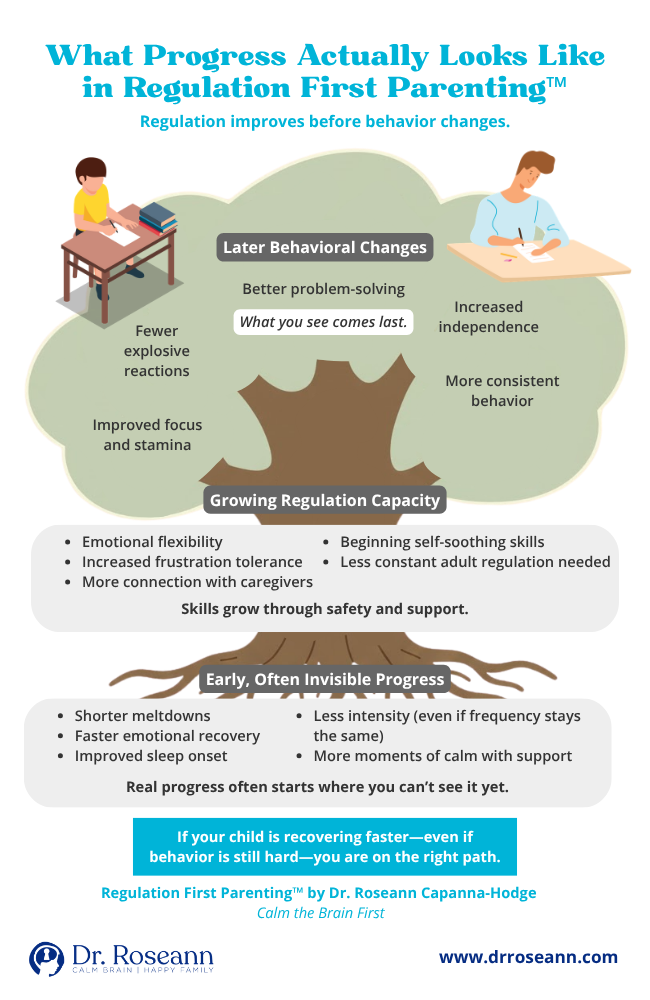
This is the foundation of Regulation First Parenting®.
How to Calm a Dysregulated Child at School
Knowing how to calm a dysregulated child at school matters because school adds demands that may not exist in the same way at home: noise, transitions, peers, academic expectations, limited movement, social pressure, and less control over the environment.
The goal remains the same:
Reduce overwhelm before increasing demands.
1. Reduce Verbal Demands
Use short, calm instructions rather than asking multiple questions while the child is overwhelmed.
Instead of:
“Why are you doing this? What happened? You know you're supposed to be sitting down.”
Try:
“You’re having a hard time. Let’s get calm first.”
2. Offer a Predictable Regulation Space
Identify a quiet, supervised place the child can use when they begin to feel overwhelmed.
It should function as a regulation tool—not a punishment.
3. Build in Movement
A brief walk, stretching, wall pushes, carrying books, or another familiar movement break can give some children a productive way to reset.
4. Reduce Sensory Overload
When possible, lower noise, reduce visual stimulation, use headphones when appropriate, or allow the child to move away from a crowded space.
5. Use a Familiar Calming Cue
Use a simple phrase the child already recognizes.
“Let’s get your body calm first.”
A familiar cue requires much less processing than a long explanation.
6. Delay Problem-Solving Until the Child Is Regulated
The middle of a meltdown isn't the best time to talk about consequences, missing work, peer conflict, or what should have happened differently.
Regulate first, then return to the problem.
Parents and teachers can also partner on a consistent regulation plan.
Sharing known triggers, early warning signs, sensory needs, calming strategies, and language that already works for the child can make support more predictable across home and school.
How to Regulate Your Child’s Nervous System Long-Term
Parents often ask both “How do you calm a dysregulated child’s nervous system?” and “How can I help regulate my child’s nervous system?”
The answer is partly about what you do during a hard moment, but long-term regulation is really about helping your child build more capacity before the next hard moment happens.
That means creating predictable routines, supporting sensory and physical needs, practicing regulation skills when your child is calm, and paying attention to the patterns that repeatedly push them into overwhelm.
Build Daily Regulation Habits
The nervous system responds best to consistency and repetition. You don’t need a complicated routine, but your child does benefit from having predictable ways to regulate throughout the day.
Focus on:
- Consistent sleep and wake times so your child isn’t starting the day already depleted
- Regular movement, outdoor time, and physical activity
- Predictable routines and transitions so fewer things feel sudden or uncertain
- Sensory support that matches your child’s needs, such as quiet spaces, headphones, movement, or calming input
- Balanced meals and regular snacks to support steady energy
- Emotional check-ins so your child learns to notice feelings before they become overwhelming
- Practicing self-regulation skills while calm, not only during a meltdown
The goal is to make regulation part of everyday life instead of something you only think about when your child is already dysregulated.
Social situations can also be a major source of overwhelm. Role-play difficult situations, talk with teachers, and help your child know how to ask for space or support before stress builds.
Use Regulation Tools Before, During, and After Dysregulation
Different tools work at different stages of dysregulation. The key is knowing when to use them.
Some children respond well to:
- Heavy work activities such as wall pushes, carrying appropriately weighted objects, or squeezing putty
- Rhythmic movement such as walking, rocking, swaying, or swinging
- Deep pressure when the child enjoys and seeks that type of input
- Simple breathing exercises
- Sensory reduction, including less noise, light, screen input, or activity
- Cool sensory input, such as cold water or a cool cloth
- Nature and outdoor time
- Music, rhythm, singing, or humming
- Co-regulation with a calm, steady adult
Use these tools differently depending on what your child needs.
Before escalation: Build in movement, sensory breaks, outdoor time, and predictable routines.
During early escalation: Reduce demands and stimulation, and use familiar regulation tools your child already knows.
During or after a meltdown: Prioritize safety, quiet, low demands, co-regulation, and recovery.
A tool that works beautifully before a meltdown may feel like too much during one, so always pay attention to your child’s cues.
Address What Is Driving the Dysregulation
Long-term regulation also means looking beneath the behavior.
Some children become dysregulated more easily because of sensory sensitivity, sleep problems, accumulated stress, anxiety, transitions, social demands, environmental chaos, or a naturally more reactive temperament.
Instead of only asking:
“How do I calm this down?”
also ask:
“What keeps pushing my child into overwhelm?”
Patterns are useful information.
If dysregulation tends to happen after school, during transitions, in noisy environments, when your child is hungry, or after a poor night of sleep, that gives you something concrete to work with.
The more you understand the triggers, early warning signs, and recovery patterns, the easier it becomes to support regulation before your child reaches the breaking point.
Over time, reinforce the small moments when your child asks for help, notices a trigger, takes a break, or uses a coping tool. Those are the building blocks that help them learn to regulate emotions more effectively.
Long-term regulation isn’t about preventing every meltdown.
It’s about helping your child recover more easily, recognize what they need, and build stronger regulation skills over time.
When Calming a Dysregulated Child Needs a Bigger Framework
A breathing exercise, movement break, sensory tool, or quiet moment can absolutely help.
But no single technique works in every hard moment.
The bigger goal is to notice what your child needs, regulate yourself first, recognize patterns, and return to a consistent supportive approach over time.
The Dysregulated Kid® gives parents a deeper framework for doing exactly that, including practical ways to respond when behavior is communicating overwhelm instead of simply assuming defiance.
Calming a Dysregulated Child With ADHD
Children with ADHD may become dysregulated when frustration, impulsivity, transitions, sensory input, or executive functioning demands exceed their capacity.
Use the same regulation-first approach above, but pay particular attention to movement needs, transitions, reduced verbal demands, and giving your child a clear way to request a break.
Once they are regulated, help them practice noticing triggers, pausing, and choosing a coping strategy before overwhelm builds.
Calming a Dysregulated Autistic Child
For an autistic child, dysregulation may be connected to sensory overload, unexpected change, communication demands, transitions, or accumulated stress.
Follow the same regulation-first principles while recognizing that eye contact, touch, talking, or one particular calming strategy may not feel regulating for every autistic child.
Prioritize the supports your child already finds predictable and safe, such as quiet, movement, familiar sensory input, physical space, or support from a trusted adult.
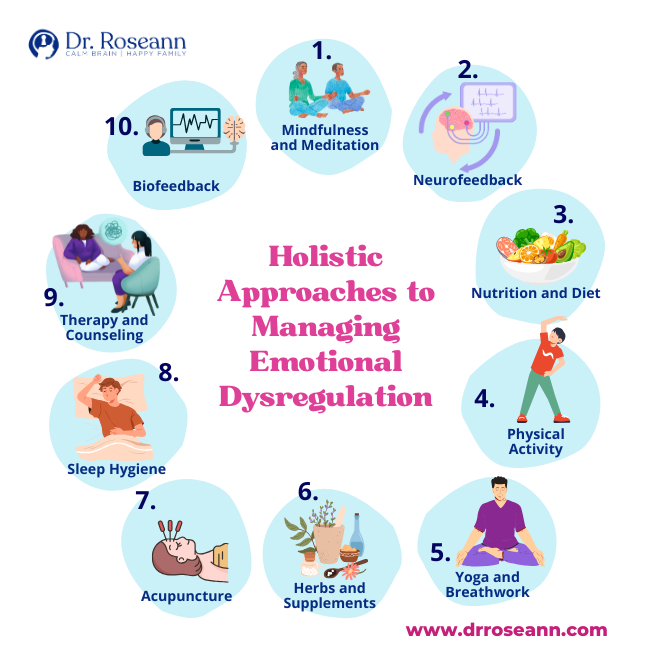
What are the Holistic Approaches to Managing Emotional Dysregulation?
Managing emotional dysregulation isn't only about stopping meltdowns.
It's about seeing the whole child and looking at what may be contributing underneath the behavior.
Supporting the nervous system, physical wellness, emotional skills, sleep, relationships, sensory needs, and environment gives children a stronger foundation for regulation.
1. Mindfulness and Meditation
Mindfulness helps children notice thoughts, emotions, and physical sensations before automatically reacting.
Breathing exercises and simple mindfulness practices can be especially useful when they're practiced while a child is already calm.
2. Neurofeedback
Neurofeedback gives people real-time information about patterns of brain activity and is used to help train brain regulation.
Dr. Roseann uses neurofeedback as one component of her clinical work supporting children and families.
3. Nutrition and Diet
What children eat supports their overall brain and body health.
A nutrient-rich diet that includes protein, whole foods, healthy fats, and important nutrients can form part of a broader wellness approach.
4. Physical Activity
Exercise gives children an outlet for physical energy and stress.
Walking, yoga, outdoor play, sports, dancing, or simply moving together can support overall well-being while giving families another opportunity to connect.
5. Herbs and Supplements
Some families also explore herbs and nutritional supplements as part of a broader wellness plan.
Because supplements vary in quality and can interact with medications or health conditions, parents should work with an appropriately qualified professional when considering them for a child.
6. Acupuncture
Some families use acupuncture as a complementary wellness approach alongside other mental and physical health supports.
7. Sleep Hygiene
Have you ever noticed how much harder everything feels after your child hasn't slept?
Poor sleep can make frustration, attention, emotional recovery, and stress management much harder.
A consistent routine, calming wind-down period, and lower stimulation before bed can support healthier sleep habits.
8. Therapy and Counseling
Therapy gives children a structured place to develop language for their feelings, understand patterns, and learn strategies for managing difficult emotions and experiences.
CBT and other therapeutic approaches may help children change patterns of thinking and behavior, depending on their individual needs.
Research also shows an important relationship between emotional dysregulation and mental health concerns such as depression and PTSD (Bailen & Thompson, 2023).
9. Parenting Support
Emotional dysregulation does not define your child.
I want you to see it as information—a sign that your child's nervous system and emotional skills may need more support.
When you understand what is happening beneath the behavior, you can respond with more clarity and less reactivity.
Parent Action Steps:
- Stay calm and co-regulate to help your child feel safe and grounded.
- Label emotions to build emotional awareness.
- Prioritize sleep and predictable routines.
- Create a sensory-friendly space.
- Teach coping skills such as deep breathing, movement, or asking for a break.
- Practice regulation skills during calm moments.
- Recognize small wins as your child builds greater capacity.
FAQs
How do I know if my child is emotionally dysregulated or just having a bad day?
A bad day happens to every child. Emotional dysregulation is more of a repeated pattern.
You may notice frequent overwhelm, intense responses to relatively small triggers, difficulty recovering, or reactions that regularly interfere with home, school, relationships, or everyday routines.
Is emotional dysregulation something my child will outgrow?
Emotional regulation naturally develops as children grow, but persistent dysregulation doesn't necessarily disappear simply with age.
When children receive consistent support, co-regulation, opportunities to practice skills, and appropriate professional help when needed, they can build much stronger self-regulation skills over time.
What’s the first thing I should do when my child is melting down?
Start with your own regulation.
Lower your voice, slow down, reduce stimulation and demands, and avoid immediately trying to teach or correct.
Your first priority is helping your child begin to feel safe enough to regulate.
Can a dysregulated brain lead to other mental health concerns?
Emotional dysregulation commonly occurs alongside concerns such as ADHD, anxiety, autism, mood difficulties, and trauma-related symptoms.
When dysregulation is frequent or significantly affects daily functioning, identifying the underlying contributors and getting appropriate support can make a meaningful difference.
When should I seek the help of a mental health professional for my child?
Consider professional support when emotional dysregulation is frequent, intense, worsening, interfering with school or relationships, creating safety concerns, or significantly affecting family life.
A qualified professional can help identify what may be contributing to the dysregulation and what type of support is appropriate.
How can I calm down a dysregulated child quickly in the moment?
To calm down a dysregulated child, start with co-regulation.
Use a calm voice, reduce stimulation and demands, say less, and offer simple regulation tools such as breathing, movement, sensory support, or quiet.
Don't rush into consequences or problem-solving before your child has begun to settle.
What are the signs of a dysregulated child?
Common signs of a dysregulated child include frequent meltdowns, irritability, impulsive behavior, difficulty with transitions, shutting down, sensory overwhelm, intense reactions to frustration, and difficulty calming after becoming upset.
Look for repeated patterns rather than one isolated incident.
Why does my child become dysregulated so easily?
A child may become dysregulated more easily when stress, sensory input, transitions, poor sleep, frustration, emotional demands, or underlying developmental or mental health needs exceed their current ability to cope.
Understanding the trigger can help you choose a more effective response.
What strategies help with calming a dysregulated child long-term?
Long-term support often includes consistent routines, co-regulation, practicing coping skills, adequate sleep, movement, sensory support, nutrition, emotional awareness, and daily nervous system regulation.
The goal is to build your child's overall capacity to regulate rather than simply stopping individual meltdowns.
How Do I Calm My Child Down When They’re Angry?
When your child is angry, regulate before you reason.
Lower your voice, reduce demands, give them physical space if needed, and offer a familiar calming strategy such as movement, breathing, sensory support, or simply your quiet presence.
Once their body has settled, help them identify what happened, name the emotion, and think through what they can do differently next time.
Citations
Bailen, N. H., & Thompson, R. J. (2023). Emotion dysregulation. In D. J. A. Dozois & K. S. Dobson (Eds.), Treatment of psychosocial risk factors in depression (pp. 181–206). American Psychological Association. https://doi.org/10.1037/0000332-009
O'Brien, K. S., & Nelson, R. H. (1976). Sensory input and its relevance to psychotherapeutic procedures. Psychotherapy: Theory, Research & Practice, 13(3), 274–279. https://doi.org/10.1037/h0088355
Dr. Roseann is a mental health expert in Self-Regulation who frequently appears in the media:
- Parade — Psychologists Reveal: You’ve ‘Succeeded’ as a Parent if Your Adult Child Has These 11 Subtle Habits
- Healthline — Understanding Self-Regulation Skills
- Scary Mommy — What Is Self-Regulation In Children, And How Can You Help Improve It?
- HomeschoolOT Therapy Services — Understanding Nervous System Dysregulation in Children: A Guide for Homeschool Parents
Get Dr. Roseann’s complimentary gift!
©Roseann Capanna-Hodge
Anxiety and dysregulation often co-occur. The Dysregulated Kid includes practical guidance for parents managing both.
Always remember…
“Calm Brain, Happy Family™”
Disclaimer: This article is not intended to give health advice, and it is recommended to consult with a physician before beginning any new wellness regime. The effectiveness of diagnosis and treatment varies by patient and condition. Dr. Roseann Capanna-Hodge, LLC does not guarantee certain results.
Are you looking for SOLUTIONS for your struggling child or teen?
Dr. Roseann and her team are all about science-backed solutions, so you are in the right place!
Meet the Expert
Licensed Therapist | Certified School Psychologist
Board Certified in Neurofeedback (BCN) | 30+ Years Clinical Experience
Expert in Emotional Dysregulation in Children and Nervous System Regulation
Host, Dysregulated Kids Podcast | Author, The Dysregulated Kid
Dr. Roseann Capanna-Hodge is a licensed therapist, certified school psychologist, and leading expert in emotional dysregulation in children and nervous system regulation. With over 30 years of clinical experience and having analyzed more than 10,000 brain maps, she helps families understand what behavior is really signaling—and how to calm the nervous system first so real change can happen.
She is the creator of Regulation First Parenting® and the CALMS Protocol™, host of the top 1% podcast Dysregulated Kids, and author of The Dysregulated Kid.