




Estimated reading time: 14 minutes
ADHD therapy activities for children are structured, brain-based strategies that help improve focus, emotional regulation, and impulse control by calming the nervous system first.
If your child can’t sit still, melts down over small things, or seems to ignore everything you say, it’s exhausting. You’ve probably tried charts, consequences, maybe even therapy—and still wonder, Why isn’t anything sticking? You’re not failing.
The truth is, ADHD isn’t a behavior problem—it’s a regulation problem. And when a child’s brain is dysregulated, traditional strategies simply don’t work.
I’m Dr. Roseann Capanna-Hodge, and for more than three decades, I’ve helped families pinpoint the neurological drivers of dysregulation in children with ADHD and use proven, science-backed strategies to support real change.
In this guide, you'll find:
37 activities, organized by the skill you want to practice, with suggested ages, materials, and simple instructions.
These are targeted ADHD therapy activities to build focus, emotional control, and resilience.
Most are parent-led, offline activities you can adapt at home or discuss with your child’s therapist or teacher.
What Are ADHD Therapy Activities?
ADHD therapy activities are structured opportunities to practice attention, coping, impulse control, movement, communication, and everyday routines. A therapist may use activities within treatment; parents can also use playful practice at home.
The activity should have a clear purpose. Instead of simply handing over a puzzle, you might practice following one direction, asking for help, or returning after a break.
These activities can fit into a broader support plan. They don’t need to become another thing your family must do perfectly.
What does the research say? A randomized trial of a structured play-based program for preschoolers with ADHD found improvements in both the play-based group and a parent-education-and-support group. The play-based program did not produce significantly greater improvements in ADHD symptoms or impairment (Halperin et al., 2020).
That distinction matters: practicing a skill through a game is different from proving that the game treats ADHD.
Keep the goal concrete: What are we practicing today?
How to Choose an ADHD Activity for Your Child
Choose an activity based on one current challenge, your child’s developmental abilities, and what they enjoy. Start with something easy enough to explain and inviting enough to try.
Use this guide to find the relevant group:
| Your child needs help with… | Start here | Setting and suggested ages |
|---|---|---|
| A transition or big feeling | Start-Here Calming (1–7) | Home or classroom; preschool through teens |
| Starting homework or staying with a task | Attention Builders (8–16) | Home or classroom; elementary through teens |
| Waiting, interrupting, or acting quickly | Impulse-Control Games (17–23) | Home or classroom; preschool through teens, with simplified rules |
| Restlessness or high energy | Regulating Movement (24–30) | Home, outdoors, or classroom; ages depend on the activity |
| Peer interaction | Social + Communication Practice (31–34) | Home or classroom; elementary through teens |
| Schoolwork routines | Home–School Success (35–37) | Home or classroom; elementary through teens |
The ages throughout this article are practical suggestions, not validated treatment age ranges. Adjust the language, materials, and difficulty to your child.
Before starting, ask yourself:
- What is our one practice goal?
- Can my child understand the rule?
- Would fewer steps or less noise make this easier?
- Does my child want to join me?
One game is enough to begin. We are building a routine, not opening a summer camp in the living room.
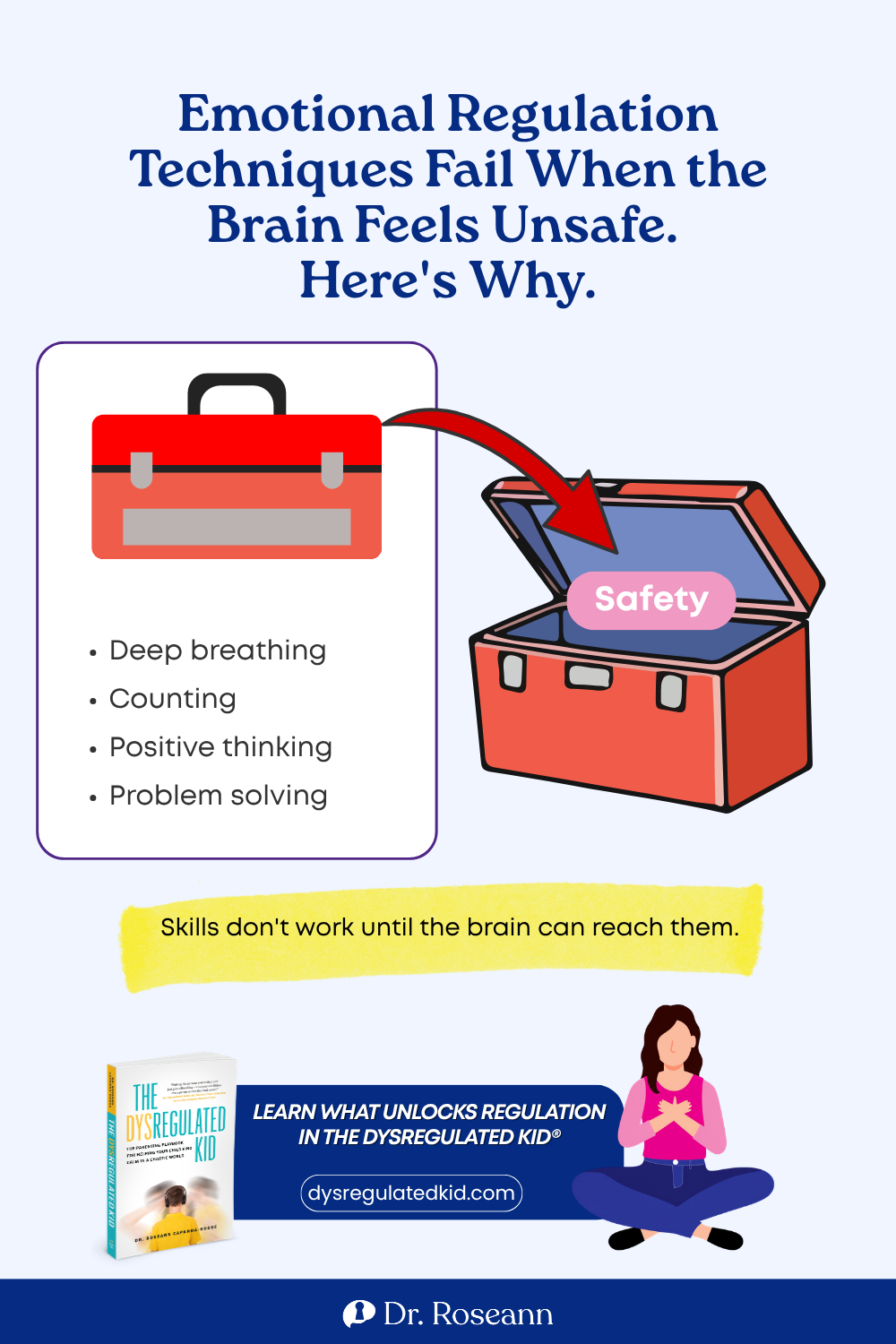
Understanding Stress Responses Before You Practice Skills
Notice what is happening around the difficulty before choosing an activity. Consider the task, the environment, your child’s comfort, and what they may need from you.
People sometimes describe stress responses as fight, flight, freeze, and fawn. I use these as prompts for curiosity, rather than labels that explain every behavior.
An argument does not automatically identify a particular nervous system state. Neither does a quiet child tell us everything is fine.
1. Fight
When you see arguing, yelling, or aggression, or explosive meltdowns, consider what happened beforehand.
Was the direction unclear? Was the transition abrupt? Did the task become frustrating?
Prioritize safety during aggressive behavior and seek individualized professional support when needed.
2. Flight
When your child leaves, avoids, or repeatedly redirects a task, look for a more manageable starting point.
Try: “Let’s do the first part together. Then we can decide what comes next.”
3. Freeze
When your child goes quiet or says, “I don’t know,” give them time and another way to respond.
They might point, write, draw, or choose between two options. More questions are not always the most helpful next step.
4. Fawn
When your child agrees quickly or apologizes repeatedly, check whether they understand and feel comfortable.
Try: “You can tell me if that doesn’t work for you. We can make another plan.”
Look beyond the behavior without assuming you already know its cause. Your observations can help you choose a better-fitting activity and identify questions to discuss with your child’s provider.
Fastest Way to Calm My Dysregulated ADHD Child?
Pause the skill practice, reduce demands, and offer a familiar form of support your child accepts. There is no single fastest calming activity for every child.
My Regulate → Connect → Correct™ sequence provides a parenting framework:
- Regulate: Slow your own pace and offer a manageable reset.
- Connect: Acknowledge what your child is experiencing.
- Correct: Return to teaching or problem-solving when they can participate.
Try: “I’m here. We can take a break, then figure this out together.”
Start-Here Calming (1–7)
| Activity | Suggested ages and materials | How to try it |
|---|---|---|
| 1. Box breathing | Elementary–teens; draw a square | Trace each side while gently breathing in and out. Add brief pauses only if comfortable; avoid forced breath-holding. |
| 2. Five-sense check-in | Preschool–teens; no equipment | Invite your child to notice things they can see, hear, or feel. Older children can try the familiar 5–4–3–2–1 sequence; younger children can name one thing at a time. |
| 3. Progressive Muscle Relaxation | Elementary–teens; comfortable seating | Gently squeeze the hands, then release. Try shoulders or feet next. Keep it comfortable and stop if anything hurts. |
| 4. Co-regulation script | Preschool–teens; your presence | Sit nearby if welcomed and say, “I’m here. Would you like to breathe with me or sit quietly?” Allow either choice. |
| 5. Weighted lap pad | Only when appropriate for the individual child; suitable equipment | Ask an occupational therapist or clinician about suitability and safe use. The child must be able to remove it freely; never use it as restraint or require it. |
| 6. Mini-swing or rocking chair | Preschool–teens; safe, suitable equipment | Offer a rocking chair or properly installed swing with appropriate supervision. Let your child choose a comfortable pace and stop when requested. |
| 7. Calm-down playlist | Preschool–teens; music player | Choose a few familiar songs at a comfortable volume. Offer listening as an option rather than insisting music should calm them. |
Everyday example: During an upset, a parent might put the explanation on hold and offer quiet company and a squeeze ball. Later, they can return to what happened and practice a next step.
The point is to make support available—not to turn breathing into a compliance test.
Therapy Activities for ADHD That Actually Improve Attention
Memory matching, “What changed?”, puzzles, and step-by-step building games offer opportunities to practice noticing, remembering, and returning to a task. Whether that practice improves attention outside the game needs to be assessed separately.
Start with a few turns. Add difficulty when your child is ready, rather than stretching the activity until everyone is frustrated.
For parents choosing therapy games for ADHD, a useful question is: Can I explain what we’re practicing in one sentence?
Attention Builders (8–16)
| Activity | Suggested ages and materials | How to play |
|---|---|---|
| 8. Memory card games | Preschool–teens; matching cards | Begin with a few pairs face down. Flip two cards per turn and look for a match. Add pairs gradually and take turns together. |
| 9. Beat-the-timer tidy | Elementary–teens; timer and basket | Pick one small job, such as gathering blocks. Agree on a comfortable time and work together. Skip the timer if racing adds pressure. |
| 10. Mindful coloring | Preschool–teens; crayons and a simple picture | Choose one small section to color. Invite your child to notice the colors or movement of the crayon without judging neatness. |
| 11. Guided imagery | Elementary–teens; no equipment | Describe a familiar place briefly. Ask your child to imagine one detail, such as the sound of waves. Offer drawing instead if imagining feels awkward. |
| 12. “What changed?” | Preschool–teens; tray and familiar objects | Look at several objects together. Cover the tray, remove one, and ask what changed. Begin with fewer objects and swap roles. |
| 13. Focused listening | Preschool–teens; a short music clip | Pick one sound to listen for, such as a drum. Pause afterward and discuss what you noticed. Keep the volume comfortable. |
| 14. Single-step LEGO build | Preschool–teens; age-appropriate blocks | Demonstrate one building step, then invite your child to copy it. Switch roles so your child can give you directions. |
| 15. Puzzle sprints | Preschool–teens; suitable puzzle | Work on a small section, take an agreed break, then return. Point out the act of coming back, not just finishing. |
| 16. Attention apps/games | School-age–teens; parent-selected device | Choose a simple activity with a clear stopping point. Preview it, play together, and agree on when to stop. Ordinary apps should not be presented as ADHD treatment. |
Watch: Impulse Control Strategies for Kids With ADHD
Prefer to listen? Listen to the podcast episode.
Parent tip: Say, “You checked the picture before choosing a piece.” That names the action you want your child to notice and practice again.
How to Build Impulse Control with Simple Games
Stop-and-go games create opportunities to pause, listen for a cue, and choose a response. Simon Says, Red Light–Green Light, and freeze dance make that practice concrete.
Explain the rule, demonstrate it, and play a practice round. Keep mistakes light: “Oops, we both moved! Let’s try again.”
When selecting impulse control games for adhd or therapeutic games for ADHD, choose a manageable challenge. The goal is participation and practice, not catching your child out.
Impulse-Control Games (17–23)
| Activity | Suggested ages and materials | How to play |
|---|---|---|
| 17. “Simon Says” | Preschool–teens; no equipment | Follow a direction only when it begins with “Simon says.” Start slowly with one movement at a time. Let your child become the leader. |
| 18. “Red Light, Green Light” | Preschool–teens; clear space | Move on green and stop on red. Add yellow for slow movement when the basic game feels familiar. Walking works well indoors. |
| 19. Freeze dance | Preschool–teens; music and clear space | Dance while the music plays and pause when it stops. Restart without eliminating players who move. |
| 20. “Count-to-10” rule | Elementary–teens; no equipment | During a playful disagreement, model pausing and counting before responding. Use it family-wide rather than singling out your child. |
| 21. Emotion charades | Elementary–teens; feeling words or pictures | Act out a feeling, guess it, then discuss one possible response. Accept different interpretations instead of insisting there is one correct expression. |
| 22. Strategy cards | Elementary–teens; Stop–Breathe–Choose cards | Practice with a pretend situation. Point to each card and choose a next action together. Keep options concrete, such as asking for help. |
| 23. Sticker pathway | Preschool–elementary; floor-safe markers | Place markers on a clear, nonslip surface. Follow the path slowly, pausing at each marker. Use comfortable steps rather than demanding perfect balance. |
Everyday example: At dinner, use a shared object to show whose turn it is to tell a short story. Everyone gets a turn, including the adults.
Keep it playful. A child should always be able to communicate an urgent need; taking turns is not a reason to withhold their voice.
Best Movement for High-Energy Kids (and Why)
Choose enjoyable movement that fits your child’s abilities, available space, and safety needs. Walking, ball games, dance, and simple movement courses provide several starting options.
A small experimental study found that children with ADHD performed better on an attention-control task after a single 20-minute aerobic exercise session than after seated reading. The findings describe short-term task performance, not a guaranteed effect from every movement activity (Pontifex et al., 2013).
Use your child’s interests to guide the choice. Movement does not have to come with a whistle and a training schedule.
Regulating Movement (24–30)
| Activity | Suggested ages and materials | How to try it |
|---|---|---|
| 24. Ball sports | Preschool–teens; suitable ball and space | Roll, kick, or dribble a ball, then pause at a signal. Adjust the movement and distance to your child’s abilities. |
| 25. Obstacle courses | Preschool–teens; stable, low obstacles | Create a route using floor markers and safe obstacles. Demonstrate it first and supervise. Avoid unstable furniture or climbing hazards. |
| 26. Martial arts basics | School-age–teens; qualified instruction | Practice beginner stances or movements taught by an instructor. Keep home practice noncontact and within the child’s training. |
| 27. Yoga animal flows | Preschool–teens; comfortable floor space | Try a gentle cat stretch or another comfortable movement. Let your child choose and avoid forcing a pose. |
| 28. Dance follow-along | Preschool–teens; music | Copy one movement at a time, then let your child lead. Complexity can wait; connection can happen now. |
| 29. Nature walks | Preschool–teens; suitable outdoor route | Walk together and choose something to notice, such as leaves or birds. Let the noticing game remain optional. |
| 30. Mini-trampoline intervals | Only when suitable for the individual child and equipment | Seek individualized safety guidance before use and follow equipment instructions with adult supervision. Use comfortable pauses rather than a fixed jump target. A floor-based dance or marching game is another option. |
Afterward, ask: “Would you like to do that again another day?”
Enjoyment is useful information when deciding what belongs in your family’s routine.
How to Grow Social Skills Without Awkward Scripts
Practice one real interaction at a time through shared play, turn-taking, and brief rehearsal. Give your child choices about what to say and how to participate.
You might practice:
- Asking to join a game.
- Explaining an idea.
- Asking for a break.
- Handling a turn that did not go as hoped.
Every interaction does not need to become a lesson. Sometimes playing together is enough.
Social + Communication Practice (31–34)
| Activity | Suggested ages and materials | How to play |
|---|---|---|
| 31. Board games | Preschool–teens; developmentally suitable game | Choose a short game and explain turn-taking. Model how to respond to disappointment. Cooperative games are also an option. |
| 32. Scenario wheels | Elementary–teens; paper wheel or scenario cards | Pick a situation, such as wanting a turn with a toy. Brainstorm several possible responses and rehearse one your child chooses. |
| 33. Compliment circle at dinner | Elementary–teens; no equipment | Invite each person to name something they appreciated about someone else. Allow passing, writing, or drawing instead of speaking. |
| 34. Group building | Elementary–teens; blocks | One person describes a step while another builds. Swap roles. Use pictures or pointing when verbal directions are difficult. |
Everyday example: Before a playdate, rehearse a simple opening tied to your child’s interest: “Want to look at my Pokémon cards?”
Then ask what they would prefer to say. We want a useful starting point, not a tiny networking professional.
How to Bring These Activities Into School and Homework Time?
Connect one practice activity to a predictable schoolwork routine, and coordinate with your child’s teacher or therapist. Keep the next action visible and manageable.
At home, start with a specific direction: “Open the assignment and find the first question.” That gives your child a concrete action to begin with.
Home–School Success (35–37)
| Activity | Suggested ages and materials | How to use it |
|---|---|---|
| 35. Beat-the-bell homework routine | Elementary–teens; assignment and optional timer | Begin with an agreed movement break, choose one manageable work section, then pause. Adjust work periods to the child and task rather than requiring a fixed interval. |
| 36. Visual schedule with timers | Preschool–teens; pictures, sticky notes, or written list | Show the immediate sequence: first one task, then a break, next the following step. Add a timer if helpful and update the plan together when things change. |
| 37. Toolbox on the desk | Elementary–teens; individually useful supplies | Keep essentials nearby, such as water, sticky notes, or an agreed sensory tool. Review what helps and remove items that interfere with the task. |
Discuss possible classroom supports with the school team:
- Short, clearly presented directions.
- A visible first step.
- Agreed movement breaks.
- A quieter workspace when appropriate.
- A way to ask for help.
Parent tip: Notice the specific action: “You found the first step and got started.”
How to Create Momentum This Week
Start with one activity, repeat it when convenient, and adjust it before adding more. A small plan is easier to use than a list of 37 things to accomplish.
| Start with… | Your action | What to notice |
|---|---|---|
| One familiar calming option | Offer it at a neutral time | Does your child want to use it? |
| One attention game | Play a few comfortable turns | Are the instructions manageable? |
| One impulse-control game | Demonstrate and swap roles | Can everyone enjoy trying again? |
| One routine support | Make the next step visible | Does your child understand what comes next? |
Write down one useful observation:
- “Four cards were manageable; twelve were too much.”
- “The timer added pressure, so we put it away.”
- “Taking turns as the leader kept the game interesting.”
These observations give you something concrete to share with a therapist or teacher.

Making Regulation Practice Part of Everyday Life
Attach a familiar activity to a routine you already have, and keep your expectations flexible. That might mean music while putting away supplies, a walk after school, or a short game before dinner.
In my Regulation First Parenting® approach, I encourage parents to make space for their own pause, too. You can model starting over:
“I rushed that direction. Let me say it more clearly.”
My book, The Dysregulated Kid, offers a practical framework for bringing calm, connection, and coaching into family life.
Ready to See Change? Here’s Your Next Step
Choose one activity that fits a current challenge, and discuss broader treatment needs with your child’s qualified provider. Bring your observations about what was enjoyable, difficult, or useful.
Explore the ADHD Treatment Hub for additional information and resources.
You don’t need to try all 37 ADHD therapy activities today. Pick one that fits your child, sit beside them, and give yourselves room to learn
And remember: It’s gonna be OK.
FAQ’s
What therapy activities help children with ADHD?
Memory games, movement activities, turn-taking games, and visual routines offer opportunities to practice specific skills.
Choose an activity that matches your child’s needs and interests. If it is part of treatment, ask the therapist how it connects to an individualized goal.
How do therapy activities improve ADHD symptoms?
These activities provide opportunities to practice particular actions. Improvement during a game does not automatically demonstrate improvement in ADHD symptoms across home and school.
Track practical observations and discuss them with your child’s provider rather than treating game performance as a clinical assessment.
Can play-based therapy help kids with ADHD?
Structured play-based approaches have been studied, but results should be described carefully. In the preschool TEAMS trial, both groups improved, and the play-based program did not outperform parent education and support on ADHD symptoms or impairment (Halperin et al., 2020).
Ask your child’s therapist how a particular activity connects to their treatment goals.
How often should ADHD therapy activities be practiced?
There is no established practice schedule for this entire collection. Begin with brief, manageable sessions that fit your child and family.
If an activity is part of professional treatment, follow the clinician’s individualized guidance.
How long after these ADHD therapy activities will I see changes?
There is no reliable results timeline for these 37 activities. Avoid putting a deadline on shorter meltdowns or better attention.
Instead, notice specific actions, such as joining a game, asking for help, or returning after a break.
Do these ADHD therapy activities replace medication?
Do not change prescribed treatment based on this activity list. Discuss medication, therapy, and other treatment decisions with your child’s qualified provider.
Parent-led games can be discussed as opportunities for practice within the child’s broader plan.
What if my child refuses to do these therapy activities?
Offer a choice, simplify the activity, or try another time. You can say, “Would you like cards, building, or a break?”
Persistent refusal is a reason to reconsider the fit and discuss barriers with your child’s therapist—not to turn play into another battle.
How to focus better with ADHD?
For activity practice, reduce the number of pieces, demonstrate one step, or choose a quieter setting. Let your child help decide what to change.
For ongoing attention difficulties, discuss individualized treatment and school supports with your child’s provider.
Terminology
- Dysregulation: Difficulty managing activation, emotions, or responses.
- Co-regulation: Support offered through a responsive interaction with another person. Learn more about how your presence helps your child’s brain settle.
- Executive function: Skills involved in managing actions, such as remembering instructions, organizing tasks, and pausing before responding.
Citations
Halperin, J. M., Marks, D. J., Chacko, A., Bedard, A.-C., O’Neill, S., Curchack-Lichtin, J., Bourchtein, E., & Berwid, O. G. (2020). Training executive, attention, and motor skills (TEAMS): A preliminary randomized clinical trial of preschool youth with ADHD. Journal of Abnormal Child Psychology, 48(3), 375–389. https://doi.org/10.1007/s10802-019-00610-w
Pontifex, M. B., Saliba, B. J., Raine, L. B., Picchietti, D. L., & Hillman, C. H. (2013). Exercise improves behavioral, neurocognitive, and scholastic performance in children with attention-deficit/hyperactivity disorder. The Journal of Pediatrics, 162(3), 543–551. https://doi.org/10.1016/j.jpeds.2012.08.036
© Roseann Capanna-Hodge
For additional guidance on understanding your child’s emotional triggers and supporting everyday regulation, explore The Dysregulated Kid.
Always remember… “Calm Brain, Happy Family™”
Disclaimer: This article is not intended to give health advice and it is recommended to consult with a physician before beginning any new wellness regime. The effectiveness of diagnosis and treatment vary by patient and condition. Dr. Roseann Capanna-Hodge, LLC does not guarantee certain results.
Meet the Expert
Licensed Therapist | Certified School Psychologist
Board Certified in Neurofeedback (BCN) | 30+ Years Clinical Experience
Expert in Emotional Dysregulation in Children and Nervous System Regulation
Host, Dysregulated Kids Podcast | Author, The Dysregulated Kid
Dr. Roseann Capanna-Hodge is a licensed therapist, certified school psychologist, and leading expert in emotional dysregulation in children and nervous system regulation. With over 30 years of clinical experience and having analyzed more than 10,000 brain maps, she helps families understand what behavior is really signaling—and how to calm the nervous system first so real change can happen.
She is the creator of Regulation First Parenting® and the CALMS Protocol™, host of the top 1% podcast Dysregulated Kids, and author of The Dysregulated Kid.

Want more Regulation First Parenting® guidance from Dr. Roseann? Add us as a preferred source on Google.