




Estimated reading time: 12 minutes
Cognitive shifting exercises give children opportunities to practice moving between tasks, rules, or approaches when something changes. This is one part of cognitive flexibility—the broader ability to adapt thinking and behavior to different situations.
Sometimes the change is small: a different breakfast bowl, a new homework instruction, or putting away a game. But to your child, that switch may feel anything but small.
And another “Come on, just move on” usually isn’t the missing ingredient.
I’m Dr. Roseann Capanna-Hodge, a therapist, school psychologist, mom of two neurodivergent boys, and author of The Dysregulated Kid. With 30+ years of experience, I help families make everyday challenges more manageable through calm, connection, and practical skill-building.
Let’s give your child opportunities to practice changing gears—with support, a little playfulness, and room to make mistakes.
What You'll Learn:
- What cognitive shifting is and why it matters.
- Practical cognitive shifting exercises for children and teens.
- How to support flexible thinking during everyday transitions.
What is Cognitive Shifting—and why does it matter for my child?
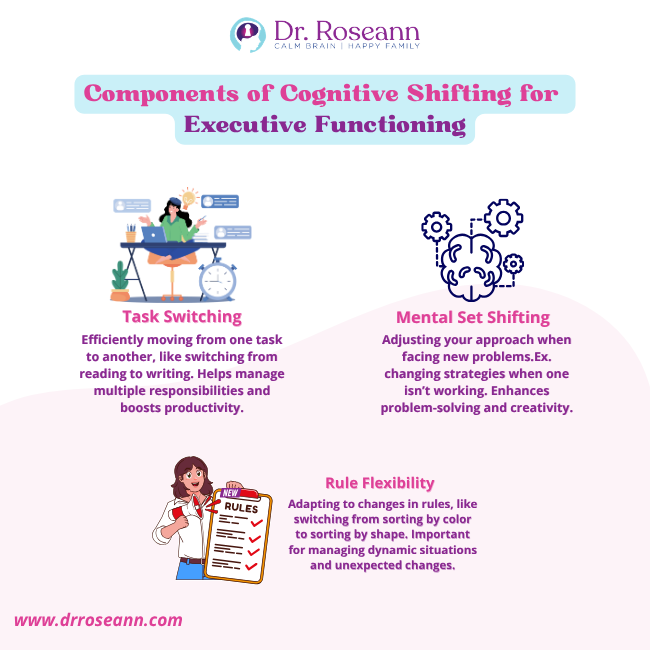
Cognitive shifting is the ability to move from one task, rule, or mental approach to another. Think of switching from recess to mathematics, sorting cards by a new rule, or trying another strategy when the first one doesn’t work.
Here’s how the related terms fit together:
| Term | What it means | Everyday example |
|---|---|---|
| Cognitive flexibility | Adapting thinking or behavior to the situation | Considering another way to solve a problem |
| Set shifting | Changing the rule or mental approach guiding a response | Sorting cards by color, then switching to shape |
| Task switching | Moving between activities or task demands | Putting away a drawing and beginning reading |
In this guide, cognitive shifting is the parent-friendly term we use for practicing those changes.
Research using a color-and-shape card-sorting task found that some young children could explain a new rule but still respond according to the old one. Knowing what to do and successfully switching are not always the same thing (Zelazo et al., 1996).
That’s worth remembering when your child says, “I know!” and still needs help taking the next step. Knowing the instruction doesn’t necessarily make the switch easy.
Parent snapshot: Your child has a chess move planned, then the other player does something unexpected. Now they need to reconsider the plan and choose another response.
You can coach that moment:
“That changed things! Let’s look at another move.”
Signs Your Child is Struggling With Flexible Thinking
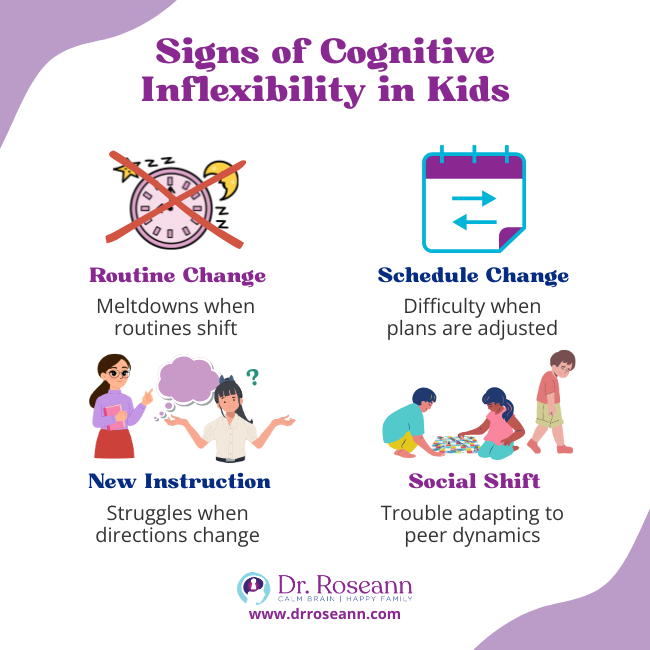
Look for recurring difficulties with changes, transitions, or trying another approach. One rough afternoon doesn’t tell you the whole story.
You might notice:
- Big reactions to changes, such as a substitute teacher or a different route.
- Getting “stuck” on rules or routines.
- Trouble moving on after mistakes.
- Homework difficulties when instructions change.
- All-or-nothing thinking: “If I can’t do it perfectly, I won’t do it.”
Start with curiosity:
“What part of this change feels hard?”
You may discover that your child doesn’t understand the next step, is worried about losing their place, or needs help ending something they enjoy.
At-Home Cognitive Shifting Exercises
These 12 activities offer different kinds of practice. Some involve changing rules; others involve problem-solving, perspective-taking, or preparing for transitions.
Choose one or two manageable activities. Explain what you’re doing, demonstrate the change, and let your child help choose the difficulty.
A randomized school-based trial found that a structured executive-function intervention improved flexibility and other outcomes in the autistic children studied. That program included guided practice, scripts, and visual or verbal cues; it did not test this collection of home activities (Kenworthy et al., 2014).
Keep practice playful and manageable. Your kitchen table does not need to become an executive-function testing center.
1) Card Sorting (5–8 minutes)
- Practice focus: Changing the rule used to sort.
- How-to: Sort cards by color, then switch to shape. Add number sorting if appropriate.
- Make it playful: “Freeze! New rule!”
- Pro tip: Keep the current rule visible. Track time or accuracy only if your child enjoys it.
Take a turn yourself. A cheerful “Oops, I was still sorting by color!” gives you a chance to model noticing and correcting a mistake.
2) Mental Math Switches
- Practice focus: Changing between familiar mathematical operations.
- How-to: Try a few addition problems, then announce a switch to subtraction.
- Real life: “We have $10 and apples cost $2—how many can we buy?”
Use mathematics your child already understands. The practice is switching the operation, not surviving a surprise math quiz.
Keep the pace comfortable and show the current operation if helpful.
3) Storytelling With Constraints
- Practice focus: Adapting an idea when a story detail changes.
- How-to: Tell a story together, then add a detail: “Now the hero is a superhero,” or “Now it’s set at the beach.”
- Stretch: Ask, “How did that change your story?”
Let your child change your story, too. Apparently, your sensible detective now has to solve the mystery while riding a talking pineapple. Work with it.
4) Dual-Task Drills
- Practice focus: Coordinating attention across more than one demand.
- How-to: Alternate a short number sequence with a familiar letter sequence—for example, “10, A, 9, B.”
- Adapt it: Practice each sequence separately before combining them.
If it gets confusing, simplify it. Making an activity easier is useful coaching, not giving up.
(Dual-task coordination is related to, but distinct from, switching between rules. Skip this activity if the combination is confusing or frustrating.)
5) Role Reversal
- Practice focus: Considering another person’s perspective.
- How-to: Use a light, pretend disagreement and take turns explaining each side.
- Coach phrase: “What might the other person be thinking or needing?”
Try something low-stakes, such as choosing a movie or deciding where a pretend family should go on vacation.
Save this for a neutral moment. During an upset, your child does not need an invitation to debate both sides.
6) Timed Task-Switching
- Practice focus: Ending one activity and beginning another.
- How-to: Agree on a short period for Task A, then use a familiar cue to move to Task B.
- Build gradually: Adjust the work periods to your child and the task.
Try:
“When the timer rings, we’ll save your drawing and read one page.”
Show your child how to leave the first task ready to return to. “You can come back to it” may be an important part of the plan.
7) Flexible Problem Solving
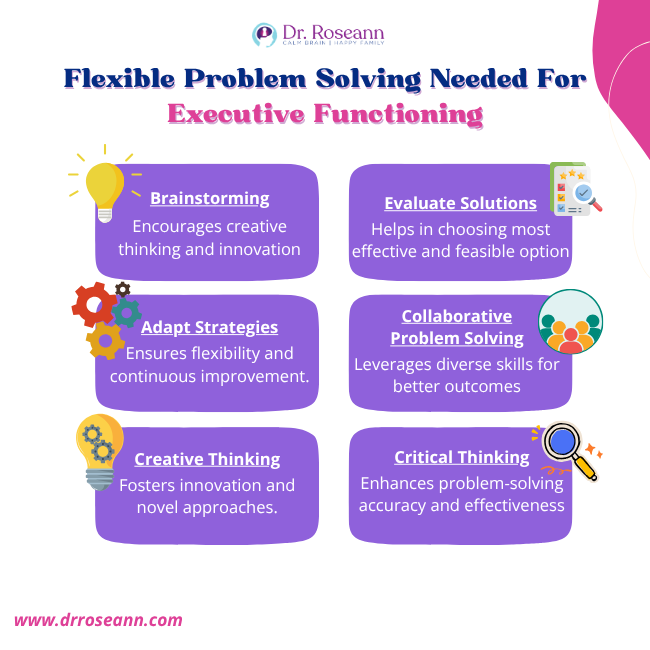
- Practice focus: Considering more than one possible solution.
- How-to: Ask, “What are three ways we could tidy this room?” Then choose one together.
- Mini-debrief: “What worked? What could we try next time?”
Accept suggestions before evaluating them. Your child’s first idea may be “Move to another house,” but you can gently bring the conversation back to the laundry.
8) Gentle Change of Routine
- Practice focus: Trying a small, agreed variation.
- How-to: Offer a choice, such as a different breakfast seat or a different order for two familiar activities.
- Keep it predictable: Explain the change beforehand.
Let your child help plan the change. We don’t need to spring surprises on them to create an opportunity for practice.
Try:
“Would you like to choose a different seat today, or keep your seat and change where I sit?”
9) Puzzle Play (Sudoku, Crosswords, Jigsaws)
- Practice focus: Trying another strategy when stuck.
- How-to: Choose a suitable puzzle and model a different approach.
- Tip: Start easier than you think and offer help when needed.
With a jigsaw, you might say:
“Matching colors isn’t helping me find this piece. I’m going to look at the shapes.”
Name the change in strategy, so your child can see what trying another approach looks like.
10) Cognitive Shuffling (for Bedtime Racing Thoughts)
- Activity: Gently thinking of unrelated, neutral words or images.
- How-to: Try a few simple examples: “Apple… carpet… mailbox.”
- When to try: As an optional wind-down activity if your child finds it comfortable.
Keep it light. Your child doesn’t need to produce an impressive list or get the sequence “right.”
11) Movement-Based “Brain Breaks”
- Practice focus: Including movement between seated activities.
- How-to: Offer a short period of comfortable stretching, wall push-ups, or dancing.
Let your child help choose. A dance break can be wonderfully ordinary—and your choreography does not need professional approval.
A randomized trial of a nine-month physical activity program found improvements in executive-control measures, including cognitive flexibility, among children ages 7–9 (Hillman et al., 2014).
12) Opposite Game
- Practice focus: Pausing and responding according to a changed rule.
- How-to: Begin with two instructions: “When I say sit, stand; when I say stand, sit.”
- Change the rule: After a few comfortable turns, announce that the words now mean their usual actions.
Take turns being the caller. Keep mistakes friendly:
“My brain was still following the old rule! Let’s try again.”
Parent example: Arlene, the mom of a ten-year-old with anxiety, described adding the opposite game and a short task-switching activity to homework time. She reported easier transitions afterward.
Start tiny, keep it playful, and notice the specific action your child practiced.

How Often Should We Practice—and How Do I Keep My Child Engaged?
Begin with brief practice your child can comfortably join, and adjust based on their response. There is no established practice schedule for this entire activity collection.
Try:
- A few turns instead of a long session.
- A choice between two activities.
- Timers or levels only when enjoyable.
- A simple reflection: “What helped you with the switch today?”
- An easier version before adding difficulty.
Parent example: Mark’s eight-year-old disliked activities described as “brain work,” so they tried a dance break and an easy puzzle instead.
Sometimes the invitation needs changing as much as the activity does. “Want to make up a silly story with me?” may be more inviting than “It’s time to work on your flexibility.”
What If My Child Has ADHD, Anxiety, ASD, OCD, or PANS/PANDAS?
Adapt practice to your child’s needs and coordinate it with their care plan. A diagnosis does not tell you which activity will fit or how difficult switching will be.
The structured intervention studied by Kenworthy et al. (2014) supported flexibility and classroom transitions in the autistic children who participated. It should not be generalized to every diagnosis or every home exercise.
| Condition or concern | Practice consideration |
|---|---|
| ADHD | Try short, interesting activities with clear instructions. |
| Anxiety/OCD | Coordinate changes and practice with the treating therapist. Avoid turning games into repeated checking rituals. |
| ASD | Offer visual cues, predictable steps, and sensory accommodations where appropriate. |
| PANS/PANDAS | Follow the medical team’s guidance and adjust demands to the child’s current condition. |
Start where your child is today. An activity they enjoyed yesterday may need to be shorter or simpler this afternoon.
You can say:
“This feels like too much right now. Let’s make it smaller.”
How to Coach Your Child Through Transitions
Preview the change, make the next step clear, and offer appropriate support.
- Preview: “In two minutes, we’ll switch to reading.”
- Use one familiar cue, such as a timer or visual card.
- Offer two workable choices: “Pencils or markers?”
- Name the action: “You put the game away and started the next step, even though it was hard.”
Be clear about what is ending, what happens next, and whether your child can return to the activity later.
Parent example: Nina’s teen found schedule changes difficult. She described using advance previews and familiar tools, including headphones and a fidget.
Make the transition understandable before expecting your child to manage it independently.
When Should You Seek Professional Support
Seek help when transition difficulties or distress interfere with daily life, or when there is a sudden change in functioning. You don’t need to finish weeks of home practice before asking.
Reasons to contact a qualified provider include:
- School avoidance or frequent distress.
- Sudden regression or a marked change in behavior.
- Persistent difficulty with sleep, hygiene, or homework.
- Practice that repeatedly becomes upsetting.
- Concerns that the current support plan is not addressing.
A provider can assess the relevant learning, developmental, emotional, or medical concerns and recommend individualized support.
You don’t have to solve every transition on your own. Asking for help is part of supporting your child.
What Results Should I Expect—and How Long Will It Take?
There is no established results timeline for these 12 activities. Notice specific changes rather than expecting smoother transitions by a deadline.
Useful observations include:
- Following a new sorting rule with fewer reminders.
- Asking for clarification when instructions change.
- Trying another puzzle strategy.
- Beginning the next activity with a familiar cue.
Notice the small actions. Asking, “Can you show me the new rule?” is something useful to recognize, even if the rest of the afternoon is messy.
Improvement in a game does not automatically demonstrate improvement across everyday settings. Share observations with your child’s therapist or teacher and review what is helping.
Try recording:
“The visual rule card helped with sorting today.”
That gives you something concrete to build on.
Cognitive Shifting Exercises Can Calm the Brain
Use these activities as opportunities for supported practice, rather than guaranteed calming treatments. Choose a comfortable moment and pause when your child needs a break.
In my Regulation First Parenting® approach, we make room for calm and connection before coaching the next manageable step.
Sit beside your child. Demonstrate the change. Let them see you get something wrong and try again.
Your child doesn’t have to love every change to practice handling one.
For practical parenting guidance, The Dysregulated Kid offers ways to bring calm, connection, and coaching into everyday family life.
Read more about Children’s Executive Functioning: Hidden Keys to Calm and Success.
It’s gonna be OK.
Frequently Asked Questions on Cognitive Shifting Exercises
Support should fit the individual child and the setting where difficulties occur. These answers explain how executive functioning and transitions can relate.
How does autism affect executive functioning skills?
Autistic children can have different executive functioning profiles. Look at your child’s planning, organization, flexibility, and other needs rather than assuming the same difficulties for everyone.
What executive functioning difficulties are common in autism?
Concerns may involve transitions, flexible thinking, organization, or planning. The structured intervention studied by Kenworthy et al. (2014) targeted these kinds of needs.
Why do autistic children struggle with transitions?
A transition can require shifting attention, understanding a new expectation, and managing a different environment. Sensory needs, uncertainty, and other factors may also matter.
Ask what makes the particular transition difficult for your child.
Can executive functioning support help autistic children?
A randomized trial found that a structured, context-based intervention improved flexibility, problem-solving, and some classroom behaviors in the children studied (Kenworthy et al., 2014).
Individualize the support and review its usefulness.
How do executive functioning challenges impact school performance in autism?
Consider whether difficulties affect starting assignments, following directions, planning projects, or moving between activities.
Ask teachers for concrete examples so you can work together on appropriate support.
What strategies improve executive functioning in autistic children?
Visual cues, clear instructions, and guided practice were components of the intervention studied by Kenworthy et al. (2014).
Discuss which supports fit your child rather than introducing every tool at once.
Are executive functioning deficits part of every autism diagnosis?
An autism diagnosis does not specify an identical executive functioning profile. Evaluate your child’s actual strengths and support needs.
How can parents support executive functioning development in autism?
Offer clear expectations, appropriate visual supports, and manageable opportunities to practice.
Coordinate with the school or therapist so the practice connects to everyday tasks.
Terminology
- Cognitive shifting: A broad term used here for moving between tasks, rules, or approaches.
- Cognitive flexibility: Adapting thinking or behavior when circumstances change.
- Executive functioning: Skills involved in managing goal-directed actions, including attention, memory, planning, and self-control.
- Task switching: Moving between activities or task demands.
- Mental set shifting: Changing the rule or approach guiding a response.
Citations
Hillman, C. H., Pontifex, M. B., Castelli, D. M., Khan, N. A., Raine, L. B., Scudder, M. R., Drollette, E. S., Moore, R. D., Wu, C.-T., & Kamijo, K. (2014). Effects of the FITKids randomized controlled trial on executive control and brain function. Pediatrics, 134(4), e1063–e1071. https://doi.org/10.1542/peds.2013-3219
Kenworthy, L., Anthony, L. G., Naiman, D. Q., Cannon, L., Wills, M. C., Luong-Tran, C., Werner, M. A., Alexander, K. C., Strang, J., Bal, E., Sokoloff, J. L., & Wallace, G. L. (2014). Randomized controlled effectiveness trial of executive function intervention for children on the autism spectrum. Journal of Child Psychology and Psychiatry, 55(4), 374–383. https://doi.org/10.1111/jcpp.12161
Zelazo, P. D., Frye, D., & Rapus, T. (1996). An age-related dissociation between knowing rules and using them. Cognitive Development, 11(1), 37–63. https://doi.org/10.1016/S0885-2014(96)90027-1
© Roseann Capanna-Hodge
Many parents discover these strategies through The Dysregulated Kid, where Dr. Roseann shares decades of clinical experience translated into practical tools for families.
Always remember… “Calm Brain, Happy Family™”
Disclaimer: This article is not intended to give health advice and it is recommended to consult with a physician before beginning any new wellness regime. The effectiveness of diagnosis and treatment vary by patient and condition. Dr. Roseann Capanna-Hodge, LLC does not guarantee certain results.
Meet the Expert
Licensed Therapist | Certified School Psychologist
Board Certified in Neurofeedback (BCN) | 30+ Years Clinical Experience
Expert in Emotional Dysregulation in Children and Nervous System Regulation
Host, Dysregulated Kids Podcast | Author, The Dysregulated Kid
Dr. Roseann Capanna-Hodge is a licensed therapist, certified school psychologist, and leading expert in emotional dysregulation in children and nervous system regulation. With over 30 years of clinical experience and having analyzed more than 10,000 brain maps, she helps families understand what behavior is really signaling—and how to calm the nervous system first so real change can happen.
She is the creator of Regulation First Parenting® and the CALMS Protocol™, host of the top 1% podcast Dysregulated Kids, and author of The Dysregulated Kid.