





Estimated reading time: 7 minutes
Autism in girls can look like social exhaustion, sensory sensitivity, intense interests, perfectionism, emotional overwhelm, or working very hard to fit in. Girls may also mask or internalize their struggles, so the signs can be less obvious to parents, teachers, and even professionals.
This autism in girls checklist can help you notice patterns worth discussing with a qualified professional, but it is a screening aid—not a diagnosis.
That’s why signs of autism in girls are so often missed. Many families I work with say the same thing: “Something feels off, but no one seems concerned.”
Part of the problem is that traditional autism checklists were built around how autism presents in boys.
When you shift your focus from labels to behavior and nervous system signals, you begin to see what your child actually needs.
I’m Dr. Roseann Capanna-Hodge, and for more than three decades I’ve worked with families to understand what’s really driving their child’s behavior—especially in girls whose challenges are often overlooked or misunderstood.
What You'll Learn:
- Common autism traits that often appear differently in girls
- Why masking behaviors can delay recognition and support
- How early understanding can help families make informed decisions
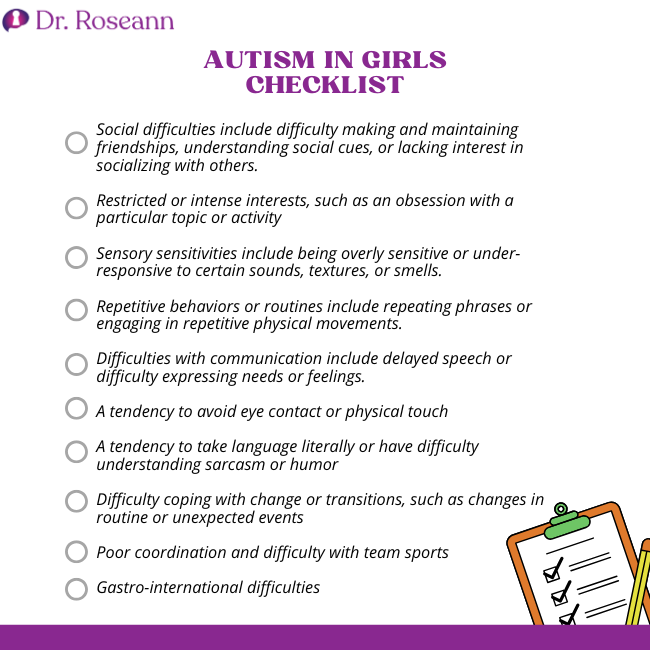
Autism in Girls Checklist
Girls with autism don’t all look or act the same. Use this checklist to look for patterns across settings and over time, rather than focusing on one behavior by itself.
Checking several boxes does not diagnose autism, but it may give you useful observations to share with your child’s pediatrician, psychologist, or another qualified professional.
Autism is one of the many differences that fall under the neurodivergent umbrella, which means there can be a wide range of strengths, needs, and ways of experiencing the world.
Social Signs
☐ Has one or two close friends but struggles in larger groups
☐ Often feels like she is “on the edge” of a group rather than fully part of it
☐ Prefers spending time with adults, younger children, or by herself
☐ Copies how other girls talk, dress, play, or behave to fit in
☐ Seems socially capable but comes home exhausted after school or social events
Communication Signs
☐ Rehearses conversations or plans what she will say ahead of time
☐ Uses memorized or scripted phrases in social situations
☐ Takes language very literally or struggles with sarcasm, teasing, or implied meaning
☐ Mimics expressions, tone of voice, or gestures she sees other people use
☐ Can talk easily about favorite subjects but finds back-and-forth conversation harder
Sensory Signs
☐ Is unusually sensitive to noise, clothing textures, lights, smells, or crowded places
☐ Becomes overwhelmed in busy classrooms, cafeterias, stores, parties, or other high-stimulation environments
☐ Has strong preferences about clothing, foods, textures, or how things feel
☐ Needs quiet or alone time after school or social activities to recover
☐ Seems to tolerate sensory discomfort in public but becomes upset once she is home
Behavior Signs
☐ Has deep or intense interests that may look age-typical on the surface
☐ Strongly prefers routines, predictability, or doing things a particular way
☐ Has difficulty with unexpected changes or transitions
☐ Shows repetitive behaviors, movements, or habits such as hair twirling, pacing, rocking, or repeating actions
☐ Is highly perfectionistic or becomes very distressed about making mistakes
Emotional Signs
☐ Appears calm or compliant at school but has meltdowns or shutdowns at home
☐ Experiences significant anxiety around friendships, school, change, or social expectations
☐ Becomes emotionally overwhelmed after holding things together for long periods
☐ Is highly self-critical or worries excessively about doing the “right” thing
☐ Needs considerable recovery time after social interaction, school, or sensory overload
Why Are Girls With Autism Often Diagnosed Later Than Boys?
Many parents notice something is different long before anyone else does. The challenge is that girls are really good at blending in.
Here’s why girls are often diagnosed later:
- They camouflage. Girls may copy what others say or do so they “look” like they fit in, even when they’re confused inside.
- They look like the “model student.” A teacher might see a quiet, rule-following girl and think she’s fine—without realizing she’s holding in all her stress until she gets home.
- The tools weren’t built for girls. Many checklists and assessments were designed around how autism shows up in boys, so girls don’t always match the criteria.
By the time they’re teens or adults, many girls finally get diagnosed after years of feeling like something was “wrong with them.” That’s why having a parent-friendly checklist is so important—it can help catch the signs earlier.
What Are the Common Signs of Autism in Girls Across Ages?
Autism doesn’t look the same at every stage. Here’s what you may notice at different ages.
You can also explore a broader breakdown of autism symptoms by age and gender.
Early Childhood
- Strong separation anxiety or preferring adult company over other kids
- Big emotional meltdowns over small changes, often seen as “bossy” or “rigid”
- Repetitive play or intense focus on a favorite toy or topic
School Age
- One or two “best friends” but struggles in larger groups
- Perfectionism, working extra hard to keep up, difficulty with change or transitions
- Literal communication (“But you didn’t say that.”) or repetitive behaviors like hair twirling
Adolescence
- Practicing conversations ahead of time, or mimicking how peers act
- High levels of anxiety that no one at school notices, but meltdowns at home
- Feeling drained after social or school activities, needing extra downtime

Red Flags for Autism in Girls
Some signs deserve a closer look when they happen repeatedly, occur across situations, or begin interfering with daily life.
Red flags may include:
- Consistently masking or copying peers to navigate social situations
- Regular meltdowns or shutdowns after school despite appearing fine during the day
- Persistent sensory overwhelm from noise, clothing, lights, crowds, or textures
- Significant difficulty navigating friendships or group dynamics
- Strong distress around changes, transitions, or unexpected events
- Intense perfectionism, anxiety, or fear of making social mistakes
- Social exhaustion that requires significant recovery time
One sign by itself doesn’t mean your daughter is autistic. Look at the larger pattern—especially when several traits appear together and affect her daily functioning.
Example
A 9-year-old girl appeared calm and collected at school, but once she got home, she would collapse into tears.
At first, her parents weren’t sure what was happening, but they began to realize it wasn’t “overly emotional” behavior—it was the exhaustion of holding it together all day.
Their observations were the key to understanding that her meltdowns were really a sign of overwhelm, not misbehavior.
How Does Camouflaging or Masking Show Up in Daily Life?
Autism masking is when a child hides her struggles by copying others or forcing herself to act “normal.” On the outside, she may look just fine—but inside, she’s overwhelmed.
Examples of masking:
- Practicing social scripts like rehearsing what to say before joining a conversation
- Copying peers’ behavior—laughing when they laugh, even if she doesn’t understand the joke
- Keeping it together at school only to melt down at home where it feels safe
Masking helps girls “blend in,” but it’s exhausting. It can leave them feeling anxious, drained, and misunderstood.

What Does Level 1 (High-Functioning) Autism Look Like in Girls?
Level 1 autism can be especially easy to miss in girls who have learned to mask. A girl may speak fluently, earn good grades, follow classroom rules, and have friends while still needing support with social communication, sensory regulation, flexibility, or the demands of everyday life.
Parents may notice that she:
- Rehearses conversations or studies other girls to know how to respond
- Maintains friendships but finds them confusing or exhausting
- Has intense interests that may look socially typical
- Relies heavily on routines or preparation
- Experiences sensory overload that others don’t see
- Appears highly capable at school but melts down or shuts down at home
- Uses perfectionism or people-pleasing to avoid standing out
“High-functioning autism” is still a common search term, but clinicians now diagnose autism based on support needs rather than using “high-functioning” as a formal diagnosis.
That is also why looking only at how a girl appears socially can be misleading. Masking can hide how much effort she is using just to get through the day.
When Should I Seek an Assessment or Professional Help?
If several of these signs sound familiar, it may be time to seek a professional opinion. You don’t need to have all the answers—that’s what the evaluation process is for.
Steps you can take:
- Talk with your pediatrician and ask for a referral
- Share your checklist observations with a psychologist or specialist
- Look for assessments that consider how autism presents in girls
What Does an Autism Assessment Involve?
An autism evaluation isn’t based on one checklist or test. A comprehensive assessment typically looks at your child’s developmental history, behavior, communication, social experiences, strengths, sensory patterns, and functioning across settings, along with professional observation.
For girls, it can also be helpful for the evaluator to ask specifically about masking, social exhaustion, internalized anxiety, friendships, and what happens after your child has spent the day holding everything together.
Depending on your child’s age and needs, professionals may use standardized screening or diagnostic tools alongside interviews and observations.
No single autism test or checklist should be used by itself to diagnose autism.
Tools you may hear about include the Modified Checklist for Autism in Toddlers, Revised with Follow-Up (M-CHAT-R/F) for younger children and diagnostic tools such as the Autism Diagnostic Observation Schedule, Second Edition (ADOS-2) or Autism Diagnostic Interview-Revised (ADI-R) as part of a broader evaluation.
And remember: It’s not bad parenting—it’s a dysregulated brain. Early understanding and support can change the whole path forward.

How Can I Support My Daughter Right Now, Even Before a Diagnosis?
You don’t have to wait for an official diagnosis to start helping your child feel calmer and more supported.
Simple strategies that help:
- Predictable routines: Consistency makes the world feel safer
- Safe sensory spaces: A cozy nook, soft blanket, or headphones can calm sensory overload
- Emotion labeling: “I see you’re overwhelmed. Let’s calm the brain first.”
- Validation: Remind her she doesn’t need to be perfect or mask at home—she’s safe to be herself
Connection: Join parent groups or online communities for families raising autistic girls—you’ll realize you’re not alone.
Read more about: A Nervous System Approach to Autism Treatment: What Every Parent Needs to Know
For parents who want a deeper understanding of why dysregulation happens—and what actually helps, Dr. Roseann explores these strategies in The Dysregulated Kid.
FAQs
How many signs of autism in girls are needed to consider an assessment?
No child has to check every box. If multiple signs of autism in girls are present and affecting daily functioning, it’s worth pursuing an evaluation.
Can sensory strategies help girls with autism even before a diagnosis?
Yes. Sensory strategies for girls with autism can calm the nervous system and improve regulation, even without a formal diagnosis.
Is masking in girls with autism always harmful?
Masking in girls with autism can help them fit in socially, but it’s exhausting and often leads to anxiety, burnout, and emotional distress.
What should parents do if a pediatrician dismisses concerns about autism in girls?
If concerns about autism in girls are dismissed, document behaviors across settings and seek a second opinion. Parent observations are essential.
What are the early signs of autism in girls?
Early signs of autism in girls include masking, sensory sensitivities, intense interests, social fatigue, and perfectionistic or people-pleasing behaviors.
Can autism in girls be misdiagnosed as anxiety or ADHD?
Yes. Autism in girls is often misdiagnosed as anxiety or ADHD because girls tend to internalize symptoms and mask social challenges.
At what age is autism in girls typically diagnosed?
Autism in girls is often diagnosed later—during late childhood or adolescence—because symptoms are more subtle and harder to recognize.
What steps should parents take if they suspect autism in their daughter?
If parents suspect autism in their daughter, they should track behaviors, use a checklist, and seek a comprehensive evaluation from a qualified specialist.
How do I know if my daughter is slightly autistic?
There isn’t a clinical diagnosis of being “slightly autistic.” Autism exists on a spectrum, and some girls have subtler outward signs or lower support needs that can be easy to miss—especially when they mask.
If you consistently notice social, sensory, communication, behavioral, or emotional patterns from this checklist, a qualified professional can help determine what is behind them.
Is there an autism in girls test?
There isn’t one specific autism in girls test that can diagnose autism. Screening questionnaires can identify concerns, but a diagnosis comes from a comprehensive evaluation that considers developmental history, behavior, professional observation, and information from parents or caregivers.
Because girls may mask their traits, it’s worth working with a professional who understands how autism can present differently in girls.
What is the treatment for autism in girls?
Autism support should be individualized to a girl’s specific strengths, challenges, sensory needs, communication, emotional regulation, and daily functioning.
Rather than trying to change who she is, the goal is to give her the support she needs to regulate, communicate, learn, connect, and function more comfortably.
Learn more in my autism treatment guide.
Citations
Bargiela, S., Steward, R., & Mandy, W. (2016). The experiences of late-diagnosed women with autism Spectrum conditions: An investigation of the female autism phenotype. Journal of Autism and Developmental Disorders, 46(10), 3281–3294. https://doi.org/10.1007/s10803-016-2872-8
Hull, L., Petrides, K. V., & Mandy, W. (2020). The female autism phenotype and camouflaging: A narrative review. Journal of Autism and Developmental Disorders, 50(3), 306–317. https://doi.org/10.1007/s40489-020-00197-9
Cremone, I. M., et al. (2023). Measuring social camouflaging in individuals with high-functioning autism: A review of available methods and their correlates. Brain Sciences, 13(3), 469. https://doi.org/10.3390/brainsci13030469
Always remember… “Calm Brain, Happy Family™”
Disclaimer: This article is not intended to give health advice and it is recommended to consult with a physician before beginning any new wellness regime. The effectiveness of diagnosis and treatment vary by patient and condition. Dr. Roseann Capanna-Hodge, LLC does not guarantee certain results.
Meet the Expert
Licensed Therapist | Certified School Psychologist
Board Certified in Neurofeedback (BCN) | 30+ Years Clinical Experience
Expert in Emotional Dysregulation in Children and Nervous System Regulation
Host, Dysregulated Kids Podcast | Author, The Dysregulated Kid
Dr. Roseann Capanna-Hodge is a licensed therapist, certified school psychologist, and leading expert in emotional dysregulation in children and nervous system regulation. With over 30 years of clinical experience and having analyzed more than 10,000 brain maps, she helps families understand what behavior is really signaling—and how to calm the nervous system first so real change can happen.
She is the creator of Regulation First Parenting® and the CALMS Protocol™, host of the top 1% podcast Dysregulated Kids, and author of The Dysregulated Kid.