



Estimated reading time: 9 minutes
The way to calm the limbic system is by using simple, body-based strategies—like slow breathing, movement, and co-regulation—that signal safety to the brain.
If your child’s big feelings seem to hijack their brain, you’re not alone. When the limbic system runs hot, thinking shuts down and fight-or-flight takes over.
An overactive limbic system can make it hard for your child to stay calm or feel in control. That’s why calming the nervous system first is key—so their brain can settle, think clearly, and regain control.
I’m Dr. Roseann Capanna-Hodge, a therapist, school psychologist, mom of two neurodivergent boys, and author of The Dysregulated Kid. For more than three decades, I’ve helped families understand what behavior is communicating and respond through Regulation First Parenting®.
You do not need to do every strategy in this article. Choose one that fits your child and your day.
What you’ll learn:
- How stress can make thinking and responding harder.
- What emotional overload can look like.
- Simple calming practices to try together.
- How sleep, movement, and everyday routines fit into the picture.
What Is the Limbic System—And Why Is Your Child So Reactive?
The limbic system refers to interconnected brain regions involved in emotion, memory, and responding to important experiences, including threats. The amygdala is part of this network; the prefrontal cortex contributes to planning, attention, and managing responses.
Think of the amygdala as an alarm and the prefrontal cortex as part of the braking system. It is a helpful picture, even though the brain is more complicated than an alarm and a brake pedal.
When your child is overwhelmed, pausing and thinking things through can become harder. That is why a long explanation may not land in the middle of a meltdown.
Parent Story:
Sarah, a teen, described feeling as though her “amygdala was on fire.” Small frustrations felt enormous, and talking through a problem felt like one more demand.
The first step was giving her room to settle. We could come back to what happened and what to do differently once she was ready. Even your best advice needs a moment when your child can take it in.
That’s what I want parents to remember:
- Pause before teaching. The lesson can wait.
- Get curious. “What is making this moment so hard?”
- Regulate → Connect → Correct™.
And yes, you can be compassionate and still hold the boundary:
“I won’t let you hit. I’m here. We’ll talk about what happened when we’re ready.”
How to Know if Your Child’s Limbic System Is Overactive
Look for patterns of overwhelm, such as explosive anger, panic, avoidance, or shutdown—especially around transitions, demanding tasks, or sensory stress. These behaviors give you clues about what needs attention; they do not diagnose activity in a particular brain region.
Start by noticing when, where, and after what the difficulty happens.
Limbic Clues and First Steps
| Situation | What you might notice | Try this first |
|---|---|---|
| Noisy cafeteria | Tears, covering ears, or “I can’t.” Noise may feel overwhelming. | Offer a quieter space and a simple grounding activity. |
| Homework after school | Yelling, avoidance, or difficulty starting. Your child may be tired or hungry. | Offer a snack and a brief movement break. |
| Social stress | Worry, withdrawal, or stomach complaints. | Listen, stay nearby, and invite a comfortable slow breath. |
| Bedtime | Restlessness, repeated requests, or difficulty settling. | Lower the lights and return to a familiar wind-down routine. |
Treat the pattern as a starting point for understanding. Persistent physical symptoms, including stomach pain, deserve attention rather than an automatic stress label.
You are gathering information, not building a case against your child.
How To Calm Your Nervous System Fast
In the heat of big feelings, simplify: fewer words, a calmer pace, and a moment of connection. Start with your own response before asking your child to do something differently.
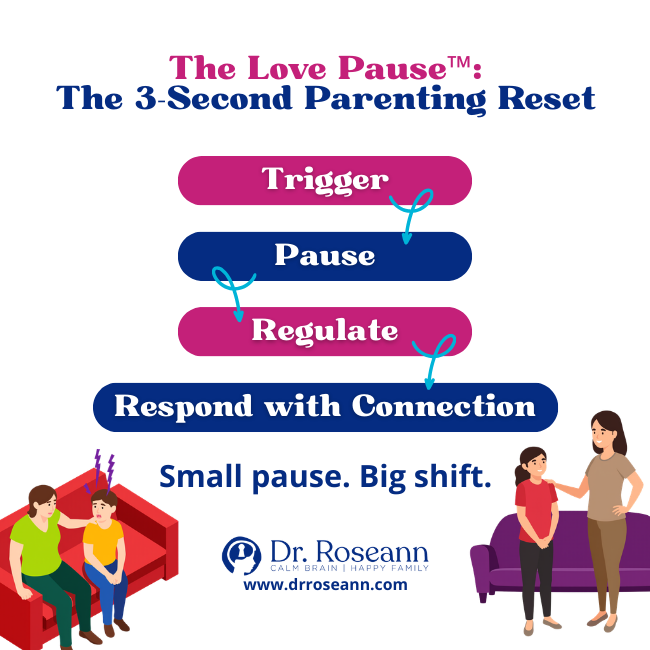
Practice The Love Pause™
Start with The Love Pause™—a moment to pause and connect before responding to your child’s behavior. Give yourself room to slow down instead of rushing into correction.
You do not need a perfect script. Try:
“I’m here. We can take a moment.”
Keep your words brief, offer closeness if your child welcomes it, and allow space if they need it.
Once your child is more settled, return to the next manageable step:
“Would you like to start together?”
Connection first. The conversation about what happened can wait.
If your child welcomes a breathing practice, invite a few comfortable, slow breaths together. A randomized study found that a brief video guiding children through slow breaths reduced physiological arousal during the activity (Obradović et al., 2021).
Try:
“I’m going to slow down for a moment. You can join me.”
Keep breathing easy, without long holds or forced breaths. If your child feels dizzy or uncomfortable, stop and return to normal breathing.
Mateo’s bus-stop example captures the idea: his mom stayed close and practiced with him before trying to talk through the problem. Offer touch only if your child welcomes it.
Your role is to be available. You do not have to become a perfectly serene meditation instructor while also locating the missing lunchbox.
Does Sleep Really Lower Emotional Reactivity
Sleep supports emotional regulation, and insufficient sleep can make everyday challenges harder to manage.
Research in adults found heightened amygdala responses to negative images after sleep deprivation (Yoo et al., 2007). In a separate child study, modest sleep extension was associated with improved teacher-rated emotional regulation and restless-impulsive behavior, while sleep restriction had the opposite pattern (Gruber et al., 2012). www.sciencedirect.com
Try this tonight:
- Keep bedtime and wake-up times reasonably consistent.
- Begin winding down before your child is overtired.
- Dim lights and put screens away during the wind-down period.
- Offer quiet reading, comfortable breathing, or gentle humming if welcomed.
Make the sequence familiar:
“Bathroom, pajamas, then our book.”
The routine does not need to be elaborate. Predictable is useful; a twelve-part bedtime production is exhausting for everyone.
Explore more emotional regulation tips for everyday family life.
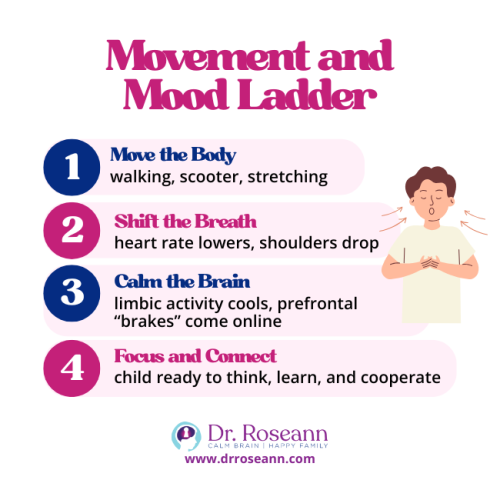
Will Movement Help Your Anxious or ADHD Child
Movement can be a useful part of supporting attention and giving your child a break from demanding tasks.
In a study involving children with and without ADHD, a 20-minute bout of moderate aerobic exercise was followed by improvements on measures of attention and academic performance compared with seated reading (Pontifex et al., 2013).
For everyday practice, offer movement your child enjoys:
- A walk or scooter loop before homework.
- Wall push-ups or animal crawls.
- Helping carry a manageable basket of laundry.
- Marching and touching the opposite elbow to the knee.
These are activity options, not a requirement to complete a particular exercise sequence.
Sam’s parent described fewer homework struggles after adding a scooter break before sitting down. The practical idea is simple: notice whether changing the order of the afternoon helps your child participate.
“Let’s move a little, then look at the first question.”
Keep movement comfortable and suited to your child’s abilities. The goal is a useful break, not boot camp.
Read more about emotional regulation skills and explore self-regulation strategies for kids.
Watch: How to Calm the Limbic System—An Educational Overview
Prefer to listen? Listen to the podcast episode.
Daily Habits That Steadily “Cool” the Limbic System
Build around a few repeatable habits: comfortable breathing, movement, regular meals, a sleep-friendly evening, and support that fits your child.
Think gentle repetition. You do not need to redesign family life by Monday.
1. Breath + Mindfulness
Offer a short practice when your child is already relatively comfortable.
- Take a few slow, unforced breaths together.
- Try gentle humming if they enjoy it.
- Notice a sound, color, or physical sensation.
- Use a visual timer only if it makes the activity easier.
“Want to try a few breaths with me, or sit quietly?”
Choice matters. A breathing exercise should not become a power struggle about breathing.
2. Movement Snacks Across the Day
Make room for short movement breaks between seated or demanding activities.
Try:
- Walking outside.
- Stretching together.
- A scooter ride.
- A familiar movement game.
Choose an activity your child can comfortably stop and transition away from. Notice what fits their day.
3. Food That Steadies Energy
Keep regular meals and snacks in the routine.
- Include protein-containing foods and fiber-rich foods your child tolerates.
- Make room for an after-school snack when needed.
- Notice whether hunger is part of a difficult transition.
Before launching into homework expectations, it is reasonable to ask:
“Have you had enough to eat?”
Sometimes the next useful step is a snack and a pause.
4. Tech and Light Hygiene
Create a clear transition into the evening:
- Dim lights as bedtime approaches.
- Put devices away during the wind-down routine.
- Keep the bedtime sequence familiar.
- Plan where devices will stay overnight.
Give a little preparation:
“We’re finishing this, then moving into our evening routine.”
Keep the boundary clear and the explanation short. Bedtime is rarely improved by a lengthy debate about bedtime.
5. Supports Parents Ask About
Keep the foundations—connection, routines, sleep, and manageable expectations—at the center.
Some families also ask about PEMF as an additional support. If it is part of your child’s plan, follow the device’s instructions and keep the experience comfortable. It belongs alongside the everyday support your child needs.
For practical guidance on understanding those needs, my book, The Dysregulated Kid, explores Regulation First Parenting® in family life.

When Do We Need Professional Help—And What Should We Ask For?
Seek support when emotional or behavioral difficulties regularly interfere with home, school, relationships, or safety. You do not have to wait a set number of weeks to ask for help.
Reach out when you notice:
- Frequent meltdowns that disrupt everyday life.
- Intense anxiety, rituals, or mood swings.
- Persistent sleep difficulties or physical complaints.
- A sudden or significant change from your child’s usual functioning.
- Talk or behavior involving self-harm.
If there is immediate danger, stay with your child and seek emergency help.
For an assessment, bring concrete examples:
“Transitions are hardest after school.”
“She wants to join practice, but panic keeps stopping her.”
“He is sleeping poorly and struggling much more than usual.”
Ask about:
- What may be contributing to the difficulties.
- Co-regulation and sensory supports.
- Sleep and daily routines.
- School accommodations.
- Whether an assessment for a specific condition is appropriate.
Parent Story: Keira wanted to join practice, but panic kept getting in the way. Wanting to participate and feeling able to participate are two different things. Another “You can do it!” wasn’t the whole answer.
When you ask for support, bring that everyday picture:
“She wants to be there, but she gets overwhelmed. Here’s what happens, and here’s what we’ve tried.”
You don’t need all the answers before asking for help. Start with what you’re seeing so you can build a plan around what your child needs.
One Small Daily Shift That Changes Everything
Start with one manageable habit you can repeat. You do not need to overhaul your whole routine to offer your child more support.
Choose one:
- Morning: A few comfortable breaths together.
- After school: A snack and a brief movement break before homework.
- Evening: Dimmed lights and a familiar wind-down routine.
When a difficult moment comes up, return to The Love Pause™. Give yourself a moment to connect before deciding what to say next.
Ask yourself:
“Which part of our day needs a little more breathing room?”
That is a good place to begin.
As you practice nervous system regulation, notice small changes in how your child participates, communicates, or asks for help.
This is the practical heart of how to calm the limbic system: offer connection, reduce unnecessary demands, and practice manageable strategies together.
You do not have to get every moment right. There will still be lost shoes, hard transitions, and evenings when everyone needs a do-over.
Start again with the next moment.
For more guidance, The Dysregulated Kid helps parents look beyond behavior and respond with greater understanding.
Calm Brain, Happy Family™
FAQs
How long does it take to calm the nervous system and see changes?
Look for small, practical signs rather than a fixed timeline. Your child may accept support, ask for a break, or return to an activity more comfortably. Notice patterns over time without putting them on a deadline.
What if my child refuses breathing exercises to calm the nervous system?
Model comfortable breathing yourself and offer another option. Sitting quietly, taking a movement break, or moving to a less overwhelming space may be more welcome.
“You don’t have to do the exercise. I’m here.”
Are these strategies only for anxiety, or do they help other conditions too?
Choose routines around your child’s comfort, abilities, and existing care plan. You can discuss how to adapt them for your child’s needs without expecting every strategy to suit every child.
Are PEMF and neurofeedback safe for nervous system regulation?
Safety depends on the specific intervention, equipment, and individual. These approaches are different and need separate consideration. For a device already included in your child’s plan, follow its instructions and report discomfort or new symptoms.
What are signs of an overactive limbic system?
People often use this phrase to describe anxiety, irritability, emotional outbursts, or difficulty settling. Those signs have several possible explanations and do not reveal brain activity on their own.
Start by noticing patterns and seeking assessment when difficulties persist.
How do I calm my child’s nervous system quickly?
Lower the demands, use fewer words, and begin with connection. Try The Love Pause™, then offer a comfortable slow breath, gentle movement, or a quieter space if your child welcomes it.
Stay alongside your child without requiring an immediate response.
What causes the limbic system to become overactive?
“Overactive limbic system” is a simplified description, not a diagnosis. Explore what is happening around the difficulty, including stress, sensory demands, sleep, and your child’s individual needs.
Can stress keep you stuck in fight or flight?
Ongoing stress can leave a person feeling persistently on edge or ready to react. If that pattern is affecting everyday life, seek support in understanding the contributing factors.
What are the best vagus nerve exercises for calming down?
Start with comfortable slow breathing rather than trying to force a particular nerve response. A few guided slow breaths reduced physiological arousal in a child study (Obradović et al., 2021).
Keep the practice easy and stop if it feels uncomfortable.
Terminology
- Limbic system: A term for interconnected regions involved in emotion, memory, and other functions.
- Amygdala: A brain region involved in processing emotionally significant information, including threats.
- Prefrontal cortex: Brain regions involved in planning, attention, and managing responses.
- Co-regulation: Support offered through a responsive relationship as a child learns to manage emotions and behavior.
- Vagus nerve: A nerve involved in communication between the brain and several organs.
- QEEG: Quantitative analysis of recorded EEG activity.
- Neurofeedback: Training that uses feedback from recorded brain activity.
References
Gruber, R., Cassoff, J., Frenette, S., Wiebe, S., & Carrier, J. (2012). Impact of sleep extension and restriction on children’s emotional lability and impulsivity. Pediatrics, 130(5), e1155–e1161. https://doi.org/10.1542/peds.2012-0564
Obradović, J., Sulik, M. J., & Armstrong-Carter, E. (2021). Taking a few deep breaths significantly reduces children’s physiological arousal in everyday settings: Results of a preregistered video intervention. Developmental Psychobiology, 63(8), e22214. https://doi.org/10.1002/dev.22214
Pontifex, M. B., Saliba, B. J., Raine, L. B., Picchietti, D. L., & Hillman, C. H. (2013). Exercise improves behavioral, neurocognitive, and scholastic performance in children with attention-deficit/hyperactivity disorder. The Journal of Pediatrics, 162(3), 543–551. https://doi.org/10.1016/j.jpeds.2012.08.036
Yoo, S.-S., Gujar, N., Hu, P., Jolesz, F. A., & Walker, M. P. (2007). The human emotional brain without sleep—A prefrontal amygdala disconnect? Current Biology, 17(20), R877–R878. https://doi.org/10.1016/j.cub.2007.08.007
Always remember… “Calm Brain, Happy Family™”
Disclaimer: This article is not intended to give health advice and it is recommended to consult with a physician before beginning any new wellness regime. The effectiveness of diagnosis and treatment vary by patient and condition. Dr. Roseann Capanna-Hodge, LLC does not guarantee certain results.
Are you looking for SOLUTIONS for your struggling child or teen?
Dr. Roseann and her team are all about science-backed solutions, so you are in the right place!
Meet the Expert
Licensed Therapist | Certified School Psychologist
Board Certified in Neurofeedback (BCN) | 30+ Years Clinical Experience
Expert in Emotional Dysregulation in Children and Nervous System Regulation
Host, Dysregulated Kids Podcast | Author, The Dysregulated Kid
Dr. Roseann Capanna-Hodge is a licensed therapist, certified school psychologist, and leading expert in emotional dysregulation in children and nervous system regulation. With over 30 years of clinical experience and having analyzed more than 10,000 brain maps, she helps families understand what behavior is really signaling—and how to calm the nervous system first so real change can happen.
She is the creator of Regulation First Parenting® and the CALMS Protocol™, host of the top 1% podcast Dysregulated Kids, and author of The Dysregulated Kid.

Want more Regulation First Parenting® guidance from Dr. Roseann? Add us as a preferred source on Google.