





Estimated reading time: 8 minutes
The root causes of emotional dysregulation can include brain development, limbic system overactivation, prefrontal cortex challenges, genetics, temperament, trauma, chronic stress, ADHD, autism, anxiety, sleep problems, medical stressors, and traumatic brain injury.
I’m Dr. Roseann Capanna-Hodge, a licensed therapist with 30+ years of experience helping dysregulated kids and teens. Emotional dysregulation is rarely about “bad behavior”—it’s often a sign of an overloaded nervous system. With Regulation First Parenting®, we calm the brain first, then build the skills for better behavior, learning, and emotional control.
In this article, you’ll learn:
- The most common root causes of emotional dysregulation in children and teens
- Why some nervous systems are more vulnerable to stress, sensory input, and emotional overwhelm
- How brain development, trauma, ADHD, autism, anxiety, sleep, and medical factors can affect regulation
What Are the Root Causes of Emotional Dysregulation?
At the root, emotional dysregulation happens when the brain and nervous system have difficulty managing the intensity, duration, and recovery of emotional responses.
That means the issue isn’t simply that a child gets upset.
The deeper issue is that their nervous system may have trouble returning to a calm, connected, thinking state after stress.
Common root causes and contributing factors behind emotional dysregulation include:
- Immature brain development
- Overactive limbic system responses
- Weak prefrontal cortex regulation
- Genetic or temperamental sensitivity
- Trauma or chronic stress
- ADHD, autism, anxiety, OCD, or mood challenges
- Sensory processing differences
- Invalidating or high-stress environments
- Sleep problems
- Inflammation, illness, or nutrient depletion
- Traumatic brain injury or concussion
Emotional dysregulation isn’t tied to just one diagnosis. It is a cross-cutting issue, meaning it can appear in children with many different mental health, developmental, and neurological challenges.
That’s why the root cause can look different from child to child. For one child, dysregulation may stem from ADHD-related impulsivity. For another, it may come from trauma, anxiety, sensory overload, poor sleep, or several overlapping stressors affecting the nervous system at once.
The behavior may look similar. The root cause may be very different.
Root Causes vs. Triggers: Why This Difference Matters
A root cause is what makes a child’s nervous system more sensitive, reactive, or slow to recover.
A trigger is the specific moment or stressor that sets off that already-vulnerable nervous system.
This distinction matters because parents often focus only on the trigger.
Your child melts down when it’s time to leave the playground, so the transition seems like the “problem.” But the deeper root factor may be poor cognitive flexibility, sensory overload, anxiety about what comes next, hunger, fatigue, low frustration tolerance, or an already overloaded nervous system.
| Everyday Trigger | Possible Root Cause |
|---|---|
| Being told “no” | Low frustration tolerance, impulsivity, or lagging coping skills in managing delayed gratification. |
| Leaving a preferred activity | Executive function gaps in transitioning (ADHD/Autism), anxiety regarding what comes next, or dopamine drops. |
| Loud noises | Sensory processing differences (hyper-reactivity) or trauma-based hypervigilance. |
| Homework | Executive functioning challenges (initiation/planning), undiagnosed learning issues, or performance anxiety. |
| Morning routine | Poor sleep hygiene, morning "demand overload," or weak planning and sequencing skills. |
| Public embarrassment | Rejection Sensitive Dysphoria (RSD), trauma history, or acute social anxiety. |
Triggers are real. They matter.
But when a child is dysregulated again and again, the goal isn’t just to identify what set them off. The deeper work is understanding why their nervous system is so easily pushed outside its window of tolerance.
That’s where root-cause support begins.
Why Are Some Nervous Systems More Vulnerable to Dysregulation?
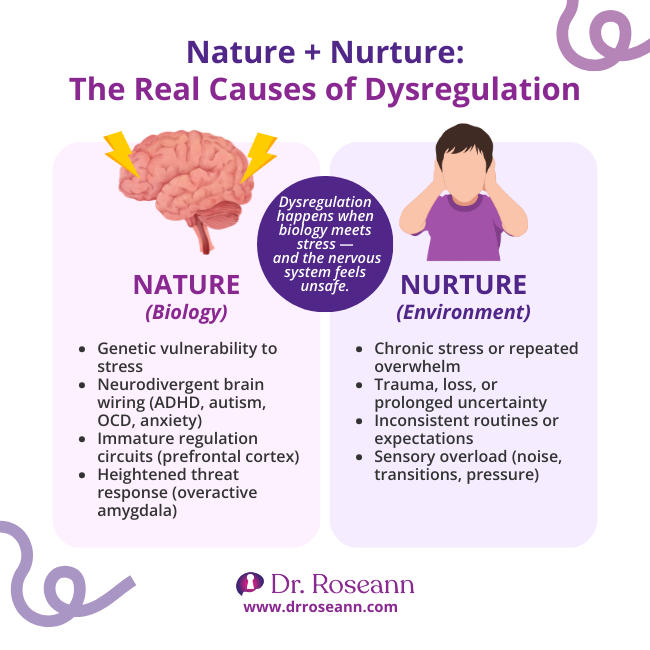
Some children have nervous systems that are more sensitive, reactive, or easily overloaded. These children may experience stress more intensely, shift into survival mode more quickly, and need longer to recover after emotional activation.
This vulnerability can come from many places, including brain development, genetics, temperament, trauma, chronic stress, neurodevelopmental differences, sensory processing challenges, or physical health factors.
Brain-Based Root Causes of Emotional Dysregulation
Many root causes of emotional dysregulation are brain-based. This doesn’t mean a child is broken—it means the systems for emotional control, threat detection, impulse regulation, and recovery may need support.
| Brain System | What It Does | How It Can Contribute to Dysregulation |
|---|---|---|
| Limbic System | The emotional center of the brain; it detects emotion, threat, and basic survival signals. | Can become hyper-reactive, making minor stressors, correction, or sensory input feel like a major threat to safety. |
| Amygdala | Acts as the brain's "smoke detector," scanning for danger and emotional intensity. | When triggered, it bypasses logic and pushes the child into fight, flight, freeze, or shutdown almost instantly. |
| Prefrontal Cortex (PFC) | The "CEO" of the brain; supports pausing, logical thinking, problem-solving, and impulse control. | Still under construction until the mid-20s. A child may "know better" when calm, but lacks the wiring to "do better" when the PFC goes offline. |
| Amygdala-PFC Connection | The neural bridge that helps the emotional brain and thinking brain communicate. | If this connection is stressed or underdeveloped, the child reacts physically before their problem-solving systems can come online. |
The takeaway: emotional regulation isn’t just willpower. It depends on how well the brain detects stress, interprets it, and returns to calm.

Developmental Root Causes: Why Kids Can’t Always “Use Their Coping Skills”
Children are still building the brain networks needed for emotional control. That means emotional regulation depends on development, not just motivation.
In a 2022 f MRI study of children and adolescents, researchers found that age and affective flexibility predicted cognitive reappraisal ability (Pierce et al., 2022), a key emotion regulation skill, showing that regulation relies on developing brain systems involved in flexibility, calming, and emotional control.
A child may truly know the coping skill.
They may have practiced the breathing exercise.
They may be able to talk about what they “should” do when they are calm.
But once the nervous system shifts into fight, flight, freeze, or shutdown, those skills can become hard to access.
That’s because emotional regulation requires several developmental abilities working together:
- Attention to notice what is happening
- Language to name feelings
- Body awareness to recognize stress signals
- Impulse control to pause before reacting
- Flexible thinking to adjust to change
- Working memory to remember the coping tool
- Recovery capacity to return to baseline
When these skills are immature, delayed, or disrupted by stress, emotional dysregulation becomes more likely.
This is why a child may seem perfectly capable one day and completely unable to cope the next.
The skill may exist, but the nervous system may not be calm enough to use it.
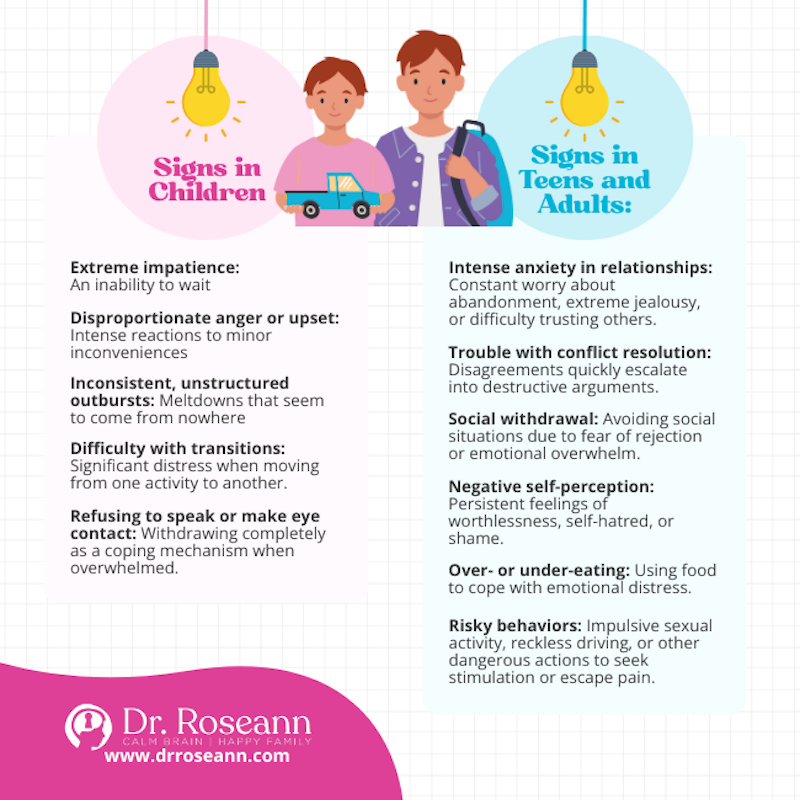
Genetic and Temperamental Root Causes of Emotional Dysregulation
Some children show signs of a more sensitive or reactive nervous system very early in life.
In a longitudinal study, infant temperament measured at 4 months predicted later emotional and behavioral risk in childhood (Morales et al., 2022).
This doesn’t mean something is wrong with them.
It means their emotional “volume dial” may naturally be turned higher.
Temperamental traits that can contribute to emotional dysregulation include:
- High emotional intensity
- Low frustration tolerance
- Sensory sensitivity
- Strong persistence
- Slow adaptability
- Behavioral inhibition
- Rejection sensitivity
- High reactivity to stress
A child with this wiring may become overwhelmed faster than siblings or peers. They may cry harder, argue longer, panic more quickly, or struggle more with change.
A child’s biology can create their vulnerability. Their environment, relationships, sleep, nutrition, therapies, and regulation tools influence how that vulnerability develops over time.
That’s the hopeful part.
A sensitive nervous system can learn regulation, but it needs more practice, more co-regulation, and more brain-based support.
Trauma, Chronic Stress, and Nervous System Sensitization
Trauma and chronic stress can be major root contributors to emotional dysregulation in children (Gruhn and Compass, 2020).
When a child experiences trauma, instability, threat, neglect, loss, medical stress, bullying, separation, or repeated fear, the nervous system can become wired for protection. The brain learns to scan for danger, react quickly, and stay alert.
That survival response can be adaptive during danger.
But when the threat has passed and the nervous system stays on high alert, emotional regulation becomes harder.
Children with trauma-related dysregulation may overreact to correction, become defensive quickly, shut down under pressure, struggle to trust adults, or misread neutral situations as threatening.
And chronic stress doesn’t have to be one huge traumatic event.
It can include ongoing stressors such as:
- Family conflict
- Academic pressure
- Medical stress
- Financial instability
- Bullying
- Repeated shame or criticism
- Unpredictable caregiving
- Sensory overwhelm
- Chronic sleep deprivation
- Living with an untreated mental health condition
When stress becomes chronic, the nervous system may stop feeling safe enough to recover.
That’s when a child can look angry, oppositional, avoidant, or shut down—but underneath, their body may be stuck in protection mode.
Neurodevelopmental and Mental Health Conditions That Increase Vulnerability
Emotional dysregulation can appear alongside ADHD, autism, anxiety, OCD, learning differences, sensory processing challenges, and mood disorders. This doesn’t mean every dysregulated child has a diagnosis, but it can point to deeper nervous system vulnerability.
- ADHD: Kids may react before thinking, melt down during transitions, struggle with waiting, or become overwhelmed by multi-step directions because of impulse control and executive functioning challenges.
- Autism: Sensory input, unexpected changes, social demands, communication stress, or masking can overwhelm the nervous system and lead to meltdowns, shutdowns, avoidance, or withdrawal.
- Anxiety: An anxious brain is always scanning for danger, so worry may show up as irritability, control, avoidance, anger, school refusal, or meltdowns before demands.
- OCD: Intrusive thoughts, compulsive urges, uncertainty, or interrupted rituals can trigger dysregulation because the brain is stuck in a loop of fear, doubt, and temporary relief.
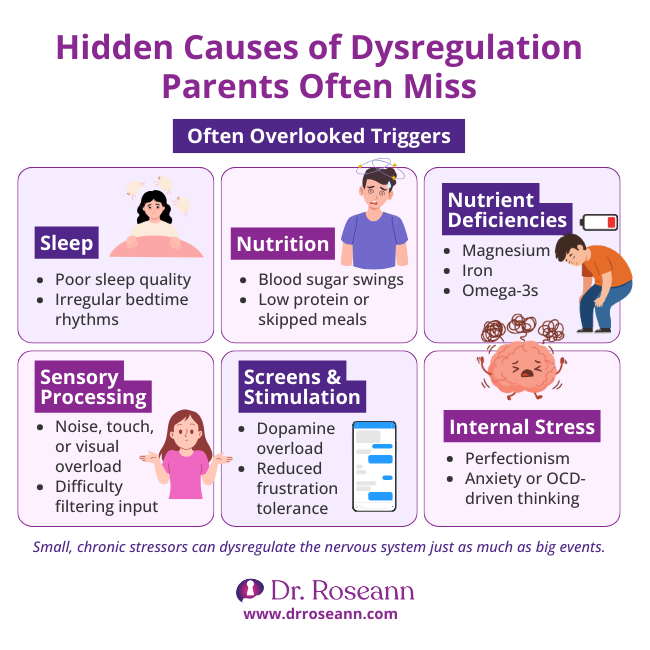
- Sensory processing challenges: Noise, light, touch, movement, crowds, or busy environments can overload the sensory system and push the child into fight, flight, freeze, or shutdown.
Medical and Physical Root Contributors: Sleep, TBI, Inflammation, and Nutrient Depletion
Emotional regulation is physical, too. A child’s brain needs sleep, nutrients, movement, safety, and a healthy nervous system to regulate well.
Medical and physical root contributors may include:
- Poor sleep, which can affect attention, impulse control, frustration tolerance, and recovery
- Sleep deprivation, which may look like irritability, anxiety, hyperactivity, tearfulness, or explosive behavior
- Traumatic brain injury or concussion, which can affect attention, impulse control, emotion recognition, and executive functioning
- Inflammation or illness, which can place extra stress on the brain and nervous system
- Nutrient deficiencies, blood sugar swings, gut issues, or chronic physical stress, which may increase nervous system vulnerability
This doesn’t mean every dysregulated child has a medical issue, but the body shouldn’t be ignored. If dysregulation appears suddenly, worsens quickly, or comes with physical symptoms, seek medical and mental health support.
Family Environment and Invalidation as Nervous System Stress
Family environment can affect emotional regulation, but parents do not cause every child’s emotional struggles. Many loving parents are raising children with sensitive, anxious, neurodivergent, traumatized, or biologically vulnerable nervous systems.
Still, a child’s environment can either add stress or support regulation. Through co-regulation, kids borrow an adult’s calm before they can create their own.
Warm, steady support helps the nervous system practice recovery. But repeated yelling, criticism, punishment, or dismissal can make regulation harder because the child’s brain experiences it as more stress.
Invalidation may sound like:
- “You’re fine.”
- “Stop crying.”
- “That’s not a big deal.”
- “Why can’t you just behave?”
Most parents say these things when they’re exhausted—no shame here. But for a dysregulated child, validation helps the brain feel safe enough to regain control. A dysregulated brain learns best through safety, structure, and supported recovery.
Can Emotional Dysregulation Have More Than One Root Cause?
Yes. Emotional dysregulation often has more than one root cause.
A child may have ADHD and anxiety. Autism and sensory overload. Trauma and sleep problems. A history of concussion plus school stress. Genetic sensitivity plus an invalidating classroom environment.
This is why emotional dysregulation can be so confusing for parents.
It rarely fits into one neat box.
For example:
- A child with ADHD may become more dysregulated when sleep-deprived.
- An anxious child may become more reactive in a chaotic classroom.
- An autistic child may melt down more often during periods of change.
- A child with trauma may appear “defiant” when they actually feel unsafe.
- A child with a concussion history may struggle more with irritability, frustration, or emotional recovery.
- A child with sensory sensitivity may be calmer at home but overwhelmed in loud, crowded environments.
The root causes of emotional dysregulation are often deeper than the behavior you see on the surface.
When we understand that, we stop asking, “What’s wrong with my child?”
We start asking, “What is their brain and body trying to tell me?”
That shift changes everything.
Because when we calm the brain first, we give children the foundation they need to feel safe, build skills, and finally move forward.

Frequently Asked Questions
Is emotional dysregulation a mental illness?
Emotional dysregulation itself isn't a standalone diagnosis, but it's a core symptom of many mental health and neurodevelopmental conditions like ADHD, anxiety, and BPD. Think of it as a key signal that your child's brain and nervous system are stressed and need support.
Can a child outgrow emotional dysregulation?
While some children develop better coping skills as they mature, emotional dysregulation, especially when linked to underlying conditions like ADHD or trauma, typically requires proactive support. With the right tools to calm and regulate the brain, children can learn to manage their emotions effectively for life.
What’s the difference between a tantrum and emotional dysregulation?
A typical toddler tantrum is goal-oriented (e.g., wanting a toy) and stops when the goal is met or the child is distracted. An emotional dysregulation episode is an overwhelming, out-of-control emotional state that isn't easily stopped. The child isn't trying to manipulate; they are genuinely unable to calm their nervous system.
How can I help my child during an emotional meltdown?
The first step is to stay calm yourself. Your calm presence is co-regulating for your child. Use a quiet voice, validate their feelings ("I see you are so angry right now"), and give them space while ensuring they are safe. Focus on connection and safety first, and save the teaching for later when their brain is calm.
Citations
Huang, H., Wu, H., Luo, L., Jiao, B., Wu, Y., Zou, G., Lin, J., Wang, W. and Ma, L. (2025). The influence of emotion dysregulation and perceived social support on the link between childhood emotional abuse and depressive symptoms in college students: a moderated mediation model. Front. Psychiatry, 16:1538390. https://doi.org/10.3389/fpsyt.2025.1538390
Luo, J., Zhu, J., The NSPN Consortium, & Chen, Y. (2024). Shedding light on the aftermath: childhood maltreatment’s role in modifying the association between recent life stress and resting-state network connectivity. Behavioral Sciences, 14(10): 958. https://doi.org/10.3390/bs14100958
Zhylin, M., Mendelo, V., Bondarevych, S., Kokorina, Y., and Tatianchykov, A. (2024). Genetic basis of emotional regulation: integrative analysis of behavioral and neurobiological data. OBM Neurobiology, 8(4):256. https://doi.org/10.21926/obm.neurobiol.2404256.
Related reading: what causes emotional dysregulation.
Always remember… “Calm Brain, Happy Family™”
Disclaimer: This article is not intended to give health advice and it is recommended to consult with a physician before beginning any new wellness regime. The effectiveness of diagnosis and treatment vary by patient and condition. Dr. Roseann Capanna-Hodge, LLC does not guarantee certain results.
Are you looking for SOLUTIONS for your struggling child or teen?
Dr. Roseann and her team are all about science-backed solutions, so you are in the right place!

Meet the Expert
Licensed Therapist | Certified School Psychologist
Board Certified in Neurofeedback (BCN) | 30+ Years Clinical Experience
Expert in Emotional Dysregulation in Children and Nervous System Regulation
Host, Dysregulated Kids Podcast | Author, The Dysregulated Kid
Dr. Roseann Capanna-Hodge is a licensed therapist, certified school psychologist, and leading expert in emotional dysregulation in children and nervous system regulation. With over 30 years of clinical experience and having analyzed more than 10,000 brain maps, she helps families understand what behavior is really signaling—and how to calm the nervous system first so real change can happen.
She is the creator of Regulation First Parenting® and the CALMS Protocol™, host of the top 1% podcast Dysregulated Kids, and author of The Dysregulated Kid.