




Estimated reading time: 11 minutes
ADHD protein shakes are smoothies that combine a protein source with fruit and other ingredients to create a practical breakfast or snack for children with ADHD. You can make one with yogurt, milk, fortified soy milk, or another suitable protein source—then build around flavors your child already enjoys.
Let’s talk about how to make that blend work for your child—and your morning routine.
Protein-containing foods supply amino acids, while a varied diet provides the nutrients your brain uses. A smoothie can be one practical way to include those foods, especially for picky eaters who prefer familiar flavors and consistent textures.
The goal is a nourishing breakfast your child will actually eat. How that fits into their focus, mood, and energy needs is individual; a particular blend is not guaranteed to improve ADHD symptoms.
I’m Dr. Roseann Capanna-Hodge, and for more than three decades I’ve helped families uncover what’s driving attention, mood, and behavioral challenges—and make everyday supports more manageable.
Nutrition is one important part of that bigger picture. And it needs to work in your kitchen, even when your child has strong opinions about a single visible blueberry.
In this guide, you’ll learn:
- How protein shakes can fit into your child’s ADHD support plan.
- Which ingredients to choose, including food-based protein and powders.
- How to build a balanced, simple shake.
- Easy recipes you can start using today.
Do Protein Shakes Help ADHD Symptoms?
Protein shakes may help support focus, energy, and mood in children with ADHD by providing protein and essential nutrients. They can also make it easier to maintain balanced nutrition, especially for picky eaters. However, protein shakes are not a proven treatment for ADHD symptoms and should be part of a broader approach to managing ADHD.
Breakfast research offers useful context. A randomized trial in adolescents found benefits on some cognitive measures after cereal and milk compared with no breakfast. It did not test protein shakes or include children with attention disorders (Adolphus et al., 2021).
The practical starting point is finding a breakfast your child can eat consistently, rather than choosing a recipe based on a promise of sharper focus.

Why Protein Matters for ADHD
Protein provides amino acids—the building blocks the body uses to make proteins and neurotransmitters involved in brain function. Including a protein source makes your smoothie more nutritionally substantial than fruit and water alone.
For busy families, a shake is simply another way to offer those foods, especially when your child struggles with a sit-down breakfast.
Protein options for smoothies include:
- Plain Greek yogurt.
- Milk or fortified soy milk, when suitable.
- Silken tofu.
- Nut or seed butter, when tolerated.
- Protein powder, if your child’s healthcare provider recommends it.
The goal is to meet your child’s nutritional needs—not to keep adding protein in pursuit of better focus. The amount should reflect their age, growth, overall diet, and whether the shake is breakfast or a snack.
When Should Kids Have Protein Shakes?
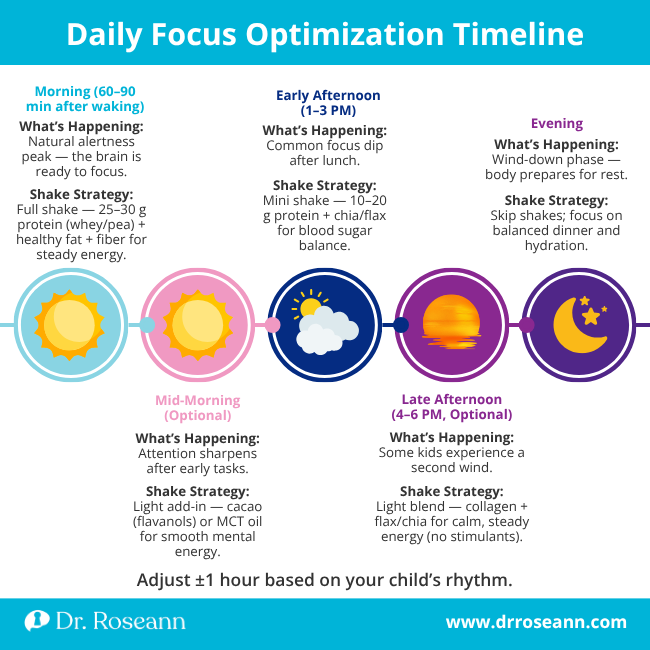
Offer a shake when it fits your child’s eating routine. Breakfast and after-school snack time are practical options.
You might use one:
- On a morning when sitting down to breakfast is difficult.
- Alongside toast or another familiar food.
- As an after-school snack.
- As an occasional alternative when your child prefers a drinkable texture.
If eating difficulties are persistent, a smoothie should be part of an individualized plan—not the only response.
There is no established shake schedule that prevents afternoon dysregulation or improves impulse control.
What to Avoid in Protein Shakes for ADHD
Avoid ingredients your child cannot safely have, and keep supplement decisions separate from ordinary recipe ingredients.
Before blending, check for:
- Known allergens.
- Caffeine-containing drinks or “energy” blends.
- Herbal extracts, mushrooms, or added supplement mixtures.
- Several products supplying the same vitamins or minerals.
- Serving instructions intended for adults.
A long ingredient name does not automatically make a product unsuitable. Look at what the ingredient is, why it is included, and whether the product fits your child’s needs.
For questions about added B vitamins and other ADHD supplements, discuss the complete product list with your child’s healthcare provider.
Megan reported that her 10-year-old daughter, Kayla, seemed more focused during afternoon math after introducing a shake. That is an individual family observation, rather than proof that the recipe caused the improvement.
Which Key Ingredients Provide the Best Focus-Enhancing Benefits?
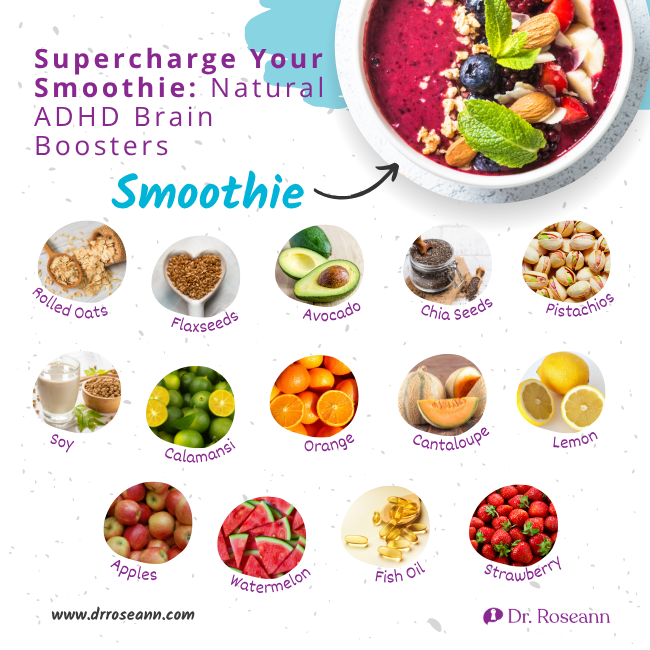
Food-based options are a good place to start. A powder may be useful in an individualized plan, but it is not required to make a protein-containing smoothie.
Choose ingredients for nutrition, taste, tolerance, and convenience—not because one is established as the best ADHD focus enhancer.
| Ingredient | Practical Role | What to Check |
|---|---|---|
| Plain Greek yogurt | Adds protein and a creamy texture | Milk allergy, tolerance, and preferred flavor |
| Milk or fortified soy milk | Can provide a protein-containing liquid base | Allergens and the product’s nutrition label |
| Silken tofu | Offers a blendable, dairy-free protein option | Soy allergy and texture preferences |
| Nut or seed butter | Adds flavor and contributes protein and fat | Allergies and school restrictions |
| Whey protein powder | A concentrated protein ingredient | Milk ingredients, serving size, and added supplements |
| Pea or blended plant protein powder | An alternative powder option | Complete ingredient list, allergens, and serving size |
| Collagen powder | A specialty supplement ingredient | Do not assume it is necessary or interchangeable with other protein foods |
| Fruit, oats, avocado, and ground seeds | Add variety, flavor, and texture | Start with amounts your child enjoys and tolerates |
Almond, oat, and coconut beverages vary in protein content. Check the label rather than assuming every milk alternative supplies the same amount.
Before choosing a protein powder, ask:
- “Does my child need it?”
- “What amount fits their overall intake?”
- “Does it contain caffeine, herbs, or extra vitamins?”
- “Are its ingredients and quality checks appropriate for my child?”
- “What would we monitor after introducing it?”
The best protein powder for ADHD is not a universal product. The first question is whether your child needs a powder at all.
How Do You Build the Perfect Brain-Boosting Recipe Foundation?
Build a shake from a liquid, a protein-containing food, and fruit, then adjust the texture and flavor. Keep the first version simple.
Try this flexible starting formula:
- Liquid: About ½–¾ cup milk or an appropriate alternative.
- Protein food: About ½ cup plain Greek yogurt or silken tofu.
- Fruit: About ½ cup berries, mango, or banana.
- Optional addition: A little nut or seed butter, avocado, oats, or ground flaxseed.
- Flavor: Cinnamon, vanilla, or another familiar flavor.
To prepare:
- Add the liquid first.
- Add the remaining ingredients.
- Blend until smooth.
- Add more liquid a tablespoon at a time if needed.
- Offer a comfortable portion rather than requiring your child to finish the blender’s contents.
(note: These are recipe quantities, not individualized protein or calorie prescriptions)
For a thinner shake: Use more liquid and less avocado, oats, or seed butter.
For a thicker shake: Use frozen fruit or slightly less liquid.
For a sensory-sensitive child: Keep the color, temperature, and texture predictable. Introduce one change at a time.
Easy ADHD-Friendly Protein Shake Ideas
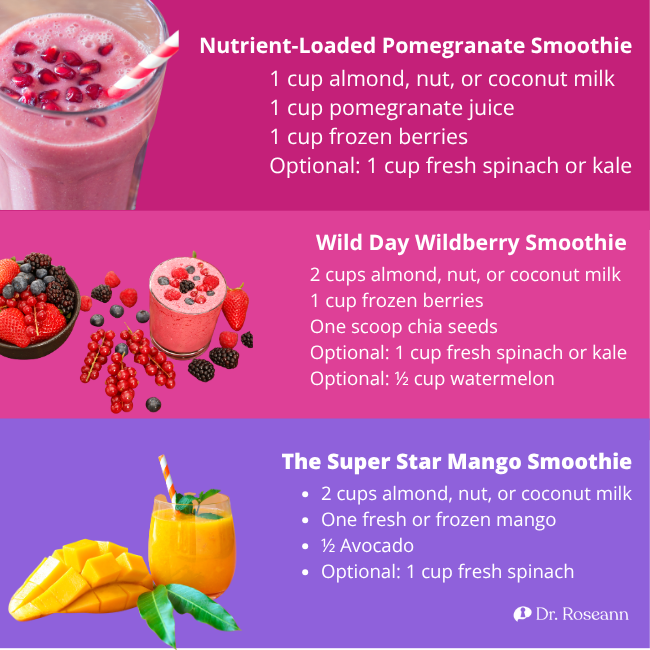
These five recipes give you familiar flavors and simple preparation steps. Their names are a playful way to organize the options, not claims that they treat particular symptoms.
Each recipe makes one small blender batch. Serve an amount that fits your child’s appetite and meal plan.
Use allergy-safe substitutions, and keep any prescribed supplement plan separate from the recipe.
Recipe #1: The Morning Focus Igniter
A blueberry-and-almond smoothie for a simple breakfast option.
Ingredients
- ½ cup milk or a suitable alternative.
- ½ cup plain Greek yogurt.
- ½ cup frozen blueberries.
- 1 teaspoon almond butter.
- 1 teaspoon ground flaxseed.
- A small pinch of cinnamon.
- Additional liquid as needed.
Instructions
- Add the liquid and yogurt to the blender.
- Add the blueberries, almond butter, flaxseed, and cinnamon.
- Blend until smooth, then adjust the thickness.
Easy substitutions
- Use sunflower seed butter instead of almond butter when suitable.
- Try another accepted berry.
- For a dairy-free version, use an appropriate alternative such as silken tofu and fortified soy milk, if tolerated.
Make it practical: Set out the measuring cup and blender the night before. Morning-you deserves a little assistance.
Recipe #2: The Calm & Concentrated
A creamy banana-and-avocado option with a mild flavor.
Ingredients
- ½ cup milk or a suitable alternative.
- ½ cup plain Greek yogurt or silken tofu.
- ½ small banana.
- 2 tablespoons avocado.
- 1 teaspoon tahini or another tolerated spread.
- A small pinch of cinnamon.
- Additional liquid as needed.
Instructions
- Add all ingredients to the blender.
- Blend thoroughly.
- Thin with a little extra liquid if your child dislikes a thick texture.
Easy substitutions
- Leave out tahini if sesame is unsuitable.
- Use a familiar nut or seed butter instead.
- Start without avocado if your child is cautious about texture.
For broader meal ideas, explore these food choices for stress-supportive routines.
No adaptogen blend is needed to make this recipe.
Recipe #3: The Afternoon Clarity Boost
A raspberry-and-vanilla smoothie for an after-school snack option.
Ingredients
- ½ cup milk or a suitable alternative.
- ½ cup plain Greek yogurt or silken tofu.
- ½ cup frozen raspberries.
- 1 teaspoon cashew butter or another tolerated spread.
- A few drops of vanilla extract.
- Additional liquid as needed.
Instructions
- Add the liquid and protein ingredient.
- Add the raspberries, spread, and vanilla.
- Blend until smooth.
Easy substitutions
- Use strawberries if raspberry seeds are a sensory challenge.
- Replace cashew butter with a suitable seed butter.
- Serve a small amount alongside another familiar snack.
This version uses ordinary food ingredients rather than green tea, collagen, or lion’s mane powder.
Recipe #4: The Creative Flow Formula
A mango smoothie with a little ginger and a familiar, fruity flavor.
Ingredients
- ½ cup milk or a suitable alternative.
- ½ cup plain Greek yogurt or silken tofu.
- ½ cup frozen mango.
- 1 teaspoon sunflower seed butter.
- 1 teaspoon ground flaxseed.
- An optional small pinch of ginger.
- Additional liquid as needed.
Instructions
- Blend the liquid, yogurt or tofu, mango, and seed butter.
- Add flaxseed and, if desired, ginger.
- Blend again and adjust the thickness.
Easy substitutions
- Use banana instead of mango.
- Leave out ginger for a milder flavor.
- Choose another tolerated spread.
Let your child help choose the fruit. You might ask: “Mango or banana—which one goes in today?”
Recipe #5: The Executive Function Enhancer
A banana-and-peanut-butter smoothie with an optional chocolate flavor.
Ingredients
- ½ cup milk or a suitable alternative.
- ½ cup plain Greek yogurt or silken tofu.
- ½ small banana.
- 1 teaspoon peanut butter or an appropriate alternative.
- An optional small sprinkle of cocoa for flavor.
- A small pinch of cinnamon.
- Additional liquid as needed.
Instructions
- Add the liquid, yogurt or tofu, banana, and spread.
- Blend until smooth.
- Add optional flavorings and blend briefly again.
Easy substitutions
- Use sunflower seed butter when suitable.
- Leave out cocoa for a banana-and-cinnamon version.
- Add a little more liquid for a thinner shake.
The recipe name does not mean it improves planning or organization. Those skills still need support and practice beyond breakfast.
Brain Science Spotlight: The Neuroscience Behind Focus-Supporting Nutrition
Breakfast research supports paying attention to eating routines, while showing why we should be careful about promises attached to a particular shake.
Two primary studies offer useful perspective:
- Breakfast versus no breakfast: In a randomized trial of 234 adolescents aged 11–13, cereal and milk improved some cognitive outcomes compared with skipping breakfast. Children with attention disorders were excluded, and the study did not test smoothies (Adolphus et al., 2021).
- More protein does not automatically mean better cognition: In a randomized crossover trial of 39 children aged 10–12, replacing some breakfast carbohydrate with dairy protein changed the glucose response but did not significantly improve the cognitive measures tested over three hours (Brindal et al., 2012).
What this means at home: Help your child find a workable breakfast. A smoothie is one option; it does not need to be presented as better than every solid-food breakfast.
For more ideas, read the Nervous System Diet for Kids: The Complete Nutrition Guide for Parents.
Watch: Picky Eating and Lower-Pressure Family Mealtimes
A Picky-Eating Conversation with Katie Kimball
Dr. Roseann and Katie Kimball discuss picky eating in this conversation—not a protein-shake tutorial.
Prefer to listen? Listen to the podcast episode.
Dr. Roseann's Therapist Tip
Choose one simple recipe and make the routine easier before adding more ingredients.
After more than 30 years working with families, I know that an elaborate plan can fall apart when real life arrives at 7:15 a.m.
Try this:
- Let your child choose between two familiar flavors.
- Keep the first recipe short.
- Prepare ingredients ahead when practical.
- Notice whether your child accepts the taste and texture.
- Change one ingredient at a time.
You might say: “Would you like blueberry or banana today?”
Or: “You don’t have to finish a big cup. Let’s start with a little.”
The first success may be a calmer breakfast—not a dramatic change in attention. That still matters.
How Can You Customize Recipes for Different ADHD Symptoms?
Customize shakes around eating needs, appetite, sensory preferences, and daily routines, rather than an assumption that specific ingredients treat each symptom.
Children with ADHD can have very different experiences at mealtimes. The useful question is: “What is making eating difficult for my child?”
| Everyday Challenge | Practical Adjustment | What to Notice |
|---|---|---|
| Distracted during breakfast | Prepare the shake ahead and reduce choices | Whether breakfast becomes easier to manage |
| Sensitive to texture | Blend thoroughly and use a consistent recipe | Which thickness and temperature your child accepts |
| Small appetite | Offer a manageable portion and discuss persistent concerns | Overall intake and whether meals are being missed |
| Overwhelmed after school | Offer a familiar snack with a calm transition | Whether the routine fits your child’s needs |
| Strong flavor preferences | Begin with an accepted fruit and a mild base | Whether your child is willing to try a small change |
Symptom-Specific Add-Ins
There is no established add-in formula here for brain fog, anxiety, depression, or emotional dysregulation.
Before adding vitamins, herbs, or mushroom extracts, ask:
- “What specific need are we addressing?”
- “Is this appropriate for my child’s age?”
- “Does it overlap with another product?”
- “Could it affect their medication?”
- “How would we know whether to continue?”
David, a 15-year-old student, reported changes in focus and mood after using different shakes in his routine. That report does not establish that one recipe treats inattention while another treats emotional dysregulation.
Keep observations useful and specific, without asking the smoothie to explain every change.
What Common Recipe Mistakes Sabotage Your Focus Goals?
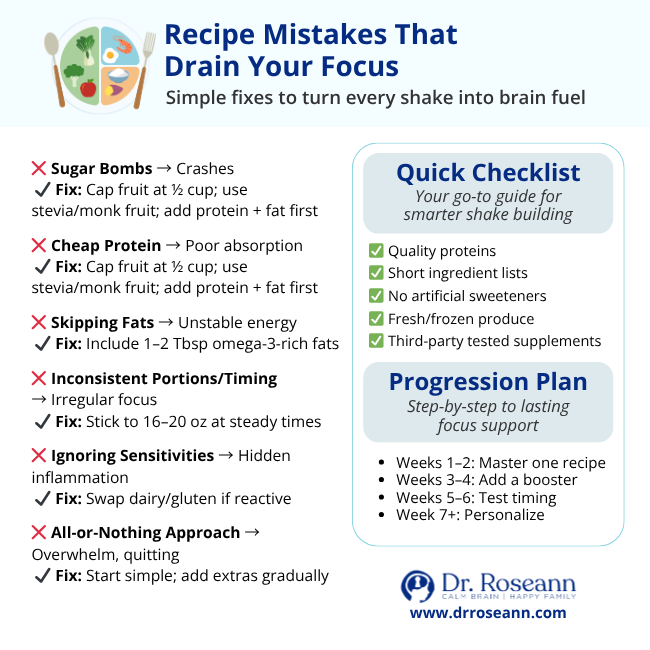
The most common practical mistakes are making the recipe too complicated, choosing an unsuitable portion, and expecting a shake to solve difficulties beyond nutrition.
Watch for these:
- Too many new ingredients: Start with a familiar flavor.
- A portion your child finds overwhelming: Offer a smaller amount.
- Fruit and liquid without considering the rest of the meal: Include a suitable protein food or serve the shake alongside breakfast.
- Several supplement products at once: Review the complete list before combining them.
- A powder chosen only for its “focus” marketing: Assess the ingredients and your child’s actual needs.
- Ignoring texture: A nutritious recipe is not useful if your child cannot tolerate it.
- Turning every sip into a negotiation: Keep the interaction calm.
Amanda, a busy mother of three, found that complicated recipes with expensive powders were difficult to maintain. Simplifying the routine is the practical lesson.
You do not need six specialty ingredients to make breakfast count.
Key Takeaways: Your Brain-Boosting Action Plan
Start with a simple, food-based shake that fits your child’s needs and your family’s routine.
- Protein powder is optional.
- Use familiar flavors and manageable portions.
- Check allergens and added supplement ingredients.
- Do not use adult protein targets as a default for children.
- Treat recipes as food options, rather than symptom-specific treatments.
- Keep nutrition connected to the broader support plan.
Choose one recipe and one manageable routine to begin. Simple is a perfectly good starting point.
Nutrition Is One Supportive Part of the Day
A nourishing breakfast or snack can support your child’s routine, but it is only one part of the day.
Predictable transitions, movement, rest, and calm connection also create opportunities to practice the skills that help children manage everyday demands.
The Dysregulated Kid gives parents a practical Regulation First Parenting® framework for bringing those supports together at home.
Your child needs support beyond the breakfast table—and you deserve a plan that feels doable.
FAQs
These answers can help you decide how ADHD protein shakes fit your child’s routine. Individual feeding, supplement, and medication questions need an individualized plan.
Can I drink ADHD protein shakes while taking ADHD medication?
Whether a shake is suitable depends on its ingredients and the medication’s instructions.
Ask the prescriber or pharmacist about food timing and any powders, herbs, or supplements you plan to include.
A shake does not automatically prevent medication side effects. If eating or weight becomes a concern, discuss it with the prescriber.
Are ADHD protein shakes safe for teenagers and children?
A food-based smoothie can be a suitable option when its ingredients, texture, and portion fit the child.
That does not mean every commercial protein shake or supplement blend is suitable.
There is no universal cup size or protein target for all children and teenagers.
What if ADHD protein shakes don’t improve symptoms after a few weeks?
Do not assume you need a stronger powder or more supplement add-ins.
The research discussed here does not establish an ADHD symptom-improvement timeline for shakes.
Consider whether the recipe helps your child eat adequately and whether it makes the routine easier. Ongoing symptoms deserve attention within the broader care plan.
Do ADHD protein shakes actually help with ADHD symptoms?
They can provide a convenient way to include food, but these recipes have not been established as ADHD treatments.
The breakfast studies discussed here do not show that a protein shake improves ADHD symptoms (Adolphus et al., 2021; Brindal et al., 2012).
When is the best time to drink ADHD protein shakes?
Choose a time that fits your child’s appetite and schedule.
Breakfast and after-school snack time are practical possibilities. There is no established shake timing that reliably improves ADHD symptoms.
Can ADHD protein shakes replace breakfast?
A shake may form part or all of breakfast if it meets the child’s needs.
A small fruit drink is different from a more substantial smoothie. Consider the full meal and the child’s intake across the day.
If shakes routinely replace meals because eating is difficult, ask for an individualized nutritional assessment.
Are ADHD protein shakes better than sugary breakfasts?
The answer depends on the actual ingredients, portions, and overall meal.
A “protein” label does not establish that a product is the better choice.
In one children’s trial, replacing some breakfast carbohydrate with protein changed the glucose response without improving the cognitive measures tested (Brindal et al., 2012).
What ingredients should I avoid in ADHD protein shakes?
Avoid known allergens and ingredients that are unsuitable for your child.
For a basic children’s recipe, leave caffeine-containing bases and herbal or mushroom supplement blends out of the default formula.
Review any powder with your child’s healthcare provider, especially when medication or other supplements are involved.
Citations:
Adolphus, K., Hoyland, A., Walton, J., Quadt, F., Lawton, C. L., & Dye, L. (2021). Ready-to-eat cereal and milk for breakfast compared with no breakfast has a positive acute effect on cognitive function and subjective state in 11–13-year-olds: A school-based, randomised, controlled, parallel groups trial. European Journal of Nutrition, 60, 3325–3342. https://doi.org/10.1007/s00394-021-02506-2
Brindal, E., Baird, D., Danthiir, V., Wilson, C., Bowen, J., Slater, A., & Noakes, M. (2012). Ingesting breakfast meals of different glycaemic load does not alter cognition and satiety in children. European Journal of Clinical Nutrition, 66(10), 1166–1171. https://doi.org/10.1038/ejcn.2012.99
Always remember… “Calm Brain, Happy Family™”
Disclaimer: This article is not intended to give health advice and it is recommended to consult with a physician before beginning any new wellness regime. The effectiveness of diagnosis and treatment vary by patient and condition. Dr. Roseann Capanna-Hodge, LLC does not guarantee certain results.
Are you looking for SOLUTIONS for your struggling child or teen?
Dr. Roseann and her team are all about science-backed solutions, so you are in the right place!
© Roseann Capanna-Hodge
Meet the Expert
Licensed Therapist | Certified School Psychologist
Board Certified in Neurofeedback (BCN) | 30+ Years Clinical Experience
Expert in Emotional Dysregulation in Children and Nervous System Regulation
Host, Dysregulated Kids Podcast | Author, The Dysregulated Kid
Dr. Roseann Capanna-Hodge is a licensed therapist, certified school psychologist, and leading expert in emotional dysregulation in children and nervous system regulation. With over 30 years of clinical experience and having analyzed more than 10,000 brain maps, she helps families understand what behavior is really signaling—and how to calm the nervous system first so real change can happen.
She is the creator of Regulation First Parenting® and the CALMS Protocol™, host of the top 1% podcast Dysregulated Kids, and author of The Dysregulated Kid.

Want more Regulation First Parenting® guidance from Dr. Roseann? Add us as a preferred source on Google.