Join the Dysregulation Insider get free calm parenting tips straight to your inbox!
YES, I'M IN!"I Swore I'd Stay Calm ... Then I lost It" | How to Self Regulate as a Parent | E329





Estimated Reading Time: 5 minutes
Have you ever promised yourself you wouldn't yell, only to find yourself losing your temper again a few hours later? If you're wondering how to self regulate as a parent, you're not alone. Every parent gets overwhelmed, especially when raising a dysregulated child with big emotions, frequent meltdowns, or challenging behaviors.
The good news is that emotional regulation is a skill. Just like our kids, we can learn how to calm our nervous system, respond instead of react, and create more connection in the hardest parenting moments.
In this episode, I share what really drives parenting blow-ups, how to stop the reactivity cycle, and practical tools to help you regulate first.
You can know exactly how you want to parent and still lose access to those skills when your own nervous system gets triggered. The Dysregulated Kid® helps you regulate yourself first, interrupt the escalation cycle, and respond with more calm and intention when parenting gets hard. Get The Dysregulated Kid® at dysregulatedkid.com.
Why do I lose it when I swore I wouldn't?
Even when we know better, our nervous system sometimes takes over.
When stress builds up, the brain shifts into survival mode and the thinking brain becomes less accessible.
Common triggers include:
- Hunger
- Fatigue
- Noise
- Feeling disrespected
- Constant demands
- Emotional overload
Real-Life Example
One day, I found myself completely losing my patience after a broken air conditioner and a wrong pizza order.
The pizza wasn't the real problem.
The problem was:
- I was hungry.
- I was stressed.
- I hadn't regulated my own nervous system.
Many parenting blow-ups have very little to do with the actual event happening in front of us.
What Parents Need to Remember
When we're running on empty:
- Small problems feel huge.
- Patience disappears.
- Reactivity increases.
- Emotional regulation becomes harder.
Learning how to self regulate as a parent starts with recognizing your own triggers.
What can I do instead of yelling?
The first step is calming your nervous system before trying to calm your child's.
Simple strategies include:
- Taking a pause
- Breathing deeply
- Stepping away briefly
- Lowering your voice
- Slowing your movements
Helpful phrases include:
- "I'm feeling overwhelmed."
- "I need a minute."
- "Let's take a break."
- "My calm is their calm."
Why This Matters
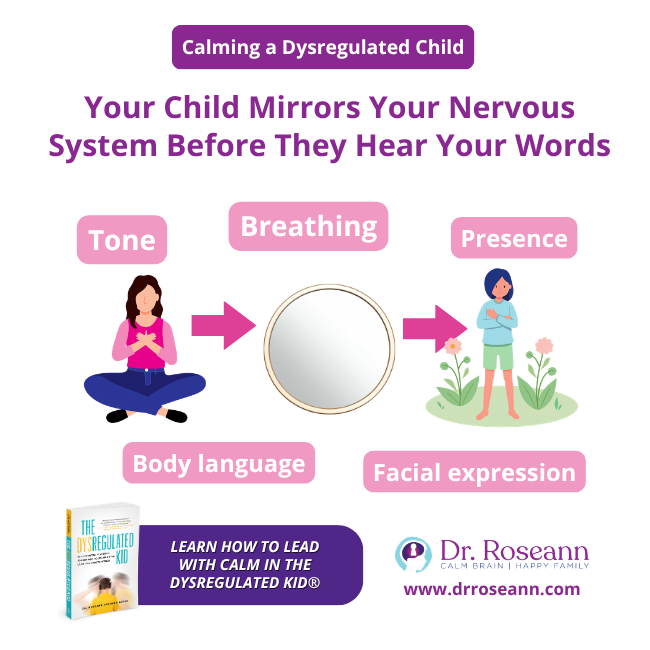
Children borrow regulation from us.
When your child is dysregulated:
- Matching their intensity escalates the situation.
- Bringing calm helps regulate the nervous system.
This is one of the most powerful lessons in how to self regulate as a parent.
Want to stay calm when your child pushes every button?
Become a Dysregulation Insider VIP and get the FREE Regulation Rescue Kit, your step-by-step guide to stop oppositional behaviors without yelling or giving in.
Go to www.drroseann.com/newsletter and grab your kit today.
How do I stop the reactivity cycle in parenting?
Awareness is the key.
Most parents can learn to identify the signs that they're heading toward a meltdown.
Common warning signs include:
- Clenched jaw
- Tight shoulders
- Shallow breathing
- Racing thoughts
- Irritability
- Feeling emotionally flooded
When you notice those signs, it's time to regulate before reacting.
Helpful Regulation Strategies
Movement
Even a few minutes can help.
Try:
- Walking
- Stretching
- Squats
- Shaking out tension
Hot and Cold Therapy
Many parents find relief through:
- Heated neck wraps
- Warm showers
- Cold water splashes
Interrupt the Pattern
Use a simple phrase such as:
- "I will not lose my stuff."
- "Pause first."
- "This is dysregulation, not defiance."
These small interruptions help prevent escalation.
What should I do after I've already blown up?
Every parent makes mistakes.
What matters most is what happens next.
Practice Self-Reflection
Ask yourself:
- Was I hungry?
- Was I tired?
- Was I triggered?
- Was I overwhelmed?
Understanding the cause helps prevent future blow-ups.
Model Accountability
Children benefit when parents own their mistakes.
Try saying:
- "I'm sorry I lost my temper."
- "That wasn't your fault."
- "I'm working on doing better."
Focus on Emotional Repair
Helpful phrases include:
- "We're both having a hard time."
- "Let's figure this out together."
- "I love you."
- "You're safe."
Even young children learn powerful lessons when they see healthy repair.
One of the best ways to teach self-regulation skills for children is by modeling them yourself.
How do I rebuild trust and connection with my dysregulated child?
Children don't need perfect parents.
They need parents who repair.
Connection grows when children see that mistakes don't end relationships.
Ways to Strengthen Connection
- Apologize sincerely.
- Stay emotionally available.
- Validate feelings.
- Create moments of positive connection.
- Model healthy coping skills.
What Children Learn
When parents repair after conflict, children learn:
- Mistakes are normal.
- Relationships can recover.
- Emotions are manageable.
- Love remains consistent.
These lessons build resilience and emotional security.
What regulation techniques help parents stay calm?
The same regulation techniques for kids often work for parents too.
Helpful strategies include:
Breathing Exercises
Try:
- Box breathing
- Long exhalations
- Belly breathing
Movement
- Walking
- Stretching
- Yoga
- Dancing
Sensory Regulation
- Weighted blankets
- Warm drinks
- Calming music
- Time outside
Nervous System Support
- Consistent sleep
- Healthy nutrition
- Hydration
- Daily stress management
The more regulated you become, the easier it is to support your child's regulation.
🗣️ “You don’t have to be a perfect parent. You just need to regulate first and respond with love.” — Dr. Roseann
A Better Way Forward
Learning how to self regulate as a parent isn't about never getting angry.
It's about:
- Becoming more aware
- Recovering more quickly
- Repairing when mistakes happen
- Modeling healthy emotional regulation
When you regulate first:
- Your child feels safer.
- Meltdowns become easier to manage.
- Connection grows.
- Emotional resilience strengthens.
You don't have to be perfect.
You just have to keep practicing.
If you're ready to take action today, grab my Quick Calm Toolkit. It's just $19 and gives you seven days of simple strategies to start calming your child's brain and yours too.
FAQs
Why do I get so triggered by my child's behavior?
When your nervous system is already stressed, small challenges can feel much bigger. Parenting often activates our own unresolved stress, making emotional reactions more intense.
What are the signs of a dysregulated parent?
Common signs include yelling, shutting down, feeling emotionally flooded, reacting impulsively, experiencing guilt after interactions, and struggling to stay calm during conflict.
How do my parenting behaviors affect my child's emotional dysregulation?
Children learn emotional regulation through co-regulation. Calm, predictable responses help children feel safe, while reactive responses can increase nervous system activation.
Can dysregulated parents raise emotionally healthy kids?
Absolutely. The key is self-awareness, repair, and a willingness to keep practicing healthier regulation skills. Children don't need perfection. They need connection and consistency.
How do self-regulation skills for children develop?
Children build regulation skills through repeated experiences with calm, supportive adults who model healthy coping, emotional awareness, and problem-solving.
Tired of not knowing what's really going on with your child?
The Solution Matcher gives you a personalized recommendation based on your child's behavior, not just a label.
It’s free, takes just a few minutes, and shows you the best next step.
Go to www.drroseann.com/help
Dr. Roseann Capanna-Hodge is a licensed therapist, certified school psychologist, and leading expert in emotional dysregulation in children. With over 30 years of experience, she helps parents understand the root causes of meltdowns, anxiety, ADHD, and challenging behavior through the lens of nervous system regulation. Dr. Roseann teaches practical, science-backed strategies for co-regulation and how to calm a dysregulated child using her Regulation First Parenting® approach. She is the host of the Dysregulated Kids Podcast and author of The Dysregulated Kid.
Dr. Roseann Capanna-Hodge
Emotional Dysregulation in Children & Nervous System Expert
Regulation First Parenting® | CALMS Protocol™
Host of the Dysregulated Kids Podcast (Top 1% Globally)
Author of The Dysregulated Kid

Find this helpful? Leave us a review!
Your feedback helps more overwhelmed parents find calm, clarity, and the proven tools that make everyday life easier.
Dr. Roseann Capanna-Hodge: Helping Families of Dysregulated Kids Thrive Through Regulation First Parenting®
As the creator of Regulation First Parenting®, she’s helping families of dysregulated kids discover a compassionate, brain-based path forward. Through The Dysregulated Kids™ Podcast (top 2% globally), she offers practical strategies that help parents understand their child’s brain and support lasting change.
Through The Global Institute of Children’s Mental Health and Dr. Roseann, LLC, she’s created resources like the Neurotastic® Brain Formulas and the Regulation First Parenting® framework—meeting families where they are and supporting them through challenges like ADHD, anxiety, OCD, PANS/PANDAS, and behavioral struggles.
Recognized by Forbes as “a thought leader in children’s mental health,” Dr. Roseann is changing how we understand emotional dysregulation in children—one family at a time.